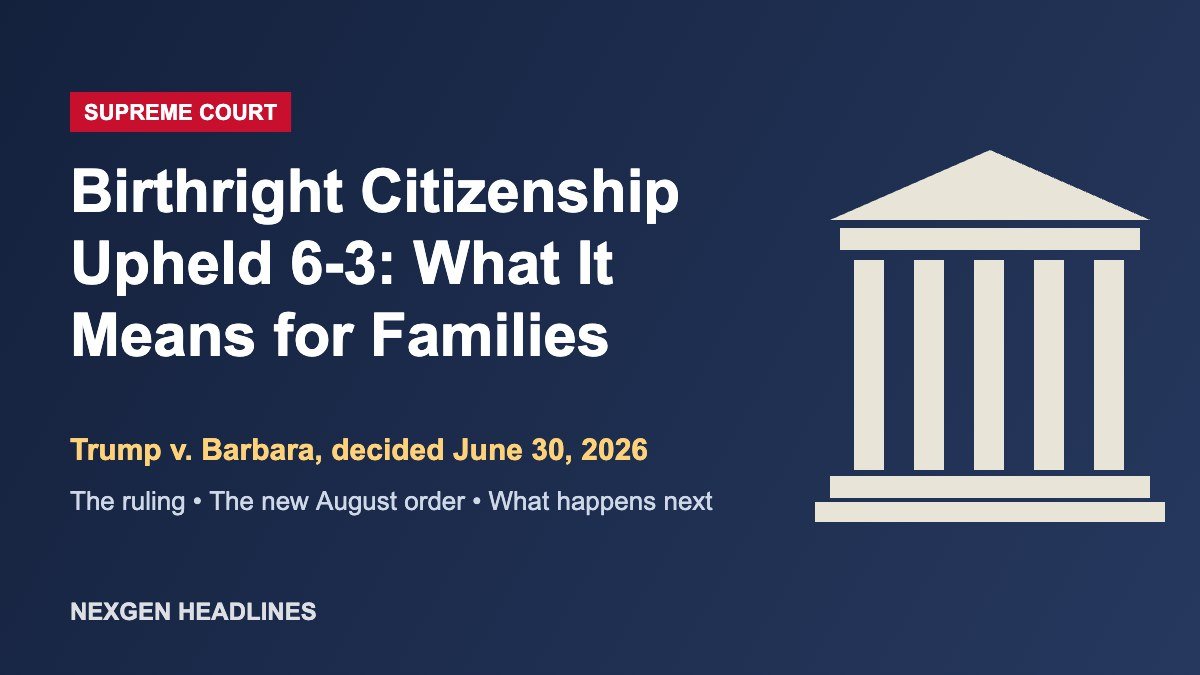

Quick answer: On June 30, 2026, the Supreme Court ruled 6-3 in Trump v. Barbara that children born in the United States are U.S. citizens at birth, even if their parents are here temporarily or without legal status. That struck down President Trump’s 2025 executive order on birthright citizenship. In August 2026 the President signed a new, narrower order, and a federal judge in Maryland temporarily blocked much of it in September.
What the Supreme Court decided
The case, Trump v. Barbara, was argued on April 1, 2026, and decided on June 30, 2026. Chief Justice John Roberts wrote the main opinion.
The question was whether Executive Order 14160, signed in January 2025, could deny citizenship to babies born in the U.S. to parents who were undocumented or only temporarily in the country, such as students or tourists. The order had never taken effect because courts across the country blocked it.
The Court said the order could not be squared with the 14th Amendment, which says that “all persons born or naturalized in the United States, and subject to the jurisdiction thereof, are citizens.” Roberts wrote that these children meet both parts of that test, so they are citizens at birth.
Why the Court ruled this way
- The 1898 precedent. The majority leaned on United States v. Wong Kim Ark, which held that a man born in San Francisco to Chinese parents was a citizen. The Court said it has applied that rule ever since.
- “Subject to the jurisdiction.” The government argued this phrase meant parents had to owe primary allegiance to the U.S., tied to where they live permanently. Roberts found little historical support for that reading.
- Narrow exceptions remain. The traditional exceptions, such as children of foreign diplomats, were not changed by the ruling.
How the justices split
- Justice Brett Kavanaugh agreed with the result but on different grounds: he said the order breaks a federal citizenship law passed by Congress, and that Congress could change that law.
- Justice Samuel Alito dissented, arguing the 14th Amendment covers only children who owe sole allegiance to the U.S. at birth.
- Justice Clarence Thomas, joined by Justice Neil Gorsuch, dissented and challenged the majority’s reading of history.
- Justice Gorsuch also wrote separately, saying some of the questions may not have been properly before the Court.
The new August 2026 order
On August 6, 2026, President Trump signed a second executive order that again tries to limit birthright citizenship, this time for narrower groups of children of foreign citizens. It includes carve-outs, such as for parents who paid for arrangements to come to the U.S. to give birth.
Immigrant-rights groups sued right away. In early September 2026, U.S. District Judge Deborah Boardman in Maryland temporarily blocked the order from being enforced against a broad group of children whose parents are in the U.S. temporarily or without legal papers. She wrote that the order is “almost certainly unconstitutional” as applied to them, because the Supreme Court had just held these children are citizens. A separate lawsuit, Nathan v. Trump, was filed in federal court in Washington, D.C.
What it means for families
- A baby born in the U.S. is still a U.S. citizen, whatever the parents’ immigration status, under the June 2026 ruling.
- Birth certificates and passports should be issued as usual. Keep copies of the birth certificate somewhere safe.
- If an agency refuses a document because of a parent’s status, contact an immigration attorney or a legal aid group. Many offer free help.
- Watch for updates on the August order. The Maryland block is temporary, and the government could appeal.
What happens next
The lawsuits against the August 2026 order are still in the lower courts. The administration may appeal the Maryland ruling, and the issue could return to the Supreme Court. Congress could also try to change the federal citizenship law, which Justice Kavanaugh noted it has the power to do. Changing the 14th Amendment itself would require a constitutional amendment.
Frequently asked questions
Is birthright citizenship still the law in the U.S.?
Yes. The Supreme Court confirmed it on June 30, 2026, in Trump v. Barbara.
Was the vote unanimous?
No. It was 6-3. Justices Alito, Thomas and Gorsuch dissented.
Is the new August 2026 order in effect?
A federal judge in Maryland temporarily blocked it for a broad group of children in September 2026. Check back for updates on appeals.
Does this affect children of diplomats?
No. Children of foreign diplomats have long been an exception, and the ruling did not change that.
Sources: SCOTUSblog, June 30, 2026; SCOTUSblog, Sept. 3, 2026; Congressional Research Service.