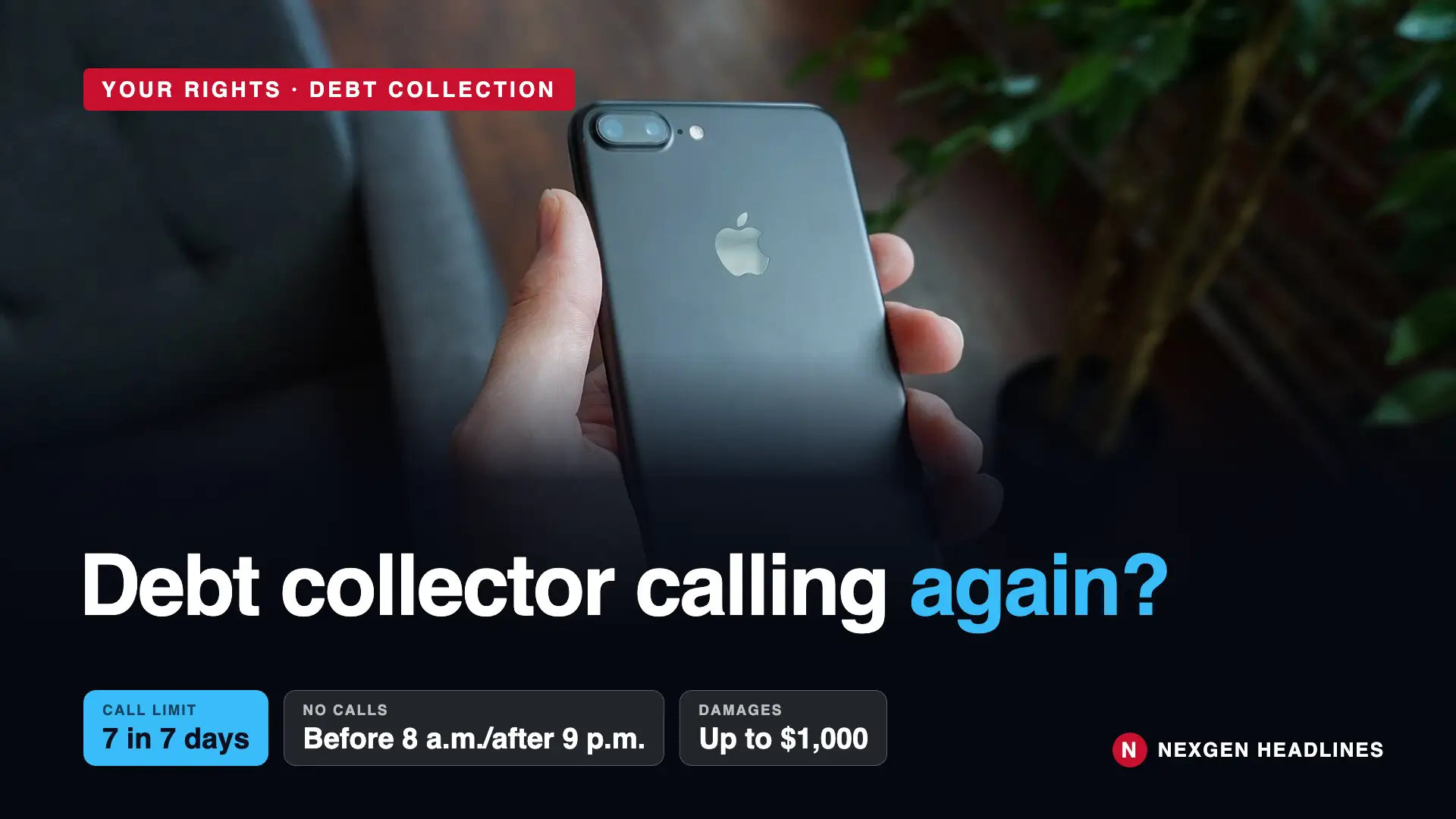

Quick answer: Under federal rules, a debt collector is presumed to break the law if it calls you about one debt more than 7 times in 7 days, or calls again within 7 days after you talk to it. It also can’t call before 8 a.m. or after 9 p.m. your time, or at work if it knows your employer doesn’t allow it. You can stop most contact with one letter.
These rules come from the Fair Debt Collection Practices Act (FDCPA) and the CFPB’s Regulation F, in effect since Nov. 30, 2021. Here is what collectors can and can’t do, and exactly how to push back.
Debt collector rules at a glance
| Question | The rule |
|---|---|
| How many calls are allowed? | No more than 7 calls in 7 days per debt |
| After you talk to them? | No more calls about that debt for 7 days, counting the day you talked |
| What hours? | Not before 8 a.m. or after 9 p.m. your local time |
| At work? | Not if they know or should know your employer forbids it |
| Texts and emails? | Allowed, but each must give a simple way to opt out |
| Social media? | No public posts about your debt |
| Time to dispute | 30 days after you get the validation notice |
| Old debt past the deadline to sue | Collector can’t sue or threaten to sue |
| If they break the law | You can sue within 1 year for actual damages plus up to $1,000 |
The 7-in-7 call rule, explained
Regulation F sets a clear test for “too many calls.” A collector is presumed to violate the law if it places calls to you about a particular debt:
- More than seven times within seven days, or
- Within seven days after a phone conversation with you about that debt. The day you talked counts as day one.
Two details matter. First, the limit is per debt. If you have three debts with the same collector, each can have its own seven calls. Second, voicemails and unanswered calls still count as calls placed.
Calls you agree to, or calls you make yourself, do not count toward the limit.
Made-up example: counting the calls
This is a made-up example to show how the rule works.
Tanya owes $1,800 on an old store card that went to a collection agency. The agency calls her Monday, Tuesday twice, Wednesday, Thursday, Friday and Saturday. That is seven calls in six days, which is allowed.
A call on Sunday would be the eighth call in seven days. That would be presumed illegal. If Tanya answers on Wednesday and talks to the agent, the agency can’t call again about that debt until the following Wednesday.
When collectors can’t contact you
Federal rules block contact at unusual or inconvenient times and places. Unless the collector knows otherwise, before 8 a.m. and after 9 p.m. your local time is inconvenient.
If you work nights, tell them. Once you say a time is inconvenient, such as “don’t call before 2 p.m., I sleep days,” they must respect it.
At work, a collector must not contact you if it knows or has reason to know your employer prohibits it. The simplest move is to say once, clearly: “My employer doesn’t allow these calls. Don’t call me at work.”
Collectors also can’t:
- Send you a postcard about a debt
- Put words on the envelope that show it is about debt collection
- Email you at an address they know is your work email, in most cases
- Post about your debt publicly on social media
- Tell your family, neighbors or boss about your debt. They may contact others only to find your address or phone number
Things a collector can never do
The FDCPA bans harassment, false statements and unfair practices. Common illegal moves include:
- Threatening arrest or jail for not paying a regular consumer debt
- Using profane or abusive language
- Lying about the amount you owe
- Pretending to be a lawyer or a government agency
- Threatening to sue when they don’t plan to, or can’t legally
- Adding fees that your original contract or the law does not allow
- Depositing a postdated check early
How to stop debt collector calls: 6 steps
- Get their details. Ask for the company name, mailing address and the original creditor. Write down every call: date, time and what was said.
- Wait for the validation notice. The collector must send it, usually within 5 days of first contact. It lists the amount, the creditor and your dispute deadline.
- Dispute within 30 days if anything looks wrong. Send a letter saying you dispute the debt and asking for verification. Until they respond, they must pause collection of the disputed part.
- Limit how they reach you. In writing, say which times, places or methods are off-limits. For example, “email only” or “no calls at work.”
- Send a stop-contact letter if you want silence. If you write that you want them to cease communication, they must stop. They may contact you only to confirm they are stopping or to tell you about a specific action, such as a lawsuit.
- Send letters by certified mail with return receipt, and keep copies.
A stop-contact letter does not erase the debt. The collector can still report it to the credit bureaus or sue, if the debt is not too old.
What to say on the phone
You do not have to argue. Short lines work best:
- “Please send me the validation notice in writing.”
- “I don’t recognize this debt. I dispute it.”
- “Don’t call me at work. My employer doesn’t allow it.”
- “Please contact me by mail only.”
Do not give a bank account or card number to someone who called you. Do not agree to pay anything until you have the debt in writing. On very old debts, even a small payment can restart the clock in some states.
Old debts: the time limit to sue
Every state sets a statute of limitations for suing over a debt. It is often 3 to 6 years, but it varies by state and type of debt.
Once that deadline passes, the debt is “time-barred.” Under Regulation F, a collector must not sue or threaten to sue you over a time-barred debt. It may still ask you to pay voluntarily.
This is separate from your credit report. Most negative items, including collections, drop off credit reports after about seven years under the Fair Credit Reporting Act.
Credit reporting rules
A collector can’t report a debt to the credit bureaus until it has first contacted you. That means talking to you, or mailing or electronically sending a notice and waiting a reasonable time to see if it bounced back.
If a collection is wrong on your report, dispute it with the credit bureau and the collector. You can check your reports for free every week at AnnualCreditReport.com.
Also read: Can’t Pay Your Credit Card Bill? What to Do First
What if a collector breaks the rules?
Write down everything, save voicemails and screenshots, and then report it:
- CFPB: file a complaint at consumerfinance.gov/complaint or call 855-411-2372. The CFPB sends it to the company for a response.
- FTC: report at ReportFraud.ftc.gov
- Your state attorney general, which often has its own debt collection laws
You can also sue. Under the FDCPA, you may recover actual damages, up to $1,000 in extra damages, plus court costs and attorney’s fees. You must file within one year of the violation. Many consumer lawyers take these cases with no upfront fee because the law can make the collector pay the fees.
Who these rules cover
The FDCPA mainly covers third-party debt collectors: collection agencies, debt buyers and law firms that regularly collect debts. It usually does not cover the original lender collecting its own debt, though some states extend similar rules to them.
It covers personal, family and household debts like credit cards, medical bills, car loans and mortgages. It does not cover business debts.
Common mistakes to avoid
- Ignoring a lawsuit. If you are served court papers, respond by the deadline. Ignoring them can lead to a default judgment and wage garnishment.
- Paying a scammer. Fake collectors are common. Verify the company and the debt before paying.
- Missing the 30-day dispute window.
- Making promises on the phone you can’t keep.
- Not keeping records. A simple call log is your best evidence.
Recommended products
A few simple tools make it easier to track calls and keep proof.
- Accordion file organizer for letters and bills
- Envelopes for certified mail letters
- Call log book for dates, times and notes
Disclosure: As an Amazon Associate, Nexgen Headlines earns from qualifying purchases.
FAQ
How many times can a debt collector call you in a day?
There is no daily number, but there is a weekly test. More than seven calls in seven days about one debt is presumed to be harassment. So is calling again within seven days after you have talked to them.
Can a debt collector call you at work?
Not if they know or have reason to know your employer prohibits it. Tell them once that you can’t take calls at work, and they must stop calling you there.
Can a debt collector text or email you?
Yes. But each text or email must include a clear, simple way to opt out, and they generally can’t use your work email.
How do I make a debt collector stop contacting me?
Send a letter saying you want them to stop communicating with you. They must stop, except to confirm it or to tell you about a specific step such as a lawsuit.
Can a debt collector have me arrested?
No. You can’t be arrested for owing a regular consumer debt. Threatening arrest is illegal. But you must respond if you are sued and the court orders you to appear.
Bottom line
You have real rights. A collector can’t call more than 7 times in 7 days about one debt, can’t call before 8 a.m. or after 9 p.m., and must stop calling you at work when told. Ask for the validation notice, dispute within 30 days if it’s wrong, and put every request in writing. If they break the rules, report them to the CFPB.
Last reviewed: Nov. 3, 2026. This guide explains federal law; it is not legal advice. State laws may add more protections.
Sources: Regulation F, 12 CFR Part 1006 (eCFR), CFPB: Debt collection, FTC: Fair Debt Collection Practices Act, FTC: Debt collection FAQs, Nolo, AnnualCreditReport.com.
Featured image: Smartphone in hand. Photo: Dennis Cortés / Unsplash via Wikimedia Commons, CC0; edited by Nexgen Headlines.