
Quick answer: Search your name for free at NCCash.gov, run by the North Carolina Department of State Treasurer. If your name shows up with a current or past address, file a claim online. Normal processing takes about 90 days once Treasury has all your documents, and claiming is free.
North Carolina has more than $1 billion in unclaimed property waiting for owners, the State Treasurer’s office said in June 2026. Here is how to find yours and get it paid without a fee.
North Carolina unclaimed property at a glance
| Question | Answer |
|---|---|
| Official site | NCCash.gov (N.C. Department of State Treasurer) |
| State Treasurer | Brad Briner |
| Total waiting | More than $1 billion (Treasurer’s office, June 2026) |
| Cost to search or claim | $0 |
| Normal processing time | About 90 days after all documents arrive (NCCash); longer during backlogs |
| Faster option | Some claims qualify for electronic matching with no paperwork |
| Deadline | None. The state holds the money until it is claimed |
What counts as unclaimed property in North Carolina?
When a business or government office owes you money and cannot find you, state law makes it turn the money over to the Treasurer. The money is then held for safekeeping until you claim it. This is called escheat.
Common examples:
- Forgotten bank accounts and credit union balances
- Uncashed paychecks and final checks from old jobs
- Utility and rent deposits you never got back
- Insurance refunds and life insurance benefits
- Stock, dividends and brokerage cash
- Medical refunds from hospitals and doctor’s offices
- Court deposits and government refunds held by local offices
Businesses, churches, schools and towns can have unclaimed money too. The Treasurer’s office regularly returns checks to local groups.
How to search and claim NC unclaimed property: 6 steps
- Type NCCash.gov into your browser. Do not use links from texts or emails.
- Search your name. Use your last name and first initial to catch spelling errors. Repeat for maiden names and old business names.
- Match the address. Look for a city or street where you once lived or worked.
- Start the claim online. Select every matching item, then enter your details.
- See if you qualify for fast processing. Some claims are verified electronically and need no extra papers. If not, the site lists what to send.
- Send documents and track the claim. Upload or mail ID and proof of address. Check your status on NCCash.gov.
A processor will contact you if anything is missing. Answer quickly so your claim does not sit.
Made-up example: a Charlotte family checks NCCash
These are made-up examples to show how claims usually work.
Marcus, 41, searches his name at lunch. He finds a $180 refund from a Raleigh apartment complex he left in 2019. His claim qualifies for electronic matching, so he does not need to mail anything.
His mother, Brenda, finds a life insurance payout listed under her late husband’s name. Her claim needs a death certificate and estate papers. It takes longer, but it is the larger amount.
How long does an NCCash claim take?
NCCash says normal processing is about 90 days, and the clock starts once it has every required document. During busy periods, it has warned that times can run longer. A past WRAL report described claimants being told 90 to 120 days.
To keep yours on the fast side:
- Send clear, readable copies of your ID
- Include proof of the address shown on the record
- Put all your items on one claim
- Respond to any letter or email within days, not weeks
Claiming for a relative who died
Heirs and estates can claim. Expect to send:
- A certified death certificate
- Letters testamentary or letters of administration, if an estate was opened
- If no estate was opened, an affidavit and proof of your relationship
- Your photo ID
Estate claims usually take longer because the Treasurer must confirm who has the legal right to the money.
What to send, by type of claim
Most delays come from missing papers. Use this table to gather everything before you file.
| Your situation | Usually needed | Tip |
|---|---|---|
| Money in your own name | Photo ID, Social Security number, proof of the address on the record | An old tax return or W-2 works well as address proof |
| Joint account | ID for each owner, or a signed form from the other owner | Agree on who files before you start |
| Name changed by marriage | ID plus marriage certificate | Search both names |
| Owner died | Death certificate, estate or heirship papers, your ID | Ask the probate court for certified copies |
| Business or nonprofit | Proof you can act for the group, plus its tax ID letter | Board minutes or a letter on letterhead often helps |
| Stocks or shares | Same as above, plus your brokerage details if you want shares moved | Ask whether cash or shares will be paid |
How to stop money from going unclaimed again
Once you get your money back, a few habits keep it from happening again:
- Update your address with banks, insurers, employers and brokers every time you move. Use USPS change of address too.
- Cash checks right away, even small refunds. Uncashed checks are one of the biggest sources of unclaimed money.
- Log in to old accounts once a year. Activity resets the dormancy clock.
- Keep a simple list of every bank, retirement and insurance account. Share where it is with a trusted family member.
- Name beneficiaries on life insurance and retirement accounts, and keep them current.
- Search once a year. New money is reported all the time. Set a yearly reminder.
Helping an older parent search
Older adults often have the most forgotten money: old savings accounts, small life insurance policies and stock from a former employer. Sit down together and search every name they have used, including a late spouse’s name.
Help them file in their own name, with their own ID. Never give their Social Security number to a caller or a website that is not the official state site. If they get a letter offering to “find” money for a fee, show them the free search instead.
5 questions to ask before you file
- Is this really me? Check the city, middle initial and business name against your history.
- Are there more items under other spellings? Add them all to one claim.
- Do I have proof of that old address? Find it before you start, not after.
- Is anyone else entitled to it? Joint owners and other heirs may need to sign.
- Am I on the official site? Check the web address one more time before you type your Social Security number.
Also read: Unclaimed Money by State: All 50 Official Search Sites (2026)
Search beyond North Carolina
NCCash only shows money reported to North Carolina. If you lived in another state, check there too. Free places to look:
- MissingMoney.com: searches many state databases at once
- Treasury Hunt on TreasuryDirect.gov: matured U.S. savings bonds
- IRS “Where’s My Refund?”: undelivered federal refunds
- PBGC.gov: pensions from plans that ended
Many North Carolinians moved from New York, Florida, Pennsylvania or Virginia. Search each state where you once lived.
Avoid finders and fake NCCash sites
Private “finders” may send letters offering to get your money for a percentage. You never need them. The state will pay you directly, for free.
Be careful with:
- Texts that say “You have unclaimed funds, click here”
- Sites that copy the NCCash look but use a different address
- Anyone who asks for a fee up front or for gift cards
- Calls asking for your full Social Security number
Report scams to the N.C. Department of Justice or ReportFraud.ftc.gov.
Common mistakes
- Searching only your full name. Records often have typos or initials
- Skipping your business name if you ran a small business or LLC
- Not checking older relatives, who often have the largest forgotten accounts
- Letting a document request expire
Recommended products
Keep your claim papers organized and ready to scan.
- Fireproof document bag for IDs and records
- Accordion file organizer for bills and statements
- Portable scanner for uploading claim documents
Disclosure: As an Amazon Associate, Nexgen Headlines earns from qualifying purchases.
FAQ
Is NCCash.gov legit?
Yes. It is the official unclaimed property site of the North Carolina Department of State Treasurer. Type the address yourself.
How much unclaimed money does North Carolina have?
The Treasurer’s office said in June 2026 that more than $1 billion is waiting to be claimed. Older reports used higher figures, so treat any single number as approximate.
How long does NCCash take to pay?
About 90 days after all documents arrive, according to NCCash. Some claims qualify for faster electronic processing.
Does it cost anything to claim?
No. The state does not charge. Only private finders charge fees.
Can a business or church claim money?
Yes. Organizations can search and claim with proof that the person filing has authority to act for them.
Bottom line
North Carolina holds more than $1 billion in forgotten money. Searching NCCash.gov takes two minutes and is free. Search every name you have used, file one claim and answer document requests quickly. Expect about 90 days.
Last reviewed: Nov. 3, 2026.
Sources: NCCash.gov, N.C. Department of State Treasurer, NCCash: Claiming your unclaimed property, About the NC Cash program, N.C. Treasurer newsroom, WRAL, ABC11.
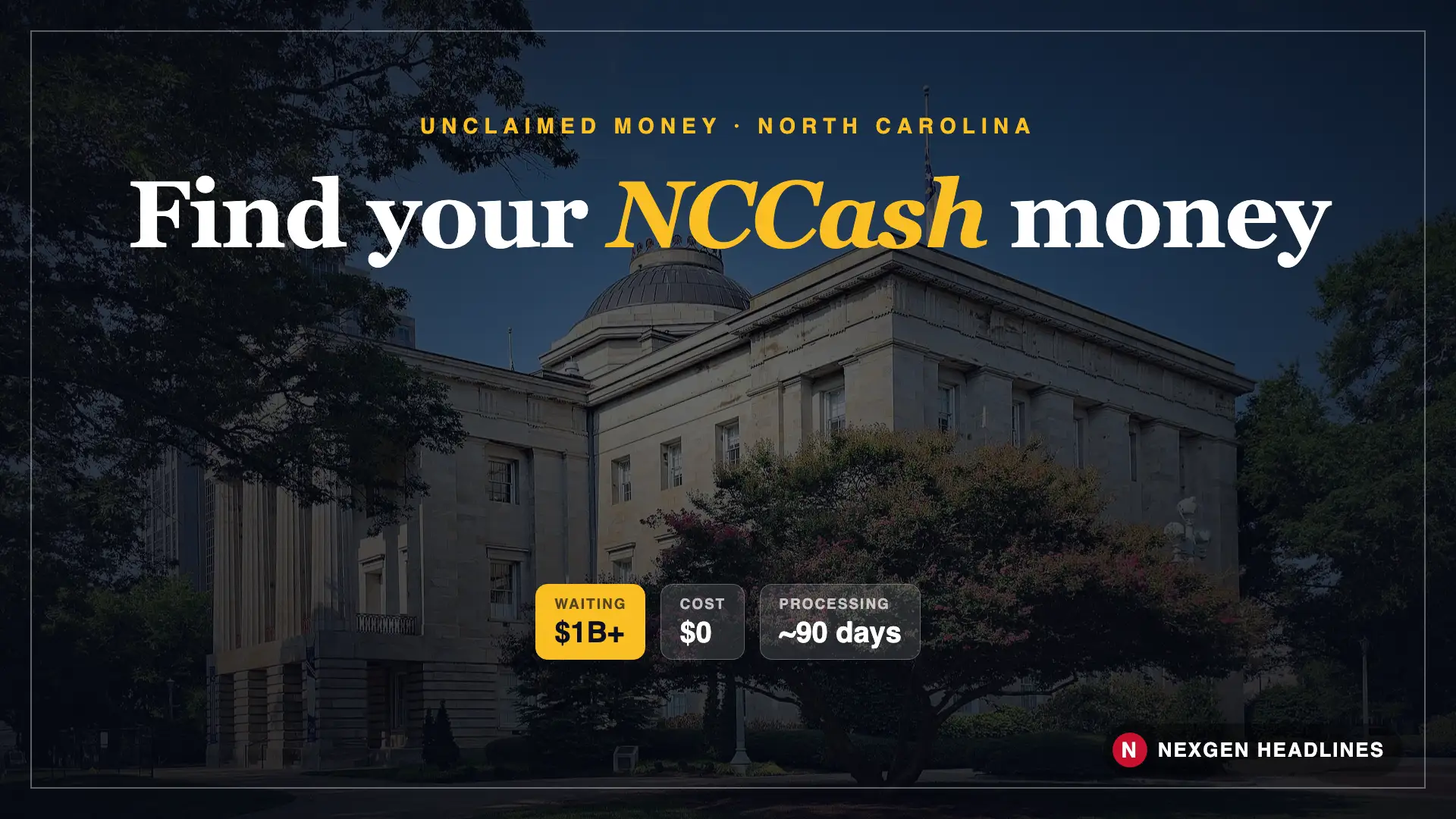
Featured image: North Carolina State Capitol, Raleigh. Photo: P. Hughes / Wikimedia Commons, CC BY 4.0; edited by Nexgen Headlines.