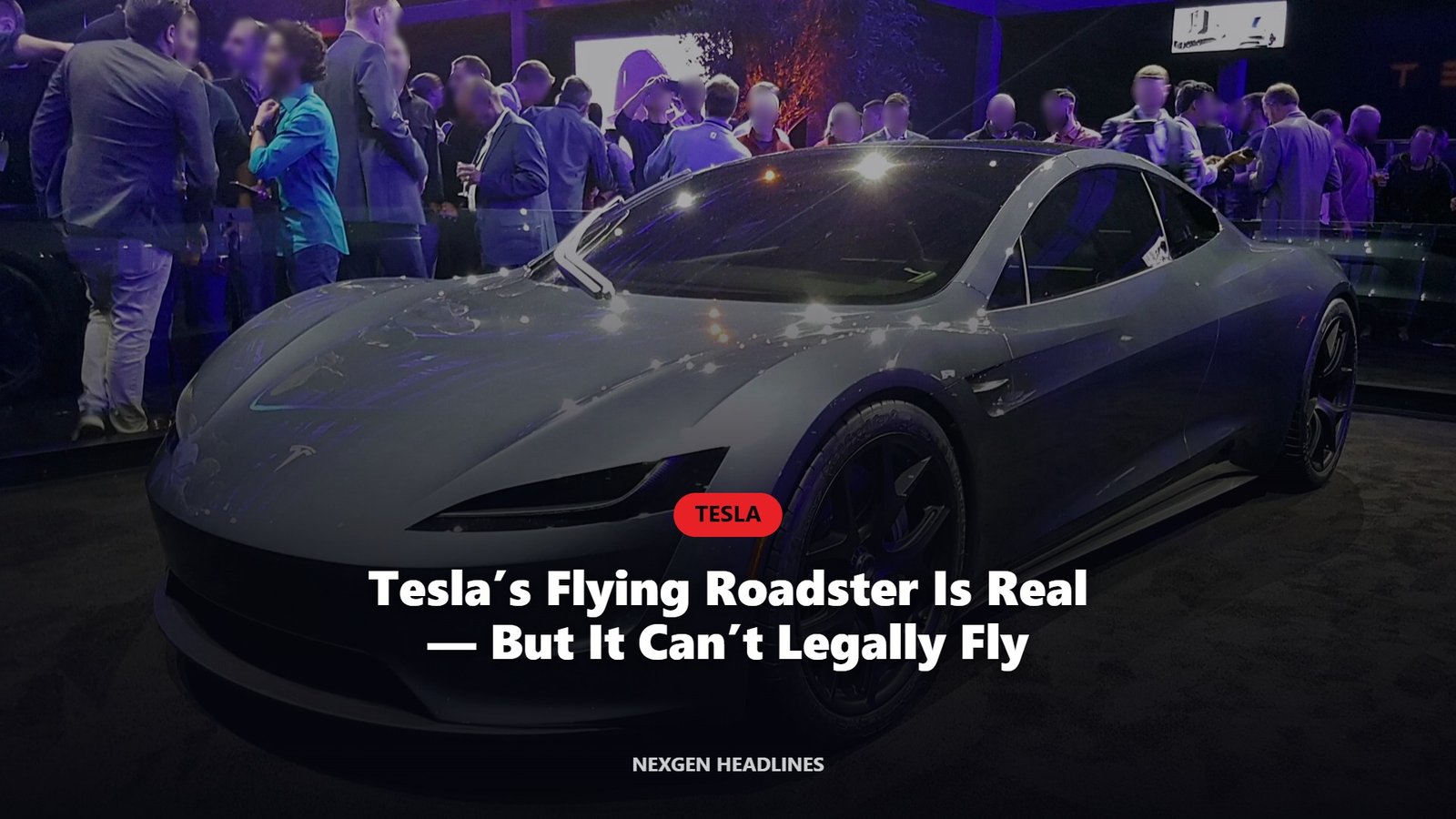

Elon Musk has been promising a flying Tesla since 2018. On Wednesday night, in a field outside Waco, Texas, he finally showed one — and then spent the rest of the evening explaining why it probably isn’t legal, isn’t safe, and won’t reach a driveway until 2028.
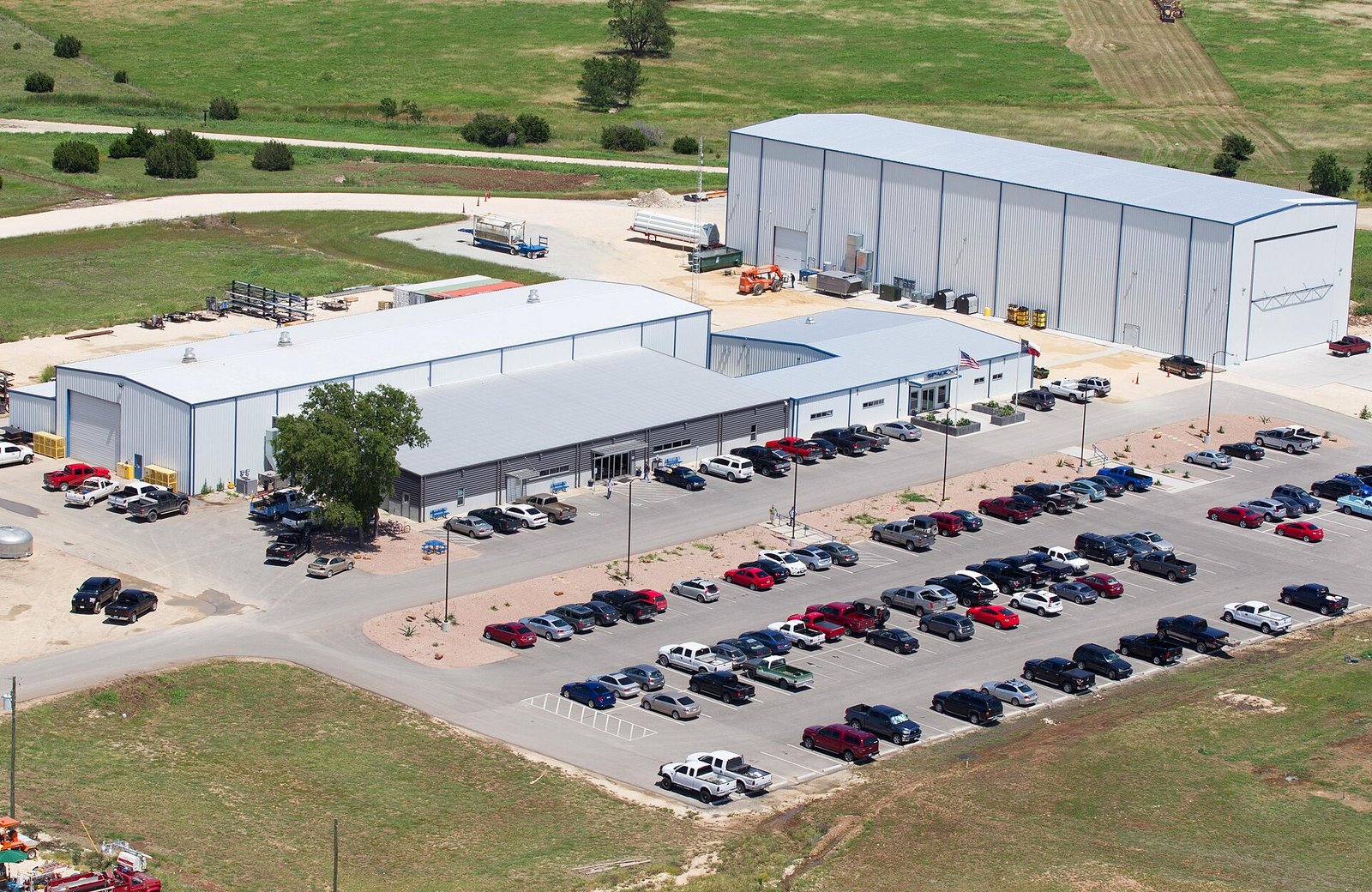
The second-generation Tesla Roadster was revealed on Oct. 15 at SpaceX’s rocket test site in McGregor, Texas, nine years after the first prototype rolled onto a stage and six years after Tesla originally said deliveries would begin. The headline feature is not the battery or the 230 mph top speed. It’s the cold-gas thrusters, built with SpaceX, that let the car leave the ground.
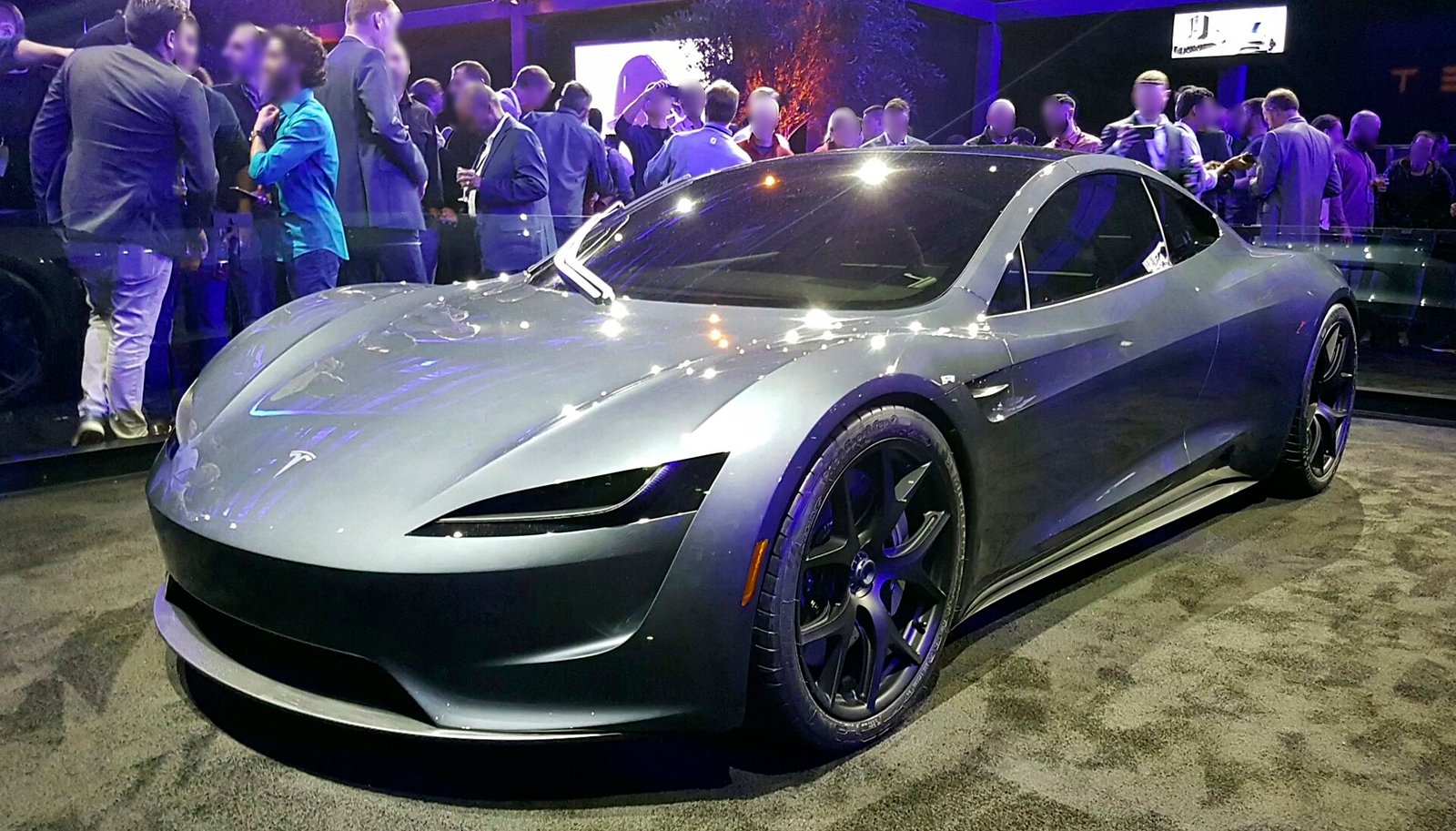
During the livestream, a Roadster accelerated up a curved ramp, held itself upside down with a fan-driven suction system, then fired its thrusters to launch, flip, and land on its wheels. In a second run, it cleared an entire lineup of parked Teslas — a Cybercab, a Cybertruck, a Tesla Semi, a Model Y and a Model 3 — flipped in midair, and came down on the far side.
“Turns out the future does have flying cars,” Musk said. Tesla’s vice president of vehicle engineering, Lars Moravy, put it more bluntly: “Flying cars are real.”
Whether that’s true in any way a buyer can use is the real story, and it’s more complicated than the clips going around your feed.
The short version
- What: Second-generation Tesla Roadster, revealed Oct. 15, 2026
- Where: SpaceX test site, McGregor, Texas (livestreamed)
- The flying part: Cold-gas thrusters developed with SpaceX, fed by 600 liters of rechargeable compressed air
- Performance: 0–60 mph in under one second on top trims; over 230 mph; about 300 miles of range
- Reservations: $50,000 Performance, $250,000 Thrust, invite-only Rocket
- Price: Not announced
- Production: 2028, per Tesla
- FAA approval to fly: None on public record
Visual version: See the flying Roadster explained in 12 slides →
Three versions, and only one of them actually flies
This is the detail most of the viral posts are skipping. Tesla is selling three different cars, and the flying is almost entirely reserved for the one you can’t order.
| Trim | Tesla calls it | Seats | Thrusters | Reservation |
|---|---|---|---|---|
| Performance | “Road ready” | 2 | None | $50,000 |
| Thrust | “Race ready” | 2 | Rear-mounted | $250,000 |
| Rocket | “Air ready” | 1 | 10, around the car | Invite only |
So the entry car, the one with the $50,000 reservation, has no thrusters at all. It’s a very fast electric sports car with active aerodynamics and a “multi-mode suction system” that helps it stick to the road. The middle trim gets thrusters at the back, which Tesla frames as a performance aid — extra shove out of a corner, not flight.
Only the single-seat Rocket trim carries the full ten-thruster setup that did the stunts, and Tesla isn’t selling it to the public. You have to be invited.
How the thrusters actually work
These are not rocket engines. Nothing burns. The car carries 600 liters of compressed air in carbon fiber overwrapped pressure vessels — COPVs, the same class of tank SpaceX uses in its rockets — and releases it through nozzles to push the car around. You recharge the air the way you’d recharge the battery.
That design choice explains both the spectacle and the limits. Compressed air gives you enormous thrust for a very short time. It’s great for a one-second flip over a Cybertruck. It is not how you cross town. Nobody at the event claimed the car could hover for a sustained period, and Tesla published no figure for altitude, distance, or flight duration.
It’s also worth noting what COPVs are known for. A failed COPV caused the 2016 Falcon 9 explosion that destroyed a satellite on the launch pad. Tesla says it has filled “every usable void” in the car with them.
The reality check: it can’t legally fly, and that isn’t a technicality
Here is the part that didn’t make the highlight reel. Under FAA rules, a machine that leaves the ground under its own power is an aircraft, and an aircraft over 250 pounds needs formal FAA authorization to operate. A Roadster weighs many times that.
There is no FAA type certification for a Tesla Roadster in public federal records. Aviation specialists who looked at the reveal put the approval timeline at a year at absolute minimum, and that assumes Tesla files for it and the agency has a category it fits into — which, for a two-ton road car that hops, it largely doesn’t.
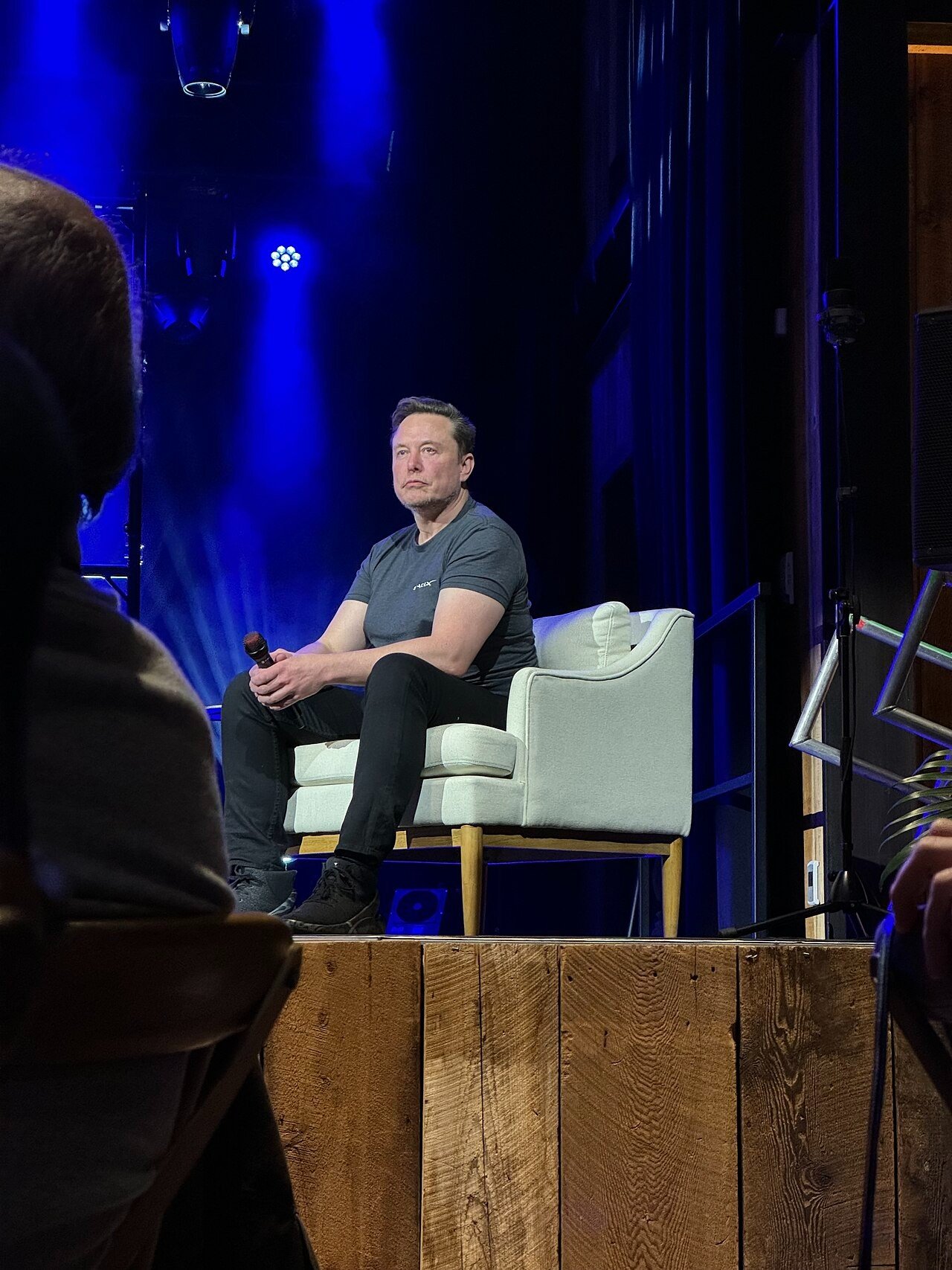
Musk acknowledged as much on stage, in his own way. He said the car is not necessarily optimized for safety, that it may not be legal everywhere, and — a line that landed strangely in the room — that Tesla would “aspire not to kill anyone in this car.” He also said beforehand that the demo would be the most exciting event of the year “whether it works or not.”
Several reports noted the demonstration vehicle may have been remote-operated rather than driven, which would mean the thing that flew is not the thing a customer would be allowed to take on a public road.
Engineers raised a more basic objection: weight. Everything that makes a car safe and legal on a road — crash structure, airbags, bumpers, a heavy battery — is exactly what you strip out of an aircraft. Building one object that satisfies both rulebooks is the problem nobody has solved in a century of trying, and a compressed-air hop doesn’t solve it. One aviation expert allowed that if Tesla does get this into production, it would be a genuinely remarkable engineering feat.
About those AI videos
If you saw a flying Tesla clip this week and assumed it was fake, that’s a reasonable instinct that happens to be wrong this time — and the confusion runs both directions.
Fake Tesla videos have been circulating all year. Fact-checkers traced one widely shared set of clips showing diesel generators strapped to Teslas back to a Sora watermark. A viral “robotic transportation” video attributed to Tesla came from an AI channel and showed a product that doesn’t exist. So when real footage of a car backflipping over a semi truck appeared, plenty of people filed it under the same category.
The Oct. 15 reveal was a real livestreamed event with press in attendance, covered by CNN, TechCrunch and Fox Business among others. But the skepticism isn’t baseless either: YouTuber Marques Brownlee asked publicly whether the whole thing was “a prank,” and at least one outlet argued the flight sequences were pre-recorded rather than performed live. The honest position right now is that the event happened, the car exists, and whether what you watched was a live demonstration or an edited package is still being argued over.
The rule of thumb that keeps working: check whether CNN, the AP or Reuters has it before you share it. For the wave of fake offers and giveaways that always follows a Tesla announcement, our guide to spotting viral product scams covers the patterns.
Should you put down $50,000?
That’s the question the reservation page is really asking, and the Roadster’s own history is the most useful data point available.
Tesla revealed the first second-generation Roadster prototype in November 2017, took $50,000 deposits then too, and said deliveries would start in 2020. It is now 2026 and the car has been redesigned. The timeline has been pushed back repeatedly. The new date is 2028.
Musk also said something telling about where this car sits inside Tesla: he’s “not sure it moves the needle massively from a revenue standpoint.” He called it “the best of the last of the human-driven cars” — a halo product and a marketing event, arriving while the company’s actual money is in the Model Y, energy storage and the robotaxi program.
None of that means the car won’t arrive. It means a 2028 date from Tesla has historically been a direction rather than a promise, and a $50,000 reservation is a long time to have money parked somewhere. Anyone considering it should read the reservation terms on refundability closely before transferring anything — and if a large payment ever goes wrong, here’s how to dispute a credit card charge.
What to watch next
Three things will tell you whether this is a product or a show. First, whether Tesla files anything with the FAA — that’s public, and it’s the clearest signal available. Second, whether the Rocket trim ever gets a price and a buyer outside the invite list. Third, whether Tesla repeats the flight demo in front of independent press, with the same car, unedited.
Until then: a real car did a real backflip in Texas, nobody can legally fly one, and the first deliveries are two years away on a timeline that has already slipped six years once.
Visual version: See the flying Roadster explained in 12 slides →
Frequently asked questions
Did Tesla really unveil a flying car?
Yes. Tesla revealed the second-generation Roadster on October 15, 2026, at SpaceX’s test site in McGregor, Texas. In the livestreamed demo the car used SpaceX-developed cold-gas thrusters to launch off a ramp, flip in midair, and jump over a lineup of parked Teslas including a Cybertruck and a Tesla Semi. Separately, a lot of fake AI-generated Tesla videos have circulated this year, so the real footage is being confused with those.
How much does the Tesla flying Roadster cost?
Tesla has not announced a final price. Reservations are open at $50,000 for the Performance trim and $250,000 for the Thrust trim. The single-seat Rocket trim, which has the full 10-thruster flight system, is invite only. The 2017 Roadster prototype had a stated base price of $200,000.
Can the Tesla Roadster legally fly?
No. Under FAA rules a machine that leaves the ground under its own power is an aircraft, and anything over 250 pounds needs formal FAA authorization. There is no FAA type certification for a Tesla Roadster in public federal records, and aviation specialists estimate approval would take at least a year if Tesla pursued it.
How do the thrusters work?
They are cold-gas thrusters, not rocket engines — nothing burns. The car stores 600 liters of compressed air in carbon fiber overwrapped pressure vessels and releases it through nozzles to push the car. The air is rechargeable. That design gives huge thrust for a very short burst, which is enough for a flip or a hop but not sustained flight.
When will the Tesla Roadster be delivered?
Tesla says production starts in 2028. For context, Tesla revealed the first second-generation Roadster prototype in November 2017 and said deliveries would begin in 2020. The timeline has slipped repeatedly since.
Does the $50,000 version fly?
No. The Performance trim has no thrusters at all — it is a two-seat electric sports car with active aerodynamics and a suction system. The Thrust trim adds rear-mounted thrusters for acceleration. Only the invite-only single-seat Rocket trim carries the 10-thruster setup used in the demo.