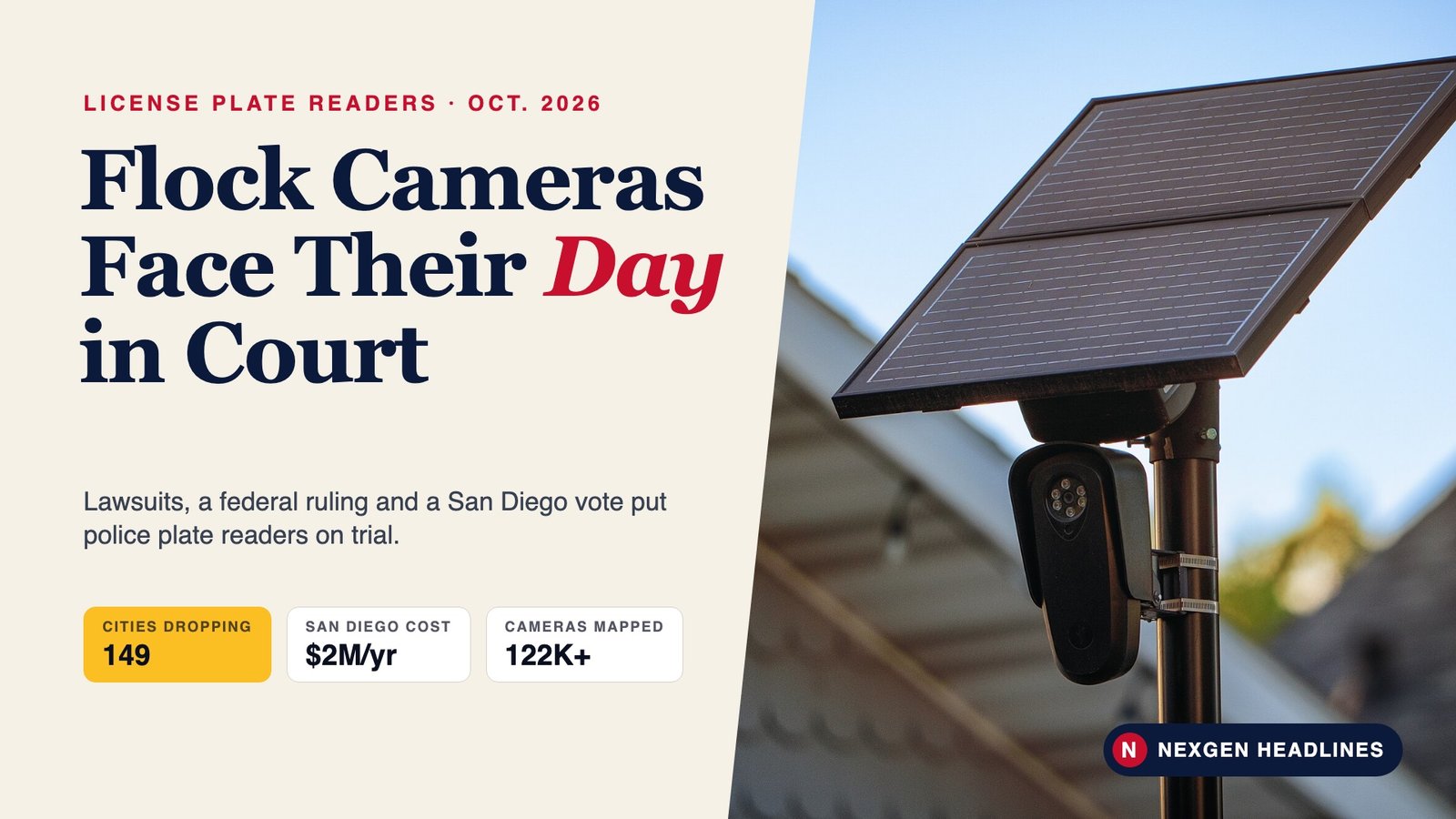

Quick answer: As of Oct. 25, 2026, Flock license plate cameras face lawsuits in California and Wisconsin. On Oct. 1, a federal judge in Oklahoma ruled that one warrantless Flock search broke the Fourth Amendment. And San Diego’s council is moving to shut its cameras off.
Nothing has banned the cameras nationwide. Police in thousands of communities still use them. But the legal and political ground under them is shifting fast, and the next few months matter.
The story at a glance
| Question | What we know |
|---|---|
| What is Flock? | A company that sells automated license plate reader (ALPR) cameras to police, cities, stores and neighborhoods |
| Cameras mapped nationwide | More than 122,000 plate reader cameras, according to a DeFlock count reported by Newsweek |
| Biggest court ruling so far | Oct. 1, 2026: a federal judge in Tulsa said one 30-day, multistate Flock search was an unconstitutional search |
| Lawsuits pending | ACLU suit against San Diego (filed Sept. 30); ACLU petition to the Wisconsin Supreme Court (mid-October); a WILL suit over Waukesha County searches |
| San Diego status | A council committee voted unanimously on Oct. 21 to end the program; the full council votes next |
| Money at stake in San Diego | About $2 million a year, according to the city’s Independent Budget Analyst, as reported by NBC San Diego |
| Cities dropping Flock | 149 local governments canceled, rejected or switched off cameras in 2026, according to a Newsweek map |
| Flock’s main change | Default data storage cut from 30 days to seven days, and searches tied to case numbers, per Newsweek |
What Flock cameras actually do
A Flock camera sits on a pole near a road. It photographs the back of every passing car. Software reads the plate number and notes the car’s make, color and other details.
Each “read” gets a time and a place. Police can then search that history. They can ask, “Where has this plate been for the last month?”
That is the heart of the fight. One photo of a car on a public street is not very private. But weeks of photos across many cities can show where a person sleeps, worships, gets medical care and works.
Supporters say the cameras help find stolen cars, missing people and suspects. Critics say they build a running record of almost everyone who drives, without a warrant or suspicion.
Timeline: how we got here
| Date | What happened |
|---|---|
| 2025 | San Diego police stop sharing plate data with federal and out-of-state agencies after California Attorney General Rob Bonta’s office said the practice likely broke state law (KPBS) |
| January 2026 | A federal judge in Virginia upholds Norfolk’s plate reader network, finding separate photos did not track “the whole” of a person’s movements (Courthouse News Service, via Sinclair stations) |
| June 2026 | A San Diego council effort to cancel the Flock contract fails 5 to 4 during budget talks (NBC San Diego, Times of San Diego) |
| August 2026 | Two men sue San Diego, saying plate data led to their wrongful arrests (KPBS). Cancellations around the country hit a record pace that month, trackers say |
| September 2026 | The Wisconsin Institute for Law & Liberty (WILL) sues over warrantless Flock searches by Waukesha County municipalities (WPR) |
| Sept. 30, 2026 | The ACLU Foundation of San Diego & Imperial Counties sues the city and its police department (KPBS) |
| Oct. 1, 2026 | U.S. District Judge Sara E. Hill in Oklahoma rules a deputy’s warrantless Flock history search was unconstitutional and throws out the evidence (TechCrunch, Sinclair stations) |
| Mid-October 2026 | The ACLU of Wisconsin and the Electronic Frontier Foundation ask the Wisconsin Supreme Court to require warrants for stored plate data in four cities (EFF, WPR) |
| Oct. 21, 2026 | San Diego’s Budget and Government Efficiency Committee votes unanimously to end the city’s plate reader use (KPBS) |
| Oct. 23, 2026 | The La Crosse, Wis., police department says it is ending its Flock contract (WEAU) |
The Oklahoma ruling, explained
This is the ruling most people are asking about. Here is what happened, based on the court’s order as described by TechCrunch and Sinclair-owned TV stations.
A Tulsa County sheriff’s deputy saw a rental car with a California plate on an Oklahoma highway. Before spotting any traffic violation, the deputy ran the plate through Flock and a second plate reader system.
The search pulled up about 30 days of location data across several states. It showed more than 50 sightings of the car. The deputy then used that travel history to justify a longer stop and a car search.
Judge Hill said the deputy had no clear reason for the search beyond the out-of-state plate. She ruled it was a “search” under the Fourth Amendment. That means it needed a warrant or a valid exception. She suppressed the evidence.
The judge leaned on Carpenter v. United States, a 2018 Supreme Court case. In Carpenter, the justices said police generally need a warrant to get weeks of cellphone location records. Judge Hill applied the same logic to weeks of plate reads.
TechCrunch quoted her description of Flock’s network as “a type of indiscriminate mass surveillance.”
What the ruling does not do
- It does not ban plate readers in Oklahoma or anywhere else.
- It does not say a single camera photo is illegal.
- It is a trial-level ruling. It does not bind other courts, as 404 Media noted.
- It conflicts with the January ruling in Virginia that upheld Norfolk’s network.
When trial judges split like this, an appeals court often ends up settling the question. That could take a year or more.
The San Diego fight
San Diego is now the biggest test of whether a large city will switch the cameras off.
On Sept. 30, the ACLU sued on behalf of the Partnership for the Advancement of New Americans. The suit says the dense camera network breaks the privacy right in the California Constitution. It asks a court to end the program, remove the cameras and delete the data, KPBS reported.
Then came the council. Councilmember Henry Foster III proposed a resolution to end the Flock contract and delete stored data. Four members backed cutting the contract in June, but they needed a fifth. Councilmember Stephen Whitburn said this month he now supports turning the cameras off.
On Oct. 21, Foster’s committee voted unanimously to move the plan forward. The full council has not set a date yet, KPBS reported.
Mayor Todd Gloria opposes the change. He told KPBS that removing the tool would be “a serious mistake.” Times of San Diego reported he says the readers assisted in nearly 900 criminal investigations and helped recover more than $8.7 million in stolen property.
Gloria can veto a council resolution. Overriding a veto takes six votes on the nine-member council. So even a council win may not be the end.
Also read: Cornell 7 Case: Civil Lawsuit and Reopened Investigation Spark Due Process Debate, another case where courts are weighing police power against individual rights.
The Wisconsin cases
Wisconsin has two separate fights, and they come from opposite political directions.
The ACLU of Wisconsin and the Electronic Frontier Foundation filed a petition asking the Wisconsin Supreme Court to take a case directly. They name Milwaukee, Green Bay, Racine and Kenosha. They want the court to rule that police need a warrant, except in emergencies, before searching stored plate data. They are not asking for a ban.
The plaintiffs include the Wisconsin Council of Churches, which represents more than 2,000 congregations, WPR reported. Their lawyers argue people expect privacy when they drive to worship, recovery meetings or domestic violence programs.
Separately, the conservative Wisconsin Institute for Law & Liberty sued over Flock searches by Waukesha County municipalities. That suit argues warrantless searches break the U.S. Constitution.
The state Supreme Court has not said whether it will take the ACLU case. If it does, a ruling would cover every police agency in the state.
Who decides what
| Decision | Who makes it | Where it stands |
|---|---|---|
| Whether a specific search was legal | The judge in that criminal case | Oklahoma judge ruled Oct. 1; other judges may disagree |
| A statewide warrant rule | State supreme courts or state lawmakers | Wisconsin Supreme Court deciding whether to hear the ACLU petition |
| A national rule | Federal appeals courts, then the U.S. Supreme Court, or Congress | No case has reached that stage |
| Whether your city keeps Flock | Your city council or county board, and sometimes the mayor | San Diego full council vote pending; many cities voting |
| How long data is kept and who can search it | Local policy, state law and Flock’s settings | Flock moved its default to seven days, per Newsweek |
Why so many cities are dropping Flock
No government agency tracks these votes, so the counts come from news outlets and advocacy groups. They use different rules, so the numbers differ.
Newsweek’s map counted 149 cities, counties and other local governments that canceled, rejected or switched off cameras in 2026. More keep coming. On Oct. 23, La Crosse police said they were ending their contract.
The reasons repeat from town to town:
- Data sharing. Local officials worry other agencies, including federal ones, can search their cameras’ data. La Crosse’s police chief said the department could not “in good conscience” stay in the wider network, WEAU reported.
- Misuse. A Washington Post investigation found at least 50 officers charged or accused of misusing Flock or similar systems, according to Sinclair stations.
- Trust and approval. Some towns found cameras were switched on without a council vote, Newsweek reported.
- Cost. Contracts cost real money, and some councils decided it was not worth it.
Not every city is leaving. Denver chose to extend its contract with extra safeguards, CBS Colorado reported. Some towns that left simply switched to another plate reader vendor.
Flock argues its system tracks cars, not people, and helps solve crimes. Newsweek reported the company is cutting its default storage from 30 days to seven and requiring case numbers for searches. Flock did not respond to Newsweek’s request for comment.
What this could mean for you (made-up examples)
These are made-up examples to show how the rules work. They are not real people.
Dana in San Diego drives to work past three cameras each day. If the council’s plan passes and survives a veto, those cameras go dark and stored data is deleted. If it fails, her reads are kept for the city’s retention period.
Marcus in Milwaukee drives to a weekly recovery meeting. If the Wisconsin Supreme Court takes the case and sides with the ACLU, police would need a warrant to search where his car has been, except in an emergency.
How to find out if your town uses Flock
- Search your city council agendas. Look for “Flock,” “ALPR” or “license plate reader.” Contracts and renewals usually need a vote.
- Check for a transparency page. Many police departments post a public Flock or ALPR page. It may list camera counts, retention time and search totals.
- Look at crowd maps. Groups like DeFlock map camera locations. Treat these as a starting point, not an official record.
- File a public records request. Ask your police department for its ALPR policy, retention period and sharing list. Most states have free online request forms.
- Show up or write in. Councils take public comment before contract votes. Short, specific comments get noticed.
Common mistakes and myths
- “The Oklahoma ruling made Flock illegal.” It did not. It covered one search in one case.
- “There’s a class action I can join.” The main cases are not class actions, and there is no money to claim, OpenClassActions noted.
- “Covering my plate fixes it.” Blocking or altering a plate is against the law in most states and can get you ticketed.
- “Only police use these cameras.” Stores, malls, homeowners associations and car dealers also run plate readers. KPBS found local police could access some of those private systems.
- “If my city drops Flock, my data is gone.” Only if the vote or contract requires deletion. San Diego’s plan does. Ask your city what happens to stored reads.
Key dates to watch
| When | What to watch |
|---|---|
| Coming weeks (no date set) | San Diego full council vote on Foster’s resolution, then a possible mayoral veto |
| Not yet scheduled | Wisconsin Supreme Court decision on whether to accept the ACLU petition |
| Not yet scheduled | Any appeal of the Oklahoma suppression ruling |
| Ongoing | San Diego Superior Court proceedings in the ACLU lawsuit |
FAQ
Are Flock cameras legal?
Yes, in most places. No court has banned them nationwide. The Oklahoma ruling found one warrantless 30-day search unconstitutional, while a Virginia judge upheld Norfolk’s network in January.
Do police need a warrant to search Flock data?
Usually not today. That is the main legal question. The Wisconsin petition asks for a warrant rule in that state, and the Oklahoma judge required one for a long, multistate search.
How long does Flock keep my plate data?
It depends on local policy. San Diego keeps data 30 days, according to the ACLU suit as summarized by OpenClassActions. Newsweek reported Flock is moving its default to seven days.
Is San Diego turning off its Flock cameras?
Not yet. A committee voted on Oct. 21 to end the program. The full council must approve it, and Mayor Gloria can veto. An override takes six votes.
Can I get my plate removed from Flock?
There is no general opt-out for drivers. You can ask your city about its retention and deletion rules, or file a public records request for its policy.
Bottom line
Flock cameras are not going away overnight. But a federal judge has called a long warrantless search unconstitutional, two states have active lawsuits, and San Diego may switch its cameras off. If you care either way, your city council is where the next real decision happens.
Last reviewed: Oct. 25, 2026. This is a developing story. We will add dated updates as courts and councils act.
Sources: KPBS (Sept. 30, 2026), KPBS (Oct. 21, 2026), NBC San Diego, Times of San Diego (Oct. 20, 2026), Sinclair/WJLA (Oct. 3, 2026), TechCrunch, Wisconsin Public Radio, Electronic Frontier Foundation, WEAU (Oct. 23, 2026), Newsweek map, Newsweek camera count, OpenClassActions (Oct. 24, 2026), Carpenter v. United States (2018).