

Updated Oct. 26, 2026: expanded into a guide to Svalbard for American readers: why the Arctic islands matter strategically, the new 2025 visitor rules, and how to plan a trip from the U.S.
Quick answer: Svalbard is a group of Norwegian Arctic islands about halfway between mainland Norway and the North Pole, home to roughly 2,500 to 3,000 people. A 1920 treaty gives Norway sovereignty but lets citizens of signing countries, including the U.S. and Russia, live and work there. That, plus melting sea ice and a Russian mining town, makes it a growing security concern. Americans can visit by flying through Oslo or Tromsø to Longyearbyen. Since 2025, visitors must stay at least 300 meters from polar bears (500 meters from March through June), and ships with more than 200 passengers are barred from protected areas.
Svalbard at a glance
| Fact | Details |
|---|---|
| Who governs it | Norway, under the 1920 Svalbard Treaty |
| Main town | Longyearbyen |
| Population | Roughly 2,500 to 3,000 |
| Russian presence | The coal-mining settlement of Barentsburg |
| Polar bear distance rule | 300 m most of the year; 500 m from March 1 to June 30 |
| Cruise limit in protected areas | Ships with more than 200 passengers barred |
| Getting there from the U.S. | Fly to Oslo, then on to Longyearbyen (often via Tromsø) |
Why Svalbard matters strategically
For years, Greenland got most of the Arctic headlines. Svalbard is getting more attention for three reasons.
- Its unusual treaty. The 1920 Svalbard Treaty recognizes Norwegian sovereignty but gives citizens and companies of signing nations equal rights to live, work and mine there. The islands must not be used for “warlike purposes.”
- Russia’s foothold. Russia runs the mining town of Barentsburg under the treaty. With relations between Russia and NATO at their worst in decades, Norway watches closely.
- Melting ice. Shrinking sea ice is opening shipping routes and making the region’s fish, minerals and energy easier to reach. Satellites and undersea cables that pass through the area also matter for communications.
Norway, a NATO member, has stepped up patrols and monitoring. It stresses that its goal is stability, not escalation.
What it means for the U.S.
The U.S. signed the Svalbard Treaty and has a direct interest in a stable Arctic. NATO’s northern flank, including Norway, guards sea lanes between Russia’s Northern Fleet bases and the North Atlantic. Any change in Svalbard’s status could affect U.S. naval planning and allied security.
For most Americans, though, Svalbard shows up as a bucket-list trip: one of the easiest places on Earth to see the Arctic, polar bears and the midnight sun.
Also read: Europe’s Ski Season and Summer Glacier Skiing in 2026
A short history with an American twist
| When | What happened |
|---|---|
| 1596 | Dutch explorer Willem Barentsz records the islands |
| 1600s–1700s | Whalers from several European countries hunt in Svalbard’s waters |
| 1906 | American businessman John Munro Longyear founds a coal-mining town; it’s named Longyearbyen after him |
| 1920 | The Svalbard Treaty is signed in Paris; the U.S. is one of the original signers |
| 1925 | The treaty takes effect and Norway formally takes control |
| 2008 | The Svalbard Global Seed Vault opens to protect the world’s crop seeds |
So the main town in this Norwegian territory carries the name of a businessman from Michigan. Longyear sold his mining company to Norwegian investors in 1916.
Is Svalbard safe to visit?
Yes, for travelers who follow the rules. Crime is very low. The real risks are natural: polar bears, cold, sudden weather changes and avalanches near town. Stick with licensed guides outside Longyearbyen, listen to local warnings, and don’t take chances near glaciers or sea ice.
Geopolitical tension doesn’t affect day-to-day visits. Tourists go about their trips normally, and Norway runs the islands like any other part of the country, with some special rules.
The new visitor rules since 2025
Norway tightened Svalbard’s environmental rules starting in 2025 to protect wildlife as tourism grows.
- Polar bears: Keep at least 300 meters away, and 500 meters from March 1 to June 30, when bears are on the sea ice with cubs.
- Walruses and other wildlife: New minimum distances apply too.
- Cruise ships: Ships carrying more than 200 passengers can no longer enter protected areas, which cover most of the islands.
- Drones: Banned in protected areas.
- Landing sites: Tour landings are limited to approved places.
Tour companies say you can still see polar bears, mostly from a safe distance on boat trips or through binoculars.
How to plan a Svalbard trip from the U.S.: 6 steps
- Pick your season. Summer (June to August) brings the midnight sun and boat trips. Late winter and spring (February to April) bring snowmobiling, dog sledding and northern lights.
- Fly via Norway. Fly from the U.S. to Oslo, then take a domestic flight to Longyearbyen, often with a stop in Tromsø.
- Check Schengen entry rules. You enter the Schengen area in Norway. Europe’s new biometric Entry/Exit System applies, and the ETIAS travel authorization is expected to begin in late 2026.
- Book guided tours. Outside town, polar bears are a real danger. Visitors must carry protection or travel with a licensed guide, so most people book tours.
- Budget for high prices. Almost everything is shipped in, so food and lodging cost more than on the mainland.
- Pack for cold, even in summer. Summer highs are often only in the 40s Fahrenheit.
Made-up example (for illustration only): These are made-up travelers and rough figures to show how a trip comes together.
Linda and Joe from Minnesota plan a July anniversary trip. They fly to Oslo, spend two nights in the city, then fly to Longyearbyen for four nights. They book a guided boat trip to a glacier and a walking tour of town, and watch for wildlife from the boat with binoculars. They budget extra for meals and tours and leave the drone at home.
Midnight sun or northern lights?
| Season | What you’ll see | Good for |
|---|---|---|
| Polar night (about late Oct. to mid-Feb.) | No sunrise; northern lights possible on clear nights | Aurora, dog sledding by headlamp |
| Late winter and spring (Feb. to May) | Returning light, deep snow, sea ice | Snowmobile trips, best chance of the full Arctic winter look |
| Midnight sun (about mid-April to late Aug.) | The sun never sets | Boat trips, hiking, glaciers, birds and walruses |
What to pack
- Layers: a base layer, a warm middle layer and a windproof, waterproof shell.
- Waterproof boots with good grip; streets can be icy even in early summer.
- A hat, gloves and a neck gaiter, even in July.
- A sleep mask for the midnight sun.
- Binoculars, since the rules keep you far from wildlife.
Things to know before you go
- The midnight sun lasts from about mid-April to late August. The polar night, with no sunrise, runs from about late October to mid-February.
- The Global Seed Vault sits near Longyearbyen. You can see the entrance from outside, but tours inside aren’t offered.
- Don’t wander outside town alone. Signs warning of polar bears mark the edges of Longyearbyen for a reason.
- Bring cards. Norway is nearly cashless.
- Get travel insurance that covers medical evacuation. Rescue in the Arctic is complex and expensive.
Traveling responsibly
Svalbard’s ecosystem is fragile, and visitor numbers keep rising. Choose operators that follow the Governor’s rules, stay on marked paths in town, don’t feed or approach wildlife, and take all trash with you on excursions. Smaller-ship expeditions and land-based trips put less pressure on the islands than large cruise visits.
What to watch
- Norway-Russia tensions over fishing, research and Barentsburg.
- NATO’s Arctic plans as sea routes open.
- New tourism limits as visitor numbers grow.
Recommended products
- Insulated waterproof boots
- Merino wool base layers
- Compact binoculars for wildlife
- Sleep masks for the midnight sun
Disclosure: As an Amazon Associate, Nexgen Headlines earns from qualifying purchases.
FAQ
Can Americans visit Svalbard?
Yes. Americans fly through mainland Norway, usually Oslo or Tromsø, to Longyearbyen. You enter the Schengen area in Norway, so Schengen entry rules apply.
Who owns Svalbard?
Norway, under the 1920 Svalbard Treaty. The treaty also lets citizens and companies of signing countries, including the U.S. and Russia, live and work there.
Why is Svalbard important?
Its Arctic location, the Russian settlement at Barentsburg and new shipping routes from melting ice make it strategically important for Norway, NATO and Russia.
How close can you get to a polar bear in Svalbard?
Under rules in effect since 2025, at least 300 meters, and 500 meters from March 1 to June 30.
Can cruise ships still visit Svalbard?
Yes, but ships carrying more than 200 passengers are barred from protected areas, which cover most of the islands.
Bottom line
Svalbard is both a geopolitical pressure point and one of the most accessible Arctic trips for Americans. Its 1920 treaty, Russian outpost and melting ice keep it on security planners’ radar. If you go, fly via Oslo, book guided tours, respect the 300-meter polar bear rule, and pack for cold.
Last reviewed: Oct. 26, 2026.
Sources: Arctic Today / Barents Observer: new distance rules; Afar; Governor of Svalbard; Visit Svalbard; U.S. State Department: Norway.
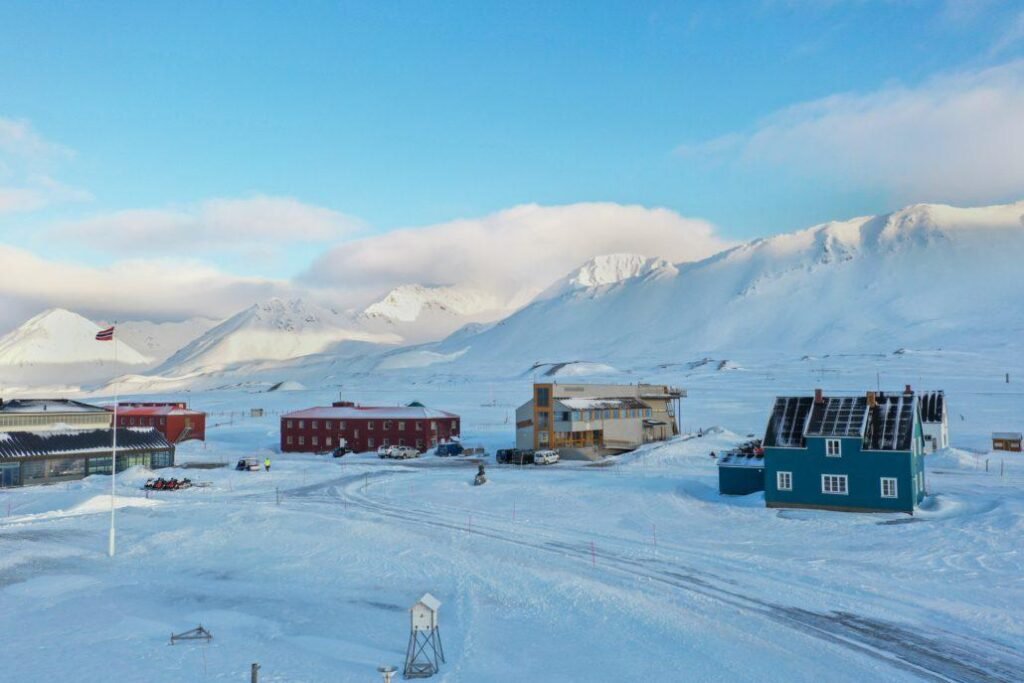
Featured image: Longyearbyen, Svalbard, in winter. Photo: Bjørn Christian Tørrissen / Wikimedia Commons, CC BY-SA 4.0; edited by Nexgen Headlines.