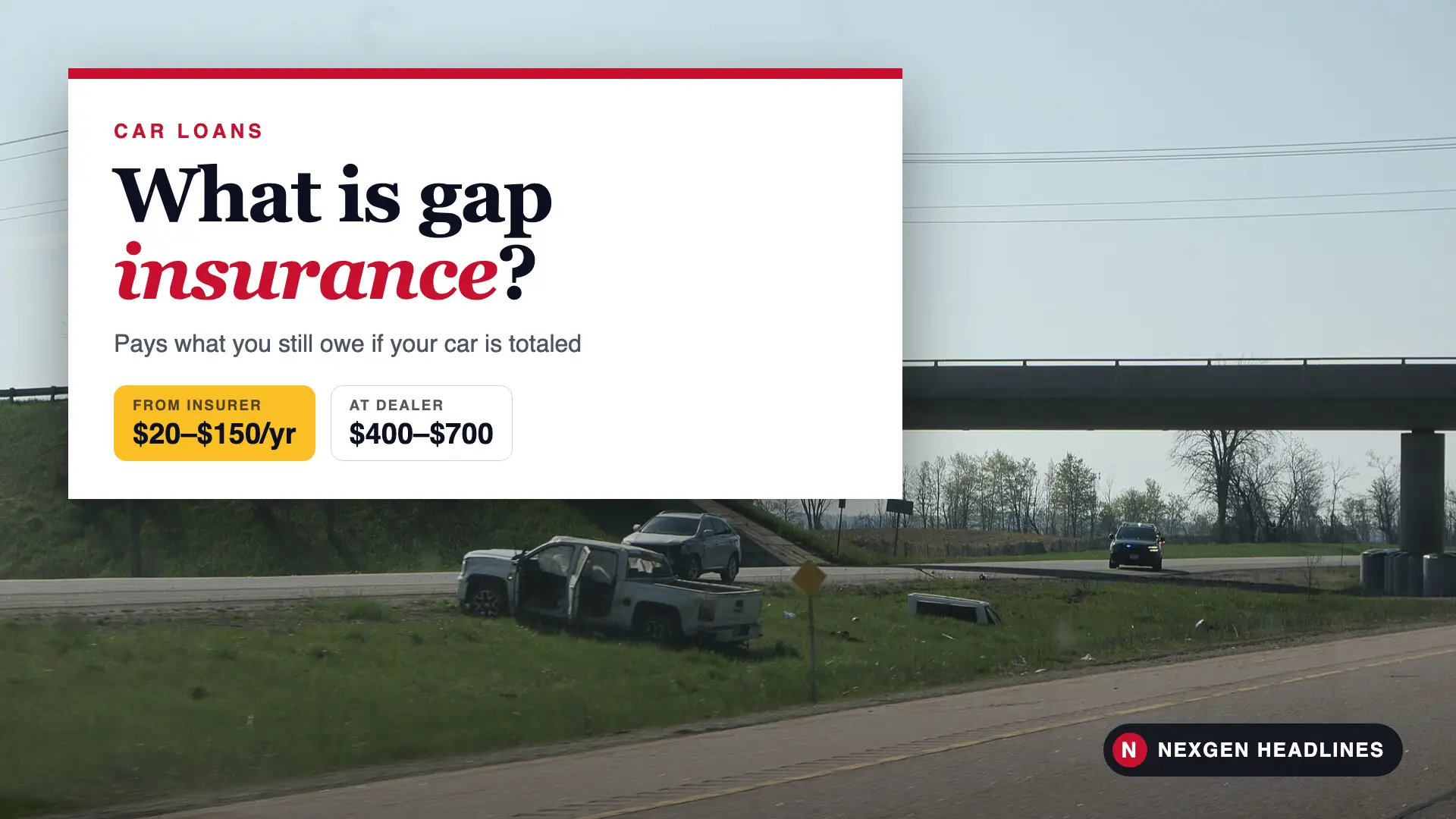

Quick answer: Gap insurance pays the difference between what your car is worth and what you still owe on your loan or lease if the car is totaled or stolen. Regular insurance only pays the car’s actual cash value. If you owe more than that, gap covers the “gap.” Through your car insurer it often costs about $20 to $150 a year; at a dealership it’s often a one-time $400 to $700, usually rolled into your loan.
New cars lose value fast. If you put little money down or took a long loan, you can easily owe more than the car is worth for the first few years. That’s when gap insurance earns its keep. Here’s how it works, who needs it and where to buy it cheaper.
Gap insurance at a glance
| Question | Answer |
|---|---|
| What it covers | Loan or lease balance minus the car’s actual cash value after a total loss |
| When it pays | Car is totaled in a covered crash or stolen and not recovered |
| Cost from a car insurer | About $20–$150 a year (estimates vary) |
| Cost from a dealer | Often $400–$700 one time, plus loan interest if financed |
| Who needs it most | Small down payment, loans of 60+ months, leases, negative equity rolled in |
| Needed by law? | No, but many leases and some lenders require it |
| When to drop it | When you owe less than the car is worth |
Cost ranges reported by Edmunds, Experian, NerdWallet and CarInsurance.com, citing industry data. Your price depends on your car, state and insurer.
How gap insurance works: a simple example
When a car is totaled, your collision or comprehensive coverage pays its actual cash value (ACV), what it was worth just before the loss, minus your deductible. That number is often lower than your loan balance.
Made-up example (for illustration):
Tyler buys a $36,000 SUV with $1,000 down and a 72-month loan. Eighteen months later, he owes $29,500. The SUV is totaled in a crash. His insurer values it at $25,000 and pays $24,500 after his $500 deductible.
Without gap: Tyler still owes the lender $5,000 for a car he no longer has.
With gap: the gap policy pays the $4,500 difference between ACV and his loan. Many insurer gap policies don’t cover the deductible, so he may still pay $500. Some dealer gap contracts do cover it.
Who needs gap insurance?
Gap insurance makes sense if you’re “upside down” on your loan, meaning you owe more than the car is worth. That’s likely if:
- You put less than 20% down.
- Your loan is 60 months or longer.
- You rolled negative equity from your old car into the new loan.
- You’re leasing. Most leases already include gap; check your contract.
- You bought a model that depreciates fast, such as many luxury cars and some EVs.
- You drive a lot of miles, which lowers value faster.
You probably don’t need it if you paid cash, made a big down payment, have a short loan, or your car is worth more than you owe.
Where to buy gap insurance (and the cheapest option)
1. Your car insurance company
Many big insurers sell gap coverage (sometimes called loan/lease payoff) as an add-on to a policy with collision and comprehensive. It’s usually the cheapest route because you pay a small amount each period, not a lump sum with interest. Some insurers limit it to newer cars or to the original owner.
2. Your bank or credit union
Many credit unions sell GAP waivers for a flat fee that’s often lower than dealers charge. Ask before you sign at the dealership.
3. The dealership
Dealers sell “GAP waivers” or contracts during financing. It’s convenient, but prices are often higher, and the cost is usually added to your loan, so you pay interest on it. The price is negotiable, and you can say no.
Also read: How to refinance a car loan
What gap insurance doesn’t cover
- Your deductible (with many insurer policies)
- Overdue loan payments and late fees
- Extended warranties or service contracts rolled into the loan
- Repairs when the car isn’t totaled
- A down payment on your next car
- Rental cars, unless your policy has rental coverage
Some dealer contracts also cap the payout, for example at a percentage of the car’s value. Read the limits before you buy.
How to file a gap claim
- File the total loss claim with your auto insurer first.
- Get the settlement letter showing the ACV and deductible.
- Get a payoff statement from your lender.
- Contact the gap provider (insurer, credit union or dealer administrator) and send the documents. Many also ask for the police report and loan contract.
- Keep making loan payments until the gap claim pays. Missed payments can hurt your credit and may not be covered.
Can you cancel gap insurance and get a refund?
Yes, in most cases. If you bought it from an insurer, just remove it from your policy. If you bought it at a dealer, you can usually cancel and get a prorated refund of the unused part. This often happens automatically when you pay off or refinance the loan early, but you may need to ask. Contact the dealer or the gap administrator named in your contract.
Several state attorneys general and the Federal Trade Commission have warned about dealers that fail to refund unused add-on fees. If you paid off your loan early, check that you got your money back.
Gap insurance vs. new car replacement coverage
Some insurers offer new car replacement, which pays for a brand-new car of the same make and model if yours is totaled in the first year or two. Gap pays off your loan; new car replacement gets you a new car. Some drivers buy both, but they overlap. Compare the price of each with your agent.
Mistakes to avoid
- Buying dealer gap without checking your insurer’s price first.
- Paying for gap on a lease that already includes it.
- Keeping gap for the full loan when you’re no longer upside down.
- Forgetting to ask for a refund after paying off or refinancing.
- Dropping collision and comprehensive. Gap usually doesn’t pay without them.
How to tell if you’re upside down on your car loan
You don’t need to guess. It takes about five minutes:
- Find your payoff amount. Log in to your lender’s website or app, or call and ask for the 10-day payoff. It’s a bit higher than your “current balance” because it includes interest.
- Look up your car’s value. Use Kelley Blue Book, Edmunds or J.D. Power. Use the “private party” or “trade-in” value for your exact trim, mileage and condition.
- Subtract. If the payoff is higher than the value, you have negative equity, and gap coverage is doing real work for you.
Check again every six months. Most drivers who put little down are upside down for the first two to three years. After that, the loan balance usually falls faster than the car’s value, and you can drop gap coverage to save money.
Questions to ask before you buy gap at the dealer
- What is the total price, and is it added to my loan?
- Does it cover my insurance deductible?
- Is there a maximum payout, such as a percentage of the car’s value?
- Can I cancel, and how is the refund calculated?
- Who is the administrator I’d call to file a claim?
Write the answers down. If the finance manager can’t answer clearly, that’s a good sign to buy gap from your insurer or credit union instead.
Recommended products
Gear that helps after a crash and protects your car’s value.
Disclosure: As an Amazon Associate, Nexgen Headlines earns from qualifying purchases.
FAQ
Is gap insurance worth it?
It’s worth it when you owe more than your car is worth, especially in the first two or three years of a long loan with little down. Once your loan balance falls below the car’s value, it isn’t needed.
Does gap insurance cover theft?
Yes, if the car is stolen and not recovered and your comprehensive coverage declares it a total loss.
Can I buy gap insurance after buying the car?
Often yes, from your insurer or credit union, but many set limits, such as only for cars a few years old or only for the original loan holder. Buy it early.
Is gap insurance required?
No state law requires it, but many leases and some lenders do.
Does gap insurance cover my deductible?
Many insurer-sold gap policies don’t. Some dealer and credit union gap contracts do. Check your terms.
Bottom line
Gap insurance protects you from owing thousands on a car you no longer have. It’s smart for leases, small down payments and long loans. Price it first with your car insurer or credit union, where it’s often around $20 to $150 a year, before paying $400 to $700 at the dealer, and drop it once you owe less than the car is worth.
Last reviewed: Nov. 13, 2026. Prices are estimates; get quotes for your car and state.
Sources: Insurance Information Institute: What is gap insurance?, NAIC: Auto insurance, FTC: Buying a new car, Edmunds, Experian.
Featured image: Car accident on Highway 400 near Barrie. Photo: Chicken4War / Wikimedia Commons, CC BY-SA 4.0; edited by Nexgen Headlines.