
Quick answer: You can get a personal loan with bad credit, but expect a higher rate and smaller amount. Start with a credit union (federal credit unions cap most loan APRs at 18%, and their small “payday alternative loans” at 28%), then compare online lenders that prequalify you with a soft credit check. Add a co-signer or collateral to get a better offer. Skip any loan above 36% APR, and never pay a fee before you get the money.
Bad credit usually means a FICO score below about 580 (“poor”) or in the 580–669 “fair” range. Lenders see more risk, so they charge more. But the gap between a fair loan and a terrible one is huge. This guide shows where to look, what it costs and what to avoid.
Your bad-credit loan options compared
| Option | Typical amount | Typical cost | Good to know |
|---|---|---|---|
| Credit union PAL I | $200–$1,000 | Max 28% APR, up to $20 application fee | 1–6 month term; you may need to be a member first |
| Credit union PAL II | Up to $2,000 | Max 28% APR, up to $20 fee | 1–12 month term |
| Regular credit union personal loan | $500–$25,000+ | Federal credit unions: most loans capped at 18% APR | Membership required; often more flexible on credit |
| Online lender | $1,000–$50,000 | Often 20%–36% APR for fair/poor credit, plus origination fee | Soft-check prequalification is common |
| Secured loan (savings or CD) | Up to your deposit | Usually lower APR | Builds credit; you can’t spend the deposit |
| Payday loan | $100–$500 | Often about 400% APR (CFPB example) | Avoid if at all possible |
PAL limits come from NCUA rules. Online lender rates are typical ranges and change often; check each lender’s current offer.
How to get a personal loan with bad credit: step by step
- Check your credit report and score. Get free reports at AnnualCreditReport.com. Dispute any errors first; a fix can raise your score fast.
- Decide how much you really need. Borrow the smallest amount that solves the problem. Smaller loans are easier to get approved.
- Figure out what you can repay. Keep the monthly payment comfortably inside your budget. A missed payment hurts more than a high rate.
- Start with your bank or a local credit union. Your history with them can count more than your score.
- Prequalify with 3–5 lenders. Use soft-pull prequalification so your score isn’t hit. Compare the APR, not just the interest rate.
- Strengthen the application. Add a co-signer, offer collateral, or show steady income with pay stubs.
- Read the loan agreement. Look for origination fees, late fees and prepayment penalties.
- Apply formally with your best choice. This triggers a hard inquiry. Then set up autopay so you never miss a payment.
APR vs. interest rate: why the fee matters
Many bad-credit lenders charge an origination fee, often a few percent and sometimes close to 10% of the loan. It is usually taken out of the money you receive. The APR includes this fee, so it is the honest number to compare.
For example, if you borrow $5,000 with an 8% origination fee, you get only $4,600 but still repay $5,000 plus interest. Ask for enough to cover the fee only if you truly need the full $5,000.
Made-up example (for illustration):
Marcus has a 590 credit score and needs $3,000 for a car repair. He prequalifies with three places:
- An online lender offers 34.9% APR over 3 years: about $135 a month, roughly $1,860 in total interest and fees.
- A second online lender offers 29.9% APR with no fee: about $127 a month.
- His credit union offers 17.9% APR over 3 years after his sister co-signs: about $108 a month, around $900 in interest.
The credit union loan saves Marcus nearly $1,000 over three years compared with the first offer.
These are made-up examples with rounded estimates. Your rate depends on your credit, income and lender.
Ways to get a better rate with bad credit
- Add a co-signer with good credit. They are fully responsible if you don’t pay, so treat this seriously.
- Offer collateral. A savings-secured or car-secured loan carries lower risk for the lender.
- Lower your debt-to-income ratio. Paying down a credit card before you apply can help.
- Pick a shorter term. Rates are sometimes lower, and you pay less total interest.
- Wait a few months if you can. On-time payments and lower card balances can lift a score noticeably.
Also read: What is a good credit score?
Red flags: loan scams that target bad credit
People with bad credit are a favorite target for scammers. The FTC warns about these signs:
- “Guaranteed approval” or “no credit check” promises for large loans.
- Upfront fees before you receive the loan, paid by gift card, wire or crypto. Real lenders deduct fees from the loan.
- Pressure to act today.
- No physical address or a lender not registered in your state.
- Calls or texts out of the blue offering a loan.
Check a lender with your state attorney general or banking regulator. Report scams at ReportFraud.ftc.gov.
Loans to avoid
Payday loans are short, usually two weeks, and the fee often works out to an APR near 400%. Many borrowers roll them over again and again. Car title loans can cost you your car. Rent-to-own deals and some “installment” lenders also charge well above 36%. If your only offers are this expensive, look at the alternatives below first.
Alternatives to a personal loan
- Ask the creditor for a payment plan. Hospitals, utilities and repair shops often agree to monthly payments with no interest.
- Nonprofit credit counseling. An NFCC member agency can set up a debt management plan and may lower card rates.
- Paycheck advance from your employer. Some employers offer them at no cost.
- Local assistance programs. Dial 211 to find help with rent, utilities and food.
- A secured credit card to rebuild credit for the next time you need to borrow.
Does a personal loan help or hurt bad credit?
It can do both. A hard inquiry may drop your score a few points for a short time. But a loan paid on time every month adds positive history. If you use it to pay off credit cards, your credit utilization can fall, which often lifts your score. Missed payments do the opposite and stay on your report for up to seven years.
Who usually qualifies?
Each lender sets its own rules, but most want to see:
- Age 18 or older and a U.S. citizen or permanent resident
- A bank account and a valid ID
- Steady income from a job, benefits or self-employment
- A debt-to-income ratio that leaves room for the new payment
- No very recent bankruptcy (some lenders allow older ones)
Secured vs. unsecured personal loans
Most personal loans are unsecured, which means no collateral. The lender relies only on your credit and income, so bad credit hurts the most here.
A secured personal loan is backed by something you own, such as money in a savings account, a CD or a paid-off car. Because the lender can take that asset if you don’t pay, it often approves more people and charges less. The risk is real: if you fall behind, you lose the collateral.
A share-secured loan at a credit union is one of the safest ways to rebuild credit. You borrow against your own savings, the rate is usually low, and each on-time payment is reported to the credit bureaus.
What to do if you’re turned down
- Read the adverse action notice. Lenders must tell you why you were denied, or how to ask. The reason tells you what to fix.
- Get your free credit report named in the notice and check it for mistakes.
- Don’t apply everywhere at once. Several hard inquiries in a short time can drop your score more.
- Fix one thing: pay a card below 30% of its limit, bring a late account current, or add a co-signer.
- Try again in 60 to 90 days, starting with a credit union.
How to compare two loan offers fast
Put the offers side by side and look at four numbers: the APR, the monthly payment, the total you will repay, and the cash you actually receive after fees. The best offer is usually the one with the lowest total repaid that still has a payment you can afford every month. A longer term lowers the payment but often raises the total cost.
Recommended products
Tools to help you budget and rebuild credit.
Disclosure: As an Amazon Associate, Nexgen Headlines earns from qualifying purchases.
FAQ
What credit score do I need for a personal loan?
There is no single minimum. Some online lenders accept scores in the high 500s, while banks often want 670 or higher. Credit unions may look past the score if you have steady income.
Can I get a personal loan with a 500 credit score?
It’s hard but possible, usually with a co-signer, collateral or a credit union PAL. Expect a small amount and a high rate.
Will prequalifying hurt my credit?
No. Prequalification uses a soft inquiry. Only the final application uses a hard inquiry.
What is a fair APR for bad credit?
Many consumer advocates treat 36% APR as the upper limit for an affordable loan. Below 25% is a good result with bad credit.
How fast can I get the money?
Many online lenders fund in one to three business days after approval. Credit unions may take a little longer.
Bottom line
Bad credit doesn’t lock you out of a personal loan, but it raises the stakes. Start with a credit union, prequalify with several lenders using a soft check, compare the full APR, and walk away from anything above 36% or anyone asking for money upfront. Pay on time, and your next loan will be cheaper.
Last reviewed: Nov. 15, 2026. Rates change often; examples are estimates, not offers.
Sources: NCUA: Payday alternative loans (PAL I and PAL II), CFPB: Payday loan costs, FTC: Fake loan offers, AnnualCreditReport.com, myFICO: Credit score ranges.
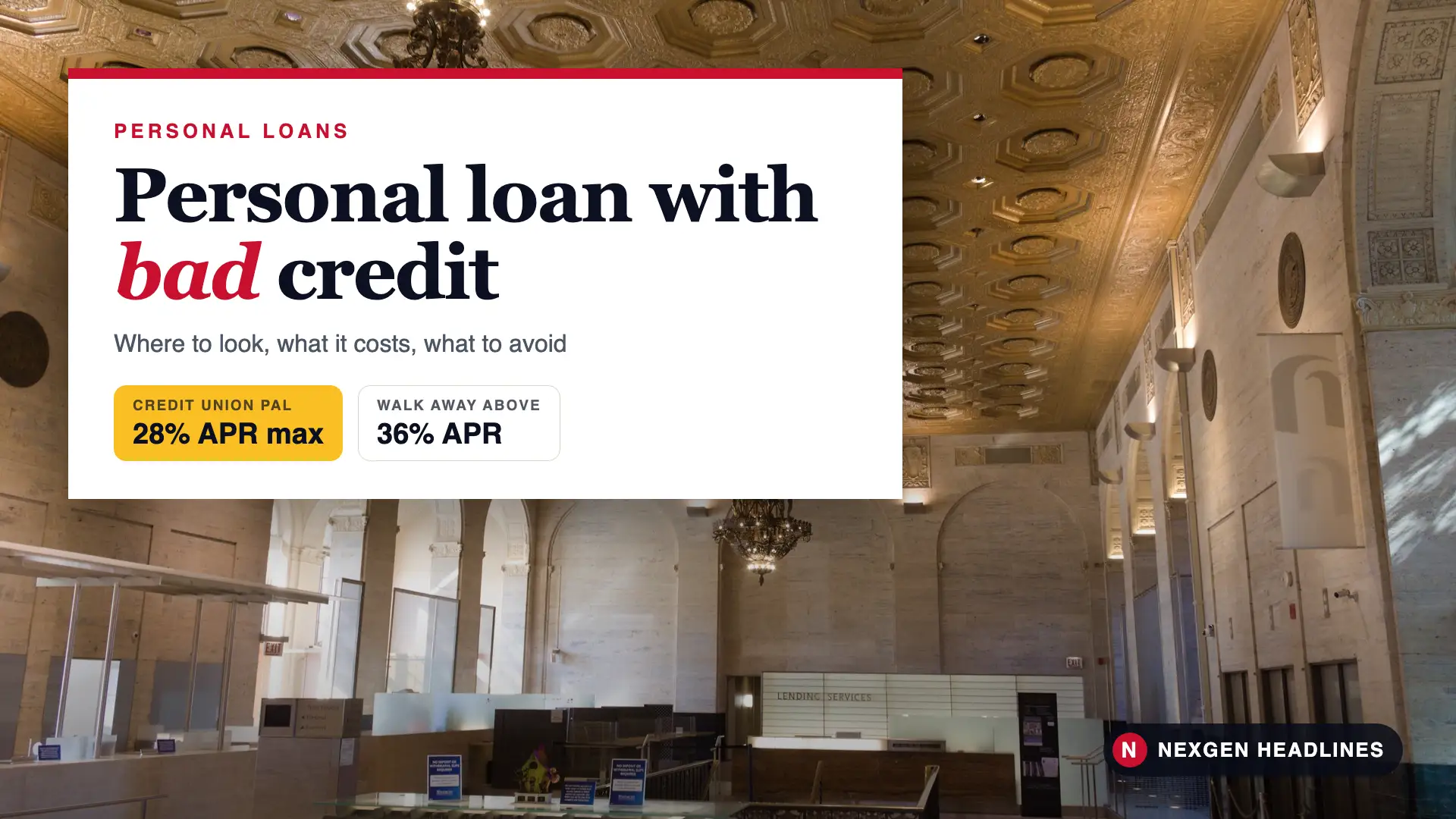
Featured image: Hyde Park Bank lobby, Chicago. Photo: Fixedsun / Wikimedia Commons, CC0; edited by Nexgen Headlines.