
Update (Oct. 27, 2026): We re-checked the Sunshine Protection Act. The House passed it 308-117 on July 14, but the Senate has not voted and is in recess, so clocks fall back as usual on Nov. 1. We also added a time-change checklist and what the bill would change if it ever becomes law. We re-checked the Sunshine Protection Act. The Senate still has not voted, so clocks fall back as usual on Nov. 1. We also added a time-change checklist and what the bill would change if it ever becomes law.
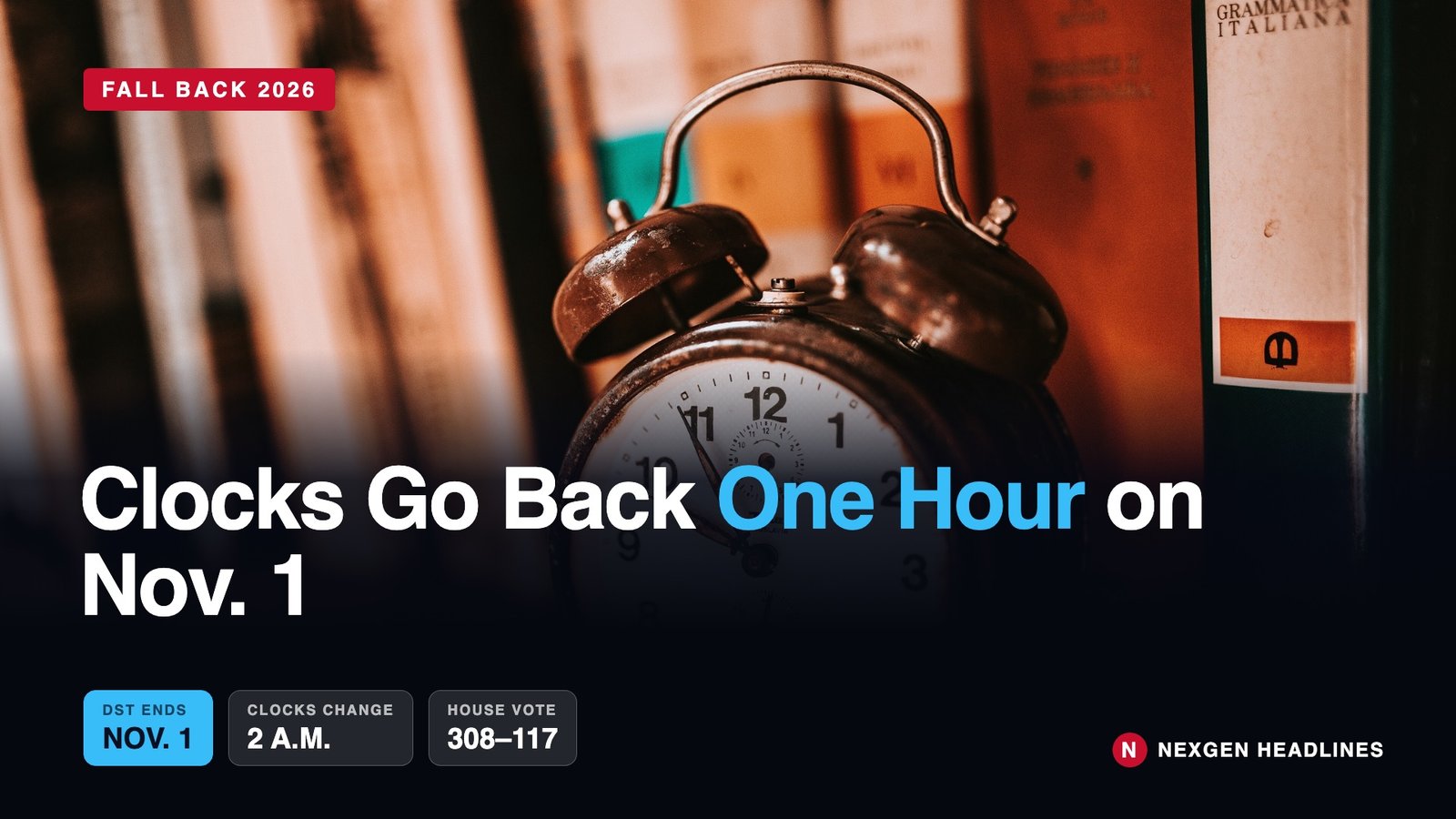
Quick answer: Daylight saving time ends at 2:00 a.m. on Sunday, Nov. 1, 2026. Clocks go back one hour to 1:00 a.m., so you gain an hour of sleep. Congress has not made daylight saving time permanent: the House passed a bill in July, but the Senate has not acted.
| Date | What happens |
|---|---|
| Sat., Oct. 31, 2026 | Halloween. Set manual clocks back before bed. |
| Sun., Nov. 1, 2026, 2:00 a.m. | Daylight saving time ends. Clocks fall back to 1:00 a.m. |
| Mid-November | Sunset around 5 p.m. in much of the country |
| Sun., March 14, 2027, 2:00 a.m. | Clocks spring forward one hour |
Twice a year Americans have the same conversation: “Wait, do the clocks go forward or back?” This fall the answer is back. Daylight saving time ends early on Sunday, November 1, 2026. That means an extra hour of sleep, darker evenings, and for many of us a groggy week while our bodies catch up.
There’s also a twist this year. The House voted in July to make daylight saving time permanent, which has many people wondering whether this is the last time change. Here’s exactly what happens, what that bill does and doesn’t mean, and practical ways to make the switch easier on you, your kids and even your pets.
Quick answer
- When: Sunday, November 1, 2026 at 2:00 a.m. local time
- What happens: clocks “fall back” to 1:00 a.m., so you gain one hour
- Who doesn’t change: Hawaii and most of Arizona, plus Puerto Rico, Guam, the U.S. Virgin Islands, American Samoa and the Northern Mariana Islands
- Next change: clocks spring forward on Sunday, March 14, 2027
What exactly happens on November 1?
At 2:00 a.m. on Sunday, November 1, clocks move back one hour to 1:00 a.m. Your phone, computer and most smartwatches update automatically. You’ll need to change:
- Car dashboard clocks
- Microwaves, ovens and coffee makers
- Older alarm clocks and wall clocks
- Some thermostats, sprinkler timers and security systems
The practical effect: sunrise comes about an hour earlier on the clock, and sunset comes about an hour earlier too. In much of the country, it’ll be getting dark around 5 p.m. by mid-November.
Is this the last time we change the clocks?
Probably not yet. Here’s where things stand:
- The Sunshine Protection Act (H.R. 139) would make daylight saving time permanent nationwide, meaning no more clock changes and later sunsets all year.
- The House passed it on July 14, 2026 by a vote of 308–117, according to Congress.gov.
- It then went to the Senate Commerce Committee, where it has not advanced as of mid-October. It would still need to pass the full Senate and be signed by the president.
So for 2026, nothing changes. Clocks fall back on November 1 as usual. The Senate passed a similar bill in 2022, but it died in the House, so this debate has been going on for a while. We’ll update this article if the Senate acts.
Why don’t we just pick one time?
Most people agree that switching back and forth is the worst option. They disagree about which time to keep. Supporters of permanent daylight time like brighter evenings for shopping, sports and outdoor activities. Many sleep scientists, including the American Academy of Sleep Medicine, prefer permanent standard time, because morning light better matches our body clocks. Under permanent daylight time, winter sunrises in some northern and western cities would come after 8:30 a.m.
How the time change affects your body
“Falling back” is easier than springing forward, since you gain an hour instead of losing one. But it can still throw you off, especially early risers, young kids and older adults. Common effects include:
- Waking up too early for several days
- Feeling sleepy earlier in the evening
- A mood dip as afternoons get dark, which is a trigger for seasonal depression in some people
Drivers should also be extra careful. The evening commute suddenly happens in the dark, which raises the risk for pedestrians, especially in the first couple of weeks.
8 tips to adjust faster
- Shift gradually. Starting a few days before, push bedtime 15 minutes later each night, so the change feels smaller.
- Get morning sunlight. Ten to fifteen minutes outside soon after waking is one of the strongest signals for resetting your body clock.
- Use the extra hour wisely. It’s tempting to stay up late Saturday night, which is also Halloween this year, but keeping your normal wake time Sunday helps you adjust faster.
- Move meals with the clock. Eat at the “new” times right away. Meal timing helps your internal clock shift.
- Get outside in the afternoon before it gets dark, even for a short walk.
- Dim screens in the evening. Bright light at night makes it harder to fall asleep at the new time.
- Consider a light therapy lamp if dark winter afternoons affect your mood. Talk to a doctor if low mood lasts more than a couple of weeks.
- Be patient. Most people adjust within a few days to a week.
For kids
Young children often wake at their old time, which means 5 a.m. instead of 6 a.m. In the days before the change, try shifting naps, meals and bedtime about 15 minutes later every night or two. Blackout curtains help a lot with early sunrises.
For pets
Dogs and cats don’t know about daylight saving time, but they know when dinner is. Shift their feeding and walk schedule gradually over a few days instead of all at once.
Use the time change as a home-safety reminder
Fire safety organizations have long encouraged people to use the clock change as a twice-a-year reminder to:
- Test smoke and carbon monoxide alarms and replace batteries if needed
- Check fire extinguishers
- Restock flashlights and emergency kits for winter
- Replace your furnace filter
Getting ready for colder weather? Our winterize your home and car checklist covers the rest.
Short on time? Flip through the quick visual version of this guide.
What the Sunshine Protection Act would actually change
The bill the House passed on July 14, 2026, would end the twice-a-year switch. Here is what it would and would not do, based on news reports of the House version:
- No more “fall back.” Clocks would stay on daylight time all year.
- States could opt out. The House version lets a state choose to stay on standard time instead, as Hawaii and most of Arizona do now.
- Not this year. Even if the Senate passed it tomorrow, Nov. 1, 2026, would still be a normal clock change. Reports say the last switch under the bill would be in March 2027.
Under current federal law, states can choose permanent standard time on their own. They cannot choose permanent daylight time without Congress. That is why more than a dozen states have passed “trigger” laws that only take effect if Congress acts, according to the National Conference of State Legislatures.
Your Nov. 1 time-change checklist
- Saturday night: set car, microwave and oven clocks back one hour.
- Check alarms. Phones update on their own, but older alarm clocks do not.
- Test smoke and CO alarms and swap batteries if needed.
- Reset timers on thermostats, sprinklers, porch lights and security cameras.
- Plan for dark commutes. Turn on headlights earlier and watch for walkers.
- Get morning light Sunday to help your body clock reset.
Made-up example (for illustration only)
These are made-up examples. Jen in Ohio has a 4-year-old who wakes at 6 a.m. If she does nothing, her son will wake at 5 a.m. after the change. So starting Wednesday, she moves his bedtime 15 minutes later each night. By Sunday he is close to the new schedule. Her neighbor Tom, a night-shift nurse, works through 2 a.m. on Nov. 1. He should check how his employer counts the repeated 1 a.m. hour on his timesheet.
Common mistakes to avoid
- Staying up late because you “gain an hour.” With Halloween on Saturday, it is tempting. Keep your normal Sunday wake time instead.
- Forgetting the car clock. It is the one most people miss for weeks.
- Missing a Sunday appointment. Double-check times for church, flights or medication schedules.
- Assuming the law changed. Viral posts claim this is the “last time change.” It is not law yet.
Also read: How to lower your heating bill this winter, because shorter, darker days also mean colder evenings at home.
Recommended products
- Sunrise alarm clock – Wakes you with gradual light on dark winter mornings.
- Light therapy lamp – Bright morning light at your desk or table.
- Blackout curtains – Help kids sleep past the earlier sunrise.
- Smoke and CO detector – Replace alarms that are more than 10 years old.
Disclosure: As an Amazon Associate, Nexgen Headlines earns from qualifying purchases. Prices and availability can change.
Frequently asked questions
Do we gain or lose an hour in November?
You gain an hour. At 2 a.m. on November 1, clocks go back to 1 a.m.
What date does daylight saving time end in 2026?
Sunday, November 1, 2026.
Which states don’t observe daylight saving time?
Hawaii and most of Arizona stay on standard time all year. The Navajo Nation in Arizona does observe DST. U.S. territories such as Puerto Rico and Guam also don’t change their clocks.
Did Congress make daylight saving time permanent?
Not yet. The House passed the Sunshine Protection Act in July 2026, but the Senate hasn’t voted on it as of mid-October 2026, so it’s not law.
When does daylight saving time start again?
Sunday, March 14, 2027, when clocks spring forward one hour.
Will my phone change automatically?
Yes, as long as automatic date and time is turned on in your settings. Double-check any alarms the night before.
Why do we have daylight saving time?
The U.S. first used it nationally during World War I to save energy, and the current rules come from the Uniform Time Act of 1966, updated in 2005. Whether it still saves meaningful energy today is debated.
The bottom line
Set a reminder for Saturday night, enjoy the extra hour, and get some morning sunlight on Sunday. Use the moment to test your smoke alarms, too. Whether or not this is one of the last clock changes depends on the Senate, but for this year, we fall back on November 1.
Last reviewed: Oct. 27, 2026
Sources: Congress.gov (H.R. 139), Fox 10 Phoenix, Texas Farm Bureau, NCSL, U.S. Department of Transportation, American Academy of Sleep Medicine.