
Updated Oct. 26, 2026: rewritten as a guide to the next solar eclipses visible from the US, how to watch safely and how to plan an eclipse trip on a budget.
Quick answer: The Aug. 12, 2026, total solar eclipse crossed Greenland, Iceland and Spain, not the US mainland. The next total solar eclipse in the continental US is Aug. 23, 2044, over parts of Montana, North Dakota and South Dakota. A much bigger one follows on Aug. 12, 2045, crossing the country from California to Florida, according to NASA. Always use ISO 12312-2 eclipse glasses for any partial phase.
This guide explains what the 2026 eclipse was, which US states will see the next total eclipses, how to watch safely and how to plan an eclipse trip without overspending. Eclipse travel can get expensive fast, especially for hotels inside the path of totality, so early planning matters more than anything else. We also cover partial and lunar eclipses you can see sooner, photography tips and how to spot fake glasses.
Upcoming total solar eclipses for US viewers
| Date | Path of totality in the US | Notes |
|---|---|---|
| Aug. 12, 2026 | None on the US mainland | Greenland, Iceland and Spain |
| Aug. 23, 2044 | Montana, North Dakota, South Dakota | Short US path; starts in Greenland and crosses Canada |
| Aug. 12, 2045 | California to Florida | Coast-to-coast path through about a dozen states |
| 2078 and 2099 | Parts of North America | Later total eclipses, per NASA projections |
Paths are based on NASA eclipse maps as reported by news outlets. Exact lines will be refined closer to each date.
What happened on Aug. 12, 2026
The 2026 total solar eclipse was the first total eclipse visible in mainland Europe since 1999. The Moon’s shadow crossed Greenland, Iceland and northern Spain. Many Americans traveled to see it, especially to Spain and Iceland.
Most of the US did not see it at all. That’s why the next two US eclipses, in 2044 and 2045, already have eclipse fans talking.
The 2045 “Great American Eclipse”
NASA maps show the Aug. 12, 2045, path crossing California, Nevada, Utah, Colorado, Kansas, Oklahoma, a small part of Texas, Arkansas, Louisiana, Mississippi, Alabama, Georgia and Florida. Because it falls in summer and crosses so many states, it could be one of the most-watched eclipses in US history.
If you live along that path, you may see totality from your own backyard. If not, it may be worth a road trip.
How to watch any solar eclipse safely: 6 rules
- Never look at the Sun without proper protection during partial phases. Regular sunglasses are not safe.
- Use eclipse glasses that meet ISO 12312-2. The American Astronomical Society keeps a list of reputable sellers.
- Check glasses for scratches or holes before use. Throw away damaged ones.
- Don’t use glasses with cameras, binoculars or telescopes. Those need special solar filters on the front.
- Remove glasses only during totality, when the Sun is fully covered. Put them back on as soon as the Sun reappears.
- Supervise children at all times.
Also read: Cheap Thanksgiving and Christmas Flights
Partial eclipses and other sky events to watch sooner
You don’t have to wait until 2044 to see something special. Partial solar eclipses and lunar eclipses are visible from parts of the US in many years. A lunar eclipse is safe to watch with your eyes alone. Check NASA’s eclipse website or a planetarium calendar for upcoming events in your area.
How to plan an eclipse trip on a budget
- Book lodging very early. Hotels in the path of totality often sell out or raise prices.
- Consider camping at state parks or campgrounds along the path.
- Stay outside the path and drive in the morning of the eclipse.
- Watch the weather. Have a backup location a few hours away.
- Pack food, water and a full tank of gas. Traffic after past eclipses has lasted hours.
- Buy eclipse glasses early from a reputable seller before prices and fakes spike.
Made-up example (not real people): These are made-up examples to show how planning pays off.
The Hendersons, Kansas live a few hours from the projected 2045 path. They plan to drive in before dawn, pack a picnic and bring certified eclipse glasses. Their total cost: gas and snacks.
Priya, New Jersey waits until the week before to book a hotel in the path. Rooms are sold out or very expensive, so she ends up watching only a partial eclipse at home.
Common eclipse mistakes
- Buying fake eclipse glasses from unknown online sellers.
- Looking at the partial phase without protection, even for a moment.
- Waiting too long to book lodging.
- Not having a weather backup plan.
- Pointing a phone camera at the Sun without a solar filter, which can damage the camera.
Why total eclipses are so rare in one place
A total solar eclipse happens somewhere on Earth about every 18 months. But the path of totality is narrow, usually less than about 120 miles wide, and much of it crosses oceans. Any single spot on Earth sees a total eclipse only once every few hundred years on average. That’s why people travel to see them.
What you’ll see during totality
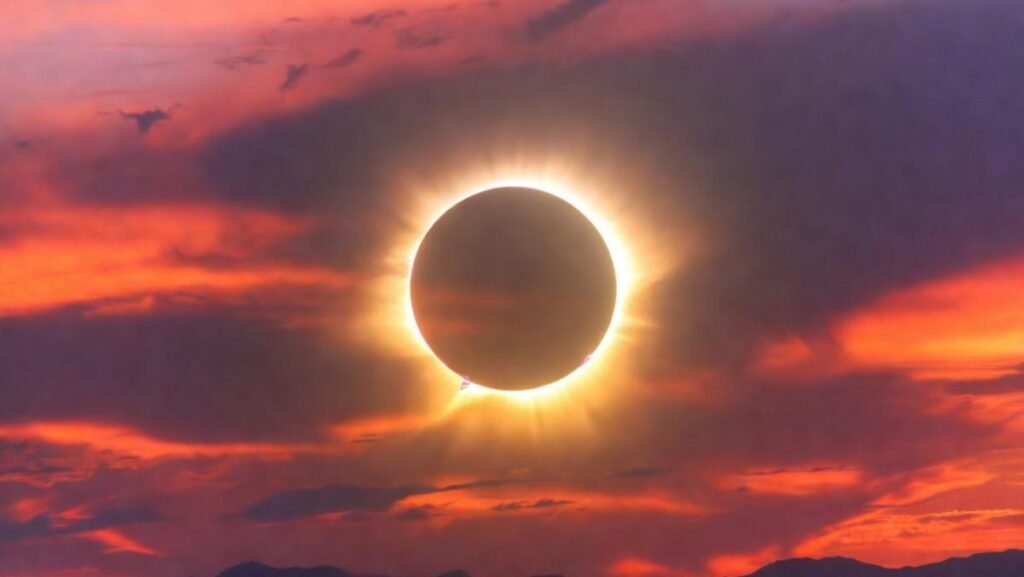
When the Moon fully covers the Sun, the sky darkens like late twilight. The temperature can drop. Bright planets and stars appear. Around the dark Moon, the Sun’s glowing outer atmosphere, the corona, becomes visible. Just before and after totality, you may see the “diamond ring” effect. It lasts only a few minutes, so plan to look up, not at your phone.
Eclipse photography tips
- Use a certified solar filter on any camera or phone lens during partial phases.
- Practice ahead of time by photographing the Sun with the filter on a normal day.
- Use a tripod to keep shots steady.
- Remove the filter only during totality to capture the corona, then put it back on.
- Don’t miss the moment. Many experienced eclipse watchers recommend setting the camera to shoot automatically so you can watch with your eyes.
Solar eclipse vs. lunar eclipse
| Feature | Solar eclipse | Lunar eclipse |
|---|---|---|
| What happens | The Moon blocks the Sun | Earth’s shadow falls on the Moon |
| When | Daytime, at new moon | Night, at full moon |
| Who can see it | Only people in a narrow path (for totality) | Anyone on the night side of Earth |
| Eye safety | Needs certified glasses except during totality | Safe to watch with your eyes |
| How long totality lasts | A few minutes | Can last over an hour |
How to spot fake eclipse glasses
- Buy from sellers on the American Astronomical Society’s reputable vendor list.
- Look for the manufacturer’s name and address printed on the glasses.
- Test them indoors: you should see nothing through them except very bright lights, like the Sun or a bright bulb, which should look dim.
- Be wary of very cheap packs from unknown online sellers right before an eclipse.
Should you travel abroad for an eclipse?
Some Americans don’t want to wait until 2044. Total eclipses happen somewhere in the world about every year and a half. Traveling abroad can be a once-in-a-lifetime trip, but it costs more. Before booking, consider:
- Passport and entry rules for the country you’ll visit.
- Weather odds along the path; clear skies matter most.
- Eclipse tour costs versus planning on your own.
- Travel insurance for cancellations and medical needs.
Teaching kids about eclipses
Eclipses are a great science lesson. NASA offers free activities for families. A simple pinhole projector made from a cardboard box lets kids watch the partial phase safely, without looking at the Sun directly.
Recommended products
- ISO 12312-2 eclipse glasses
- Solar filters for cameras
- Beginner telescopes with solar filters
- Portable camping chairs
Disclosure: As an Amazon Associate, Nexgen Headlines earns from qualifying purchases.
FAQ
When is the next total solar eclipse in the US?
Aug. 23, 2044, over parts of Montana, North Dakota and South Dakota. A coast-to-coast eclipse follows on Aug. 12, 2045.
Could I see the Aug. 12, 2026, eclipse from the US?
No, not from the US mainland. Totality crossed Greenland, Iceland and Spain.
Are regular sunglasses safe for an eclipse?
No. Only glasses or viewers that meet the ISO 12312-2 standard are safe for looking at the partial Sun.
Can I look at totality without glasses?
Only during the brief total phase when the Sun is completely covered. Put glasses back on as soon as any sunlight returns.
Which states will see the 2045 eclipse?
NASA maps show a path from California through Nevada, Utah, Colorado, Kansas, Oklahoma, a sliver of Texas, Arkansas, Louisiana, Mississippi, Alabama, Georgia and Florida.
Bottom line
The 2026 eclipse skipped the US, but two big ones are coming: Aug. 23, 2044, in the northern Plains, and the coast-to-coast Aug. 12, 2045, eclipse. Mark your calendar, buy certified glasses from a trusted seller and plan travel early. A few minutes of totality is worth the planning.
Last reviewed: Oct. 26, 2026. Future eclipse paths are projections based on NASA maps.
Sources: NASA Eclipses; American Astronomical Society: safe solar viewers; WTOP / AP; KWTX.
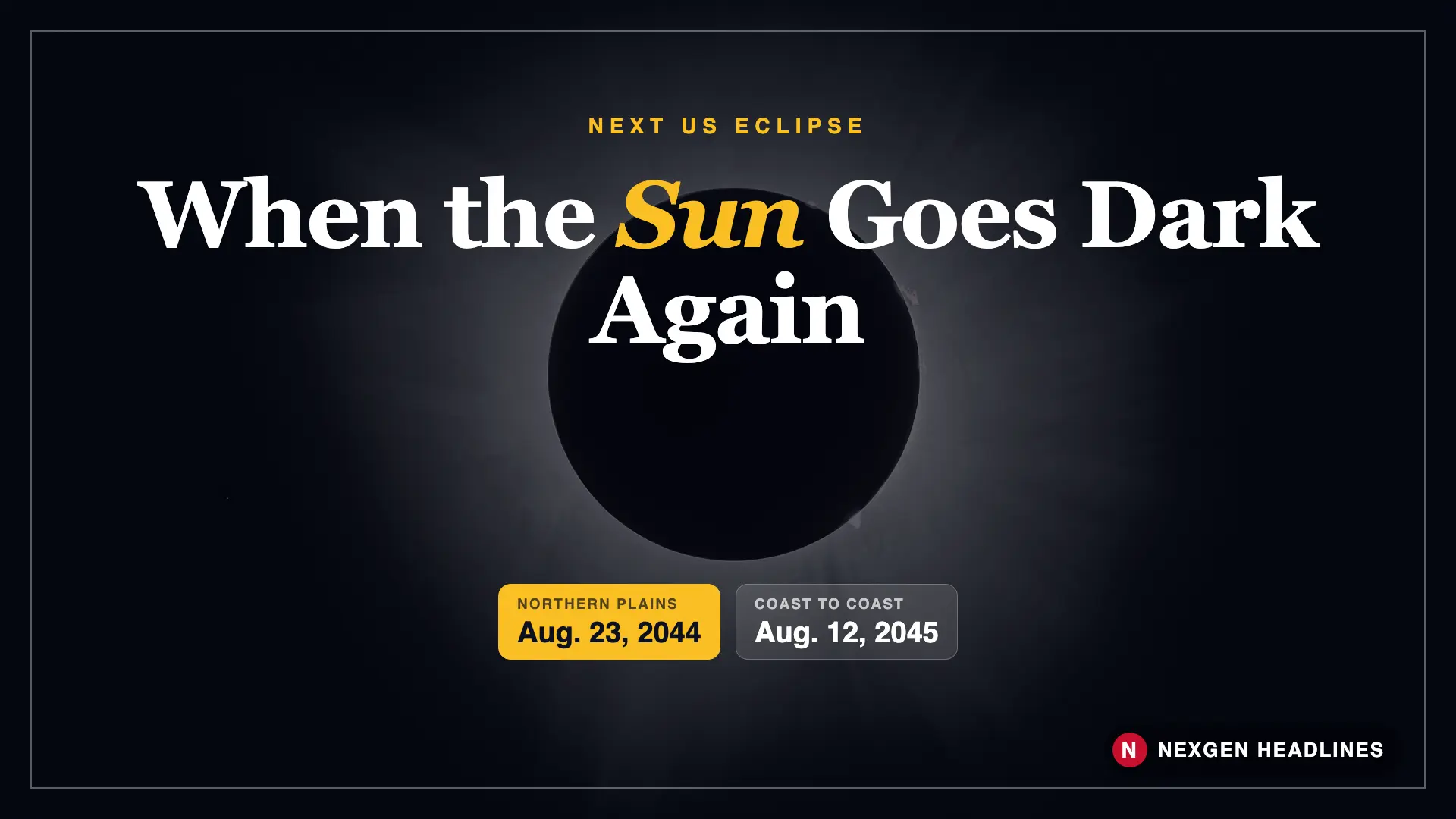
Featured image: Corona during the 2024 total solar eclipse. Photo: Brucewaters / Wikimedia Commons, CC BY 4.0; edited by Nexgen Headlines.