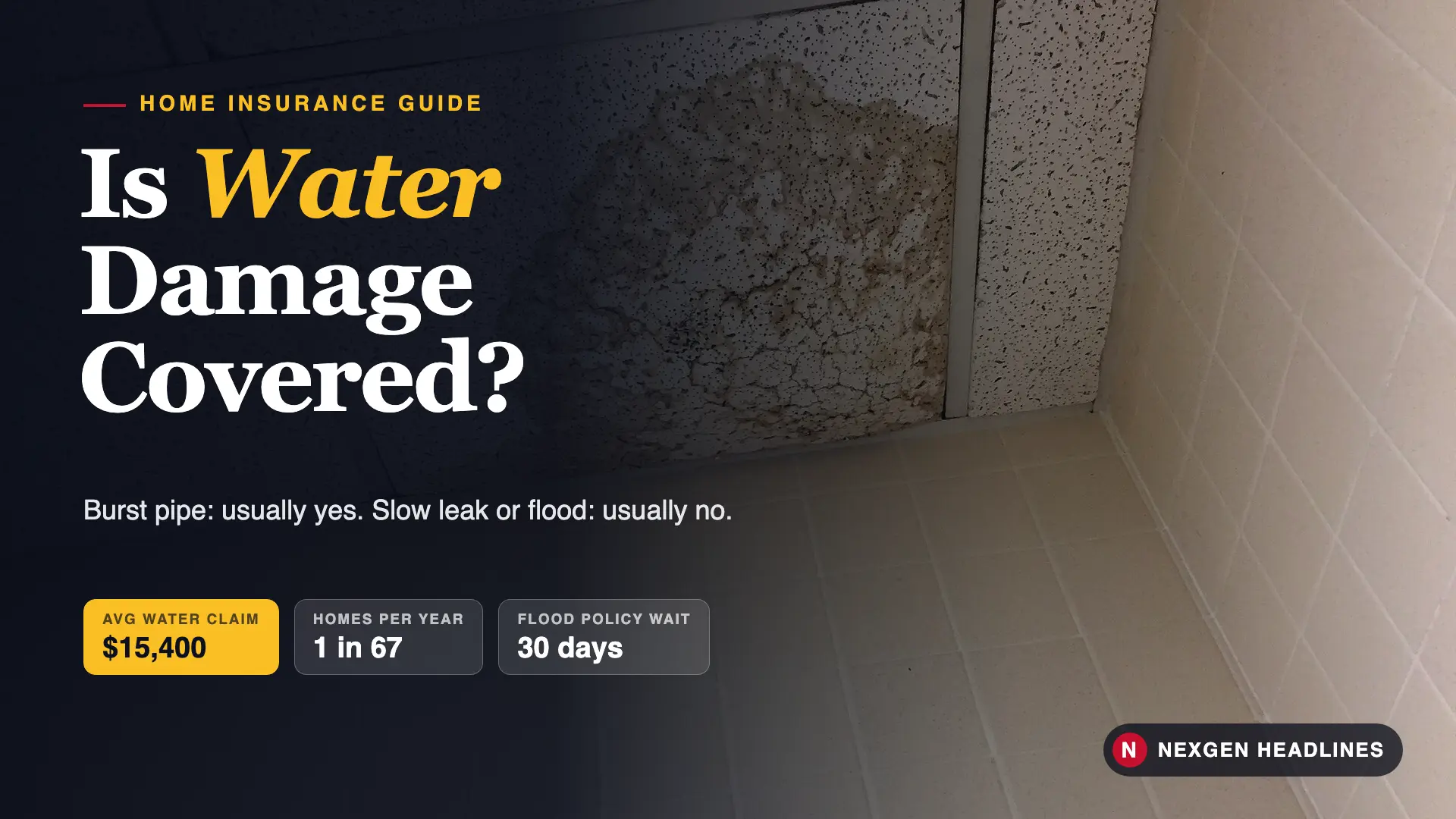

Quick answer: Homeowners insurance usually covers water damage that is sudden and accidental, like a burst pipe or a washing machine hose that splits. It usually does not cover slow leaks, flooding or sewer backups unless you added extra coverage. Flood needs a separate policy, and most new flood policies have a 30-day waiting period.
Water is one of the most common reasons people file a home insurance claim. The rules feel confusing because the same wet floor can be covered or denied. It all depends on where the water came from and how fast it happened.
Water damage coverage at a glance
| What happened | Standard policy (HO-3) | What you need |
|---|---|---|
| Pipe bursts suddenly | Usually covered | Standard policy |
| Washer, dishwasher or water heater fails suddenly | Usually covered (damage, not the appliance) | Standard policy |
| Pipe freezes and bursts in a heated home | Usually covered | Standard policy, plus proof you kept heat on |
| Slow leak under a sink for months | Usually not covered | Maintenance; fix leaks fast |
| Roof leak from old, worn shingles | Often denied | Maintenance records help |
| Sewer or drain backs up | Not covered by default | Water backup endorsement |
| Flood, storm surge or rising water | Not covered | Flood insurance (NFIP or private) |
| Mold from a covered burst pipe | Sometimes, often with a limit | Check your policy’s mold section |
These are general rules. Your own policy wording decides the claim, so read the “water damage,” “exclusions” and “endorsements” sections of your declarations page.
Why “sudden and accidental” matters so much
Insurers draw a hard line between an accident and wear and tear. A pipe that bursts on a Tuesday night is an accident. A pipe that dripped behind a wall for six months is treated as a maintenance problem.
The water in your house may look the same in both cases. The difference is time. If an adjuster finds rot, rust stains or mold that took months to grow, expect questions. That is why fast action matters.
The Insurance Information Institute (Triple-I) says water damage and freezing caused about 22.6% of homeowners losses in 2023. From 2019 to 2023, about 1.5 claims per 100 insured homes each year came from water or freezing, or roughly 1 in 67 homes. The average claim was about $15,400.
What a standard policy usually covers
- Burst pipes. Damage to floors, walls, ceilings and your belongings is usually covered. The repair to the pipe itself may not be.
- Appliance failures. If the dishwasher line snaps and floods the kitchen, the water damage is usually covered. The broken dishwasher usually is not.
- Frozen pipes. Usually covered if you kept the home heated or shut off and drained the water while away.
- Water from firefighting. Water used to put out a fire is part of the fire claim.
- Ice dams and storm leaks. If wind or hail suddenly damages your roof and rain gets in, the interior damage is often covered.
- Extra living costs. If your home is unlivable during repairs from a covered loss, “loss of use” coverage may pay for a hotel and meals.
What a standard policy usually does not cover
- Floods. FEMA’s flood program says most homeowners and renters policies do not cover flood damage. FEMA also says just one inch of floodwater can cause roughly $25,000 in damage to a home.
- Sewer and drain backup. This needs an add-on called a water backup endorsement.
- Slow leaks and seepage. Drips, sweating pipes and groundwater seeping through a basement wall are usually excluded.
- Neglect. A known leak you ignored, or a heater left off in a vacant home, can lead to a denial.
- The broken item itself. Policies pay for the damage the water caused, not for the worn-out water heater or pipe.
Also read: Winterize Your Home and Car: A Simple Checklist
Flood insurance: the gap most people miss
Flood coverage is sold mostly through the National Flood Insurance Program (NFIP), run by FEMA, and by some private insurers. Key facts from FEMA:
| NFIP item | Amount or rule |
|---|---|
| Building coverage (1–4 family home) | Up to $250,000 |
| Contents coverage | Up to $100,000 |
| Waiting period | Usually 30 days before the policy starts |
| No waiting period | When bought with a new mortgage, or a mortgage increase, extension or renewal |
| Disaster declaration needed? | No. Flood policies pay with or without one |
The 30-day wait is why you cannot buy flood coverage when a storm is already in the forecast. You can get a quote through your home insurance agent or at FloodSmart.gov.
How to file a water damage claim, step by step
- Stop the water. Shut off the main valve. Turn off power to wet areas if it is safe.
- Take photos and video before you move anything. Show the source, the water line and damaged items.
- Prevent more damage. Most policies require “reasonable” steps, like fans, a wet vac or a tarp. Keep receipts. These costs are often reimbursed.
- Call your insurer quickly. Many policies require “prompt” notice. Write down the claim number and the adjuster’s name.
- Do not throw away damaged items until the adjuster has seen them or says it is OK.
- Get a written repair estimate from a licensed contractor or a water mitigation company.
- Review the settlement. Check whether you are paid replacement cost or actual cash value, and subtract your deductible.
- Appeal if denied. Ask for the denial in writing with the exact policy language. If you disagree, contact your state insurance department.
Made-up examples to show how this works
These are made-up examples, not real people.
Example 1: covered. A supply line under a bathroom sink bursts while a family is at work. Water soaks the hallway floor and drywall. The repair estimate is $9,000. With a $1,000 deductible, the insurer pays about $8,000. The plumber’s bill to replace the hose is not covered.
Example 2: denied. A homeowner notices a soft spot in the kitchen floor near the dishwasher. The adjuster finds rot and old mold. The leak ran for months. The claim is denied as gradual damage.
Example 3: wrong policy. Heavy rain floods a basement from the outside. The homeowner has no flood policy and no water backup endorsement. The standard policy pays nothing for the basement.
How to lower your risk (and your premium)
- Install leak sensors near the water heater, washer, dishwasher and sinks. Some insurers give a discount for smart water shutoff valves. Ask yours.
- Replace rubber washer hoses with braided steel ones.
- Know where your main shutoff valve is and make sure it turns.
- Keep the heat at 55°F or higher when you travel in winter, and insulate pipes on outside walls.
- Clean gutters so water drains away from the foundation.
- Test your sump pump before the rainy season.
- Add a water backup endorsement if you have a finished basement. It is often one of the cheaper add-ons.
Common mistakes that cost homeowners money
- Waiting to report. A delay can turn a covered accident into “neglect.”
- Cleaning up before taking photos. No proof means a harder claim.
- Assuming renters are covered by the landlord. Your landlord’s policy covers the building, not your stuff. Renters need their own policy.
- Buying flood insurance too late. The 30-day wait applies in most cases.
- Not knowing the deductible. A $2,500 deductible means small leaks may not be worth a claim.
Recommended products
Simple tools that catch leaks early:
- Water leak detector sensors
- Smart water shutoff valves
- Braided steel washing machine hoses
- Foam pipe insulation
Disclosure: As an Amazon Associate, Nexgen Headlines earns from qualifying purchases.
FAQ
Does homeowners insurance cover a leaking roof?
It depends on why it leaks. Sudden storm damage, like a tree limb or hail, is often covered. A leak from old, worn shingles is usually treated as maintenance and denied.
Is mold covered?
Mold that results from a covered, sudden event may be covered, but many policies set a low dollar limit. Mold from long-term humidity or a slow leak is usually excluded. Check your policy’s mold section.
Will a water claim raise my premium?
It can. Insurers share claim history through databases, and some raise rates after a water claim. For small losses close to your deductible, paying yourself may be cheaper over time.
Does renters insurance cover water damage?
Renters insurance usually covers your belongings from sudden water events, like a neighbor’s burst pipe. It does not cover flood unless you buy flood contents coverage.
Can I buy flood insurance right before a hurricane?
You can buy it, but most NFIP policies do not start for 30 days. Buy it well before storm season.
Bottom line
If the water came suddenly from inside your home, you are probably covered. If it came slowly, or from outside and below, you probably need flood insurance or a water backup endorsement. Spend 10 minutes with your policy today, and fix any drip before it becomes a denied claim.
Last reviewed: Oct. 26, 2026. This guide is general information, not insurance or legal advice. Coverage depends on your policy and state.
Sources: Insurance Information Institute: homeowners claims facts; FEMA FloodSmart (NFIP); FEMA: flood insurance; NAIC consumer insurance resources.