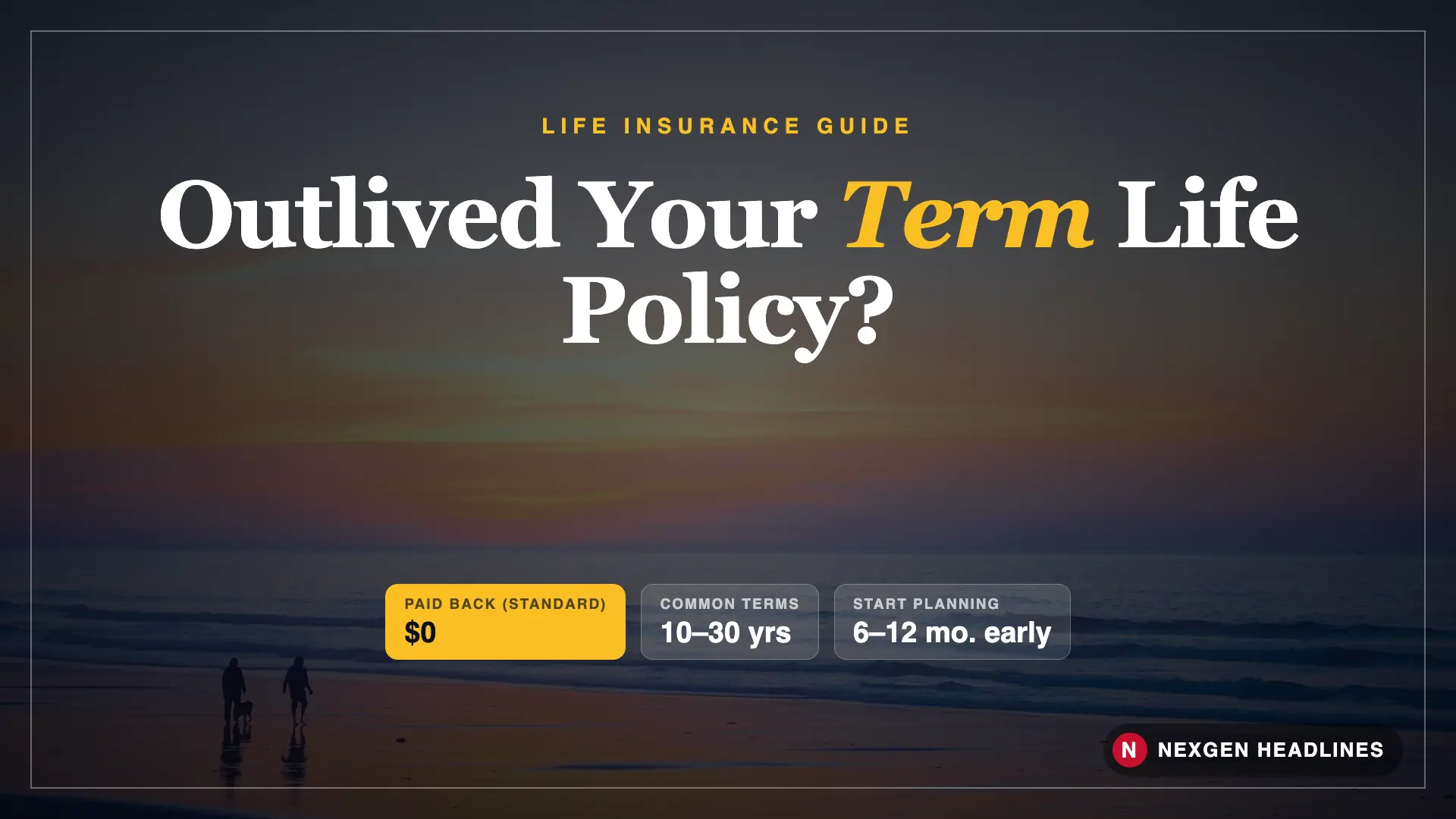

Quick answer: If you outlive a term life insurance policy, the coverage simply ends, and a standard policy pays you nothing back. You usually have four choices: renew it at a much higher price, convert it to permanent coverage if your policy allows, buy a new policy, or let it go. Start planning 6 to 12 months before the end date.
Outliving your policy is good news. You are alive, and your family never needed the payout. But it still raises real money questions, especially if you have a mortgage, a spouse or kids who rely on your income.
Your 4 options at a glance
| Option | What happens | Medical exam? | Cost | Best for |
|---|---|---|---|---|
| Let it lapse | Coverage ends, no payout | No | $0 from now on | No debts or dependents left |
| Renew | Same coverage, often year to year | Usually no | Much higher, rises each year | A short bridge while you shop |
| Convert | Switch to whole or universal life | Usually no | Higher, but locked in | Health got worse; you need lifelong cover |
| Buy new | New term or permanent policy | Usually yes | Based on your age and health now | Healthy people who still need coverage |
What “term” really means
Term life insurance covers you for a set number of years. Common terms are 10, 20 or 30 years. If you die during the term, your beneficiaries get the death benefit. If you are alive when the term ends, the coverage stops.
That is why term is much cheaper than permanent life insurance. You are paying only for protection, not for savings. A standard term policy does not build cash value, and it does not refund your premiums.
The one exception is return of premium term. These policies refund the premiums you paid if you outlive the term. They cost noticeably more than plain term, so check your policy to see which type you have.
Option 1: Let the policy end
For many people, this is the right answer. Term life is meant to cover your most expensive years: young kids, a big mortgage and lots of debt. By the time a 20- or 30-year term ends, those needs may be gone.
Ask yourself three questions:
- Would anyone struggle financially if you died next year?
- Is your mortgage paid off or nearly paid off?
- Do you have savings and retirement accounts large enough to support a spouse?
If the answers are no, yes and yes, you may not need more coverage. Make sure you have money set aside for final expenses, and keep your beneficiary forms up to date on retirement accounts.
Option 2: Renew the policy
The National Association of Insurance Commissioners (NAIC) explains in its Life Insurance Buyer’s Guide that most term coverage can be renewed at the end of the term, even if your health has changed. But the new premiums are higher.
The NAIC tells buyers to ask what the premiums will be before renewing, and whether the right to renew ends at a certain age. Renewal prices are based on your current age, so they can jump sharply and keep rising each year.
Renewal works best as a short-term bridge. For example, you might renew for a year while you apply for a new policy, so you are never without coverage.
Also read: How to Build an Emergency Fund From Scratch
Option 3: Convert to permanent insurance
Many term policies include a conversion option. It lets you switch to whole life or universal life without new medical underwriting. This is valuable if your health has changed, for example after a heart problem, diabetes or cancer.
Watch for three limits:
- A deadline. Conversion is often allowed only until a certain policy year or age. It may end before the term itself does.
- A higher price. Permanent insurance costs much more than term, because it lasts for life and can build cash value.
- Limited choices. Some insurers allow conversion only to certain products.
Find the “conversion” section in your policy, or call the insurer and ask for the exact last date you can convert.
Option 4: Buy a new policy
If you are still healthy, a new term policy may be cheaper than renewing. You will likely need a medical exam or health questions, and your price will reflect your current age.
Shop at least 6 to 12 months before your term ends. Underwriting can take weeks. Do not cancel the old policy until the new one is approved and in force.
How much coverage do you still need?
There is no single right number, but a simple check helps. Add up what your family would need if you died next month, then subtract what they already have.
| Add these up | Then subtract these |
|---|---|
| Mortgage balance and other debts | Savings and investments |
| Years of income your family would need | Retirement accounts your spouse would inherit |
| College costs you want to cover | Life insurance through work, if it will continue |
| Funeral and final expenses | Expected survivor benefits |
If the result is close to zero, you may not need new coverage. If it is still large, keep some protection in place. You can also check the Social Security Administration’s website to see what survivors benefits your family might get.
Questions to ask your insurer
- What is the exact end date of my coverage?
- Can I renew, and what would the premium be for the next five years?
- Is there an age after which I cannot renew?
- Does my policy have a conversion option, and what is the last date to use it?
- Which permanent products can I convert to, and what would they cost?
- Can I convert only part of the coverage to keep the cost down?
- Is this a return of premium policy?
Ask for the answers in writing, by email or letter, so you have a record when you compare options.
Step-by-step plan before your term ends
- Find your policy and note the exact end date, the face amount and any renewal or conversion rules.
- List who depends on you and what debts remain, such as a mortgage, car loan or co-signed loans.
- Add up your assets: savings, retirement accounts, home equity and any work life insurance.
- Decide how much coverage you still need, if any, and for how many years.
- Get prices for renewal, conversion and a new policy, side by side.
- Apply early if you want new coverage, and keep the old policy until the new one starts.
- Update beneficiaries on every policy and account.
Made-up examples to show how this works
These are made-up examples, not real people.
Example 1: let it go. A 62-year-old bought a 30-year, $500,000 policy at 32. The house is paid off, the kids are grown and the couple has solid retirement savings. They let the policy end and keep a small savings fund for final costs.
Example 2: convert. A 54-year-old’s 20-year term ends next year. Two years ago, they had a heart attack. A new policy would be hard to get. They convert part of the coverage before the conversion deadline, with no new exam.
Example 3: buy new. A healthy 45-year-old’s 15-year term is ending, but they still have a young child and a 25-year mortgage. A new 20-year term policy costs far less than renewing year to year.
Mistakes to avoid
- Missing the conversion deadline. Once it passes, you lose that no-exam option for good.
- Letting coverage lapse before a new policy starts. A gap could leave your family unprotected.
- Auto-renewing without checking the price. Some renewal bills come as a shock.
- Forgetting work coverage. Group life insurance through a job often ends when you leave or retire.
- Buying more than you need. Coverage needs often shrink as debts are paid off.
Recommended products
Simple ways to keep your policy and family papers organized:
- Fireproof document boxes
- “In case of emergency” family planners
- Accordion file organizers
- Books on retirement planning
Disclosure: As an Amazon Associate, Nexgen Headlines earns from qualifying purchases.
FAQ
Do I get my money back if I outlive term life insurance?
Not with a standard term policy. You get money back only if you bought a return of premium policy or rider. Check your policy documents to see which you have.
Can I extend my term life insurance?
Many policies let you renew, often year to year, but at a higher price based on your current age. Some stop allowing renewal at a certain age.
Do I need a medical exam to convert?
Usually not. Conversion is designed to let you keep coverage without new medical underwriting, as long as you convert before the deadline.
Is it worth getting life insurance after 60?
It can be, if someone still depends on your income or you have debts they would inherit responsibility for, such as a co-signed loan. If not, savings may cover final expenses instead.
What happens to the premiums I paid?
With standard term, they paid for the protection you had. Your family was covered the whole time, which is what the money bought.
Bottom line
Outliving term life insurance means the policy did its job. Before it ends, decide whether anyone still depends on you. If not, let it go. If yes, compare renewal, conversion and a new policy early, and never leave a gap in coverage.
Last reviewed: Oct. 26, 2026. This guide is general information, not insurance, tax or financial advice. Policy terms vary by insurer and state.
Sources: NAIC Life Insurance Buyer’s Guide; NAIC consumer resources; Experian: what happens when term life insurance expires; your state insurance department.