
Quick answer: To negotiate a medical bill, ask for an itemized bill, check it against your insurer’s Explanation of Benefits (EOB), dispute any errors, ask about financial assistance, and then offer a lump sum or ask for a payment plan you can afford. Get every deal in writing before you pay.
The first number on a medical bill is rarely the final number. Billing errors are common, nonprofit hospitals must offer financial help, and federal rules give you dispute rights. Here is the full process, step by step.
Medical bill negotiation at a glance
| Step | What to do | Why it matters |
|---|---|---|
| 1 | Ask for an itemized bill with billing codes | Summary bills hide duplicate or wrong charges |
| 2 | Compare it with your EOB | You should owe only the “patient responsibility” amount |
| 3 | Check your legal rights | No Surprises Act and nonprofit hospital rules may cut the bill |
| 4 | Apply for financial assistance | Nonprofit hospitals must have a written aid policy |
| 5 | Call and negotiate | Lump-sum offers and payment plans are often accepted |
| 6 | Get it in writing and protect your credit | A written deal stops surprise collections later |
Step 1: Get the itemized bill
Many providers send only a summary that says “hospital services” and a total. That is not enough to check anything.
Call the billing office and ask for a fully itemized bill with CPT and revenue codes. You have a right to see what you are paying for.
Keep a simple call log. Write down the date, the name of the person you spoke with, and any reference number. This log is your best tool if a dispute drags on.
What to look for on the itemized bill
- Duplicate charges: the same test or supply listed twice.
- Services you did not get: a medicine you refused, or a test that was canceled.
- Wrong dates: charges for days after you went home.
- Upcoding: a more complex (and pricier) visit code than your visit really was.
- “Unbundled” charges: items billed one by one that should be part of one package price.
You can look up what a code means with a quick search, or ask the billing office to explain any line you do not understand.
Step 2: Compare the bill with your EOB
If you have insurance, your insurer sends an Explanation of Benefits after each claim. It is not a bill. It shows what the provider charged, what the plan paid, and what you owe.
The amount on your bill should match the “patient responsibility” line on the EOB. If the bill is higher, call the provider first. Ask why they are billing you more than the insurer says you owe.
If the claim was denied, do not pay yet. Under the Affordable Care Act, you generally have 180 days after a denial notice to file an internal appeal with your health plan. If the appeal fails, you can usually ask for an external review by an independent reviewer. HealthCare.gov explains both steps.
Step 3: Know your rights before you call
Several federal rules can lower a bill or stop it outright. Knowing them changes the tone of the call.
The No Surprises Act
Since Jan. 1, 2022, the No Surprises Act protects most people with job-based or marketplace coverage from surprise out-of-network bills. That includes most emergency care and some care from out-of-network doctors at in-network hospitals.
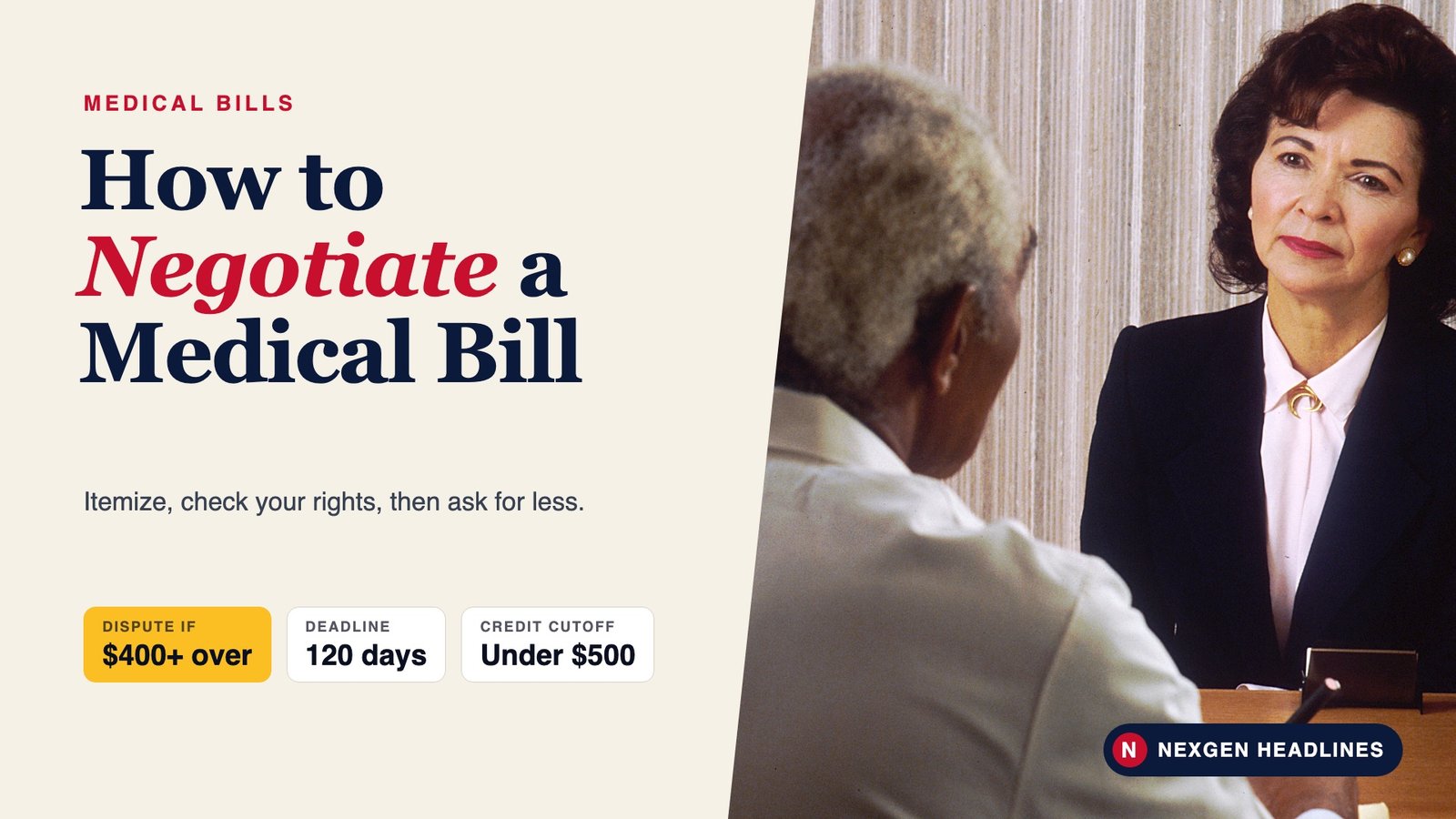
If you are uninsured or paying yourself, providers must give you a good faith estimate before scheduled care. According to CMS, you can dispute the bill if it is at least $400 more than that estimate. The bill must be dated within the last 120 calendar days, and there is a $25 fee to start the process.
Questions go to the No Surprises Help Desk at 1-800-985-3059.
Nonprofit hospital rules
Most U.S. community hospitals are nonprofits, according to the American Hospital Association. Under Section 501(r) of the tax code, they must have a written financial assistance policy and a plain-language summary of it. They also must make reasonable efforts to check if you qualify before taking “extraordinary collection actions,” such as reporting you to credit bureaus or suing.
The IRS rules give you at least 240 days from the first post-discharge bill to apply for help. Many hospitals give free or reduced-cost care to families earning up to two or three times the federal poverty level, but each hospital sets its own limits.
Hospital price transparency
Since Jan. 1, 2021, hospitals must post their standard charges online, including cash prices and negotiated rates. If your bill is far above the hospital’s posted cash price, that is a strong talking point.
Also read: How to Raise Your Credit Score
Step 4: Apply for financial assistance
Financial aid is not automatic. You have to ask. Use this script: “Do you have a financial assistance or charity care policy, and can you send me the application?”
Most applications ask for:
- Recent pay stubs or your last tax return
- Household size
- Bank statements (sometimes)
- A copy of the bill and your account number
Ask the billing office to put the account on hold while the application is reviewed. Write down who agreed to the hold.
Even for-profit hospitals and doctor groups often have hardship discounts. They may not advertise them, so ask directly.
Step 5: Call and negotiate
Once errors are fixed and aid is settled, you can negotiate what is left. Be calm and specific.
- Ask for discounts: “Are there any self-pay, prompt-pay or hardship discounts I qualify for?”
- Offer a lump sum: “If I pay today, what is the lowest amount you will accept?” Start lower than you can afford.
- Use the price data: “Your posted cash price for this service is lower. Can you match it?”
- Ask for a payment plan: Many providers offer interest-free plans. Pick a monthly amount you can actually keep up with.
- Ask for a supervisor if the first person says no. Billing staff often have limits on what they can approve.
A made-up example of how this can go
These are made-up examples to show the process, not real people.
Maria, who is uninsured, gets a $3,900 bill after an urgent care visit and lab work. She asks for an itemized bill and finds a lab panel billed twice. That fix drops the bill to $3,350.
She then asks about self-pay discounts and is offered 30% off, bringing it to $2,345. She offers $1,800 if she can pay in full that week. The office counters at $2,000, and she gets the deal in writing before paying.
Dave has insurance. His bill says he owes $1,200, but his EOB says $450. One call shows the provider had not yet applied the insurer’s payment. His corrected bill is $450, and he sets up a $75-a-month plan with no interest.
Step 6: Get it in writing and protect your credit
Never pay a negotiated amount until you have the agreement in writing. An email from the billing office is fine. It should say the amount, the account number, and that the balance will be “paid in full” after payment.
Medical debt and your credit report
The three big credit bureaus, Equifax, Experian and TransUnion, changed how they report medical debt in 2022 and 2023:
- Paid medical collections are removed from credit reports.
- Unpaid medical debt does not show up until it has been in collections for one year.
- Medical collections under $500 are not reported at all.
A CFPB rule that would have removed most medical debt from credit reports was vacated by a federal court in Texas in July 2025, so larger unpaid debts can still appear. Some states have their own limits.
You can check your reports for free at AnnualCreditReport.com. If a medical debt shows up wrongly, dispute it with the bureau.
Common mistakes to avoid
- Paying right away. Once you pay, you lose most of your leverage.
- Ignoring the bill. Silence can push the account to collections. Call, even if you cannot pay yet.
- Putting it on a credit card. You turn an interest-free medical bill into high-interest card debt.
- Agreeing to a plan you cannot keep. A missed payment can cancel the deal.
- Taking a medical credit card at the front desk. Some have deferred interest that hits hard if you do not pay it off in time.
- Not getting a written deal. Verbal promises are hard to prove later.
What if the bill is already in collections?
You still have options. Under the Fair Debt Collection Practices Act, you can ask the collector to validate the debt. Send a written request within 30 days of their first notice.
You can also call the original provider. Sometimes they will pull the account back and work with you, especially if you applied for financial aid.
Collectors often settle for less than the full amount. As always, get the settlement in writing first. If a collector harasses you, you can report it to the CFPB.
Should you use a bill-negotiation service?
Medical bill advocates and negotiation companies can help with large or complex bills. Most charge a flat fee, an hourly rate, or a share of what they save you.
For a bill under a few thousand dollars, you can usually do the same work yourself with a few phone calls. For a large hospital stay or a stack of denied claims, a professional advocate may be worth it. Ask for the fee in writing first.
Recommended products
A few simple tools make tracking bills and calls easier:
- Accordion file organizer for bills and EOBs
- Monthly bill organizer and budget planner
- Portable document scanner for saving records
- Call log notebook
Disclosure: As an Amazon Associate, Nexgen Headlines earns from qualifying purchases.
FAQ
Can I negotiate a medical bill if I have insurance?
Yes. Start by checking the bill against your EOB, since errors are common. You can also ask for prompt-pay discounts or a payment plan on your share of the cost.
How much can I usually get taken off?
There is no set amount. Fixing errors and applying for financial aid often saves the most. Lump-sum offers can also work, but results vary by provider.
Will negotiating hurt my credit?
No. Negotiating does not affect your credit. Unpaid medical collections under $500 are not reported, and paid medical collections are removed.
Can a hospital refuse a payment plan?
Yes, there is no federal rule that forces a plan. Still, most providers prefer getting paid over time to sending the bill to collections. Some states require hospitals to offer plans.
What if I was billed more than my good faith estimate?
If you are uninsured or self-pay and the bill is $400 or more above the estimate, you can file a dispute with CMS within 120 days of the bill date. The fee is $25.
Bottom line
Treat every medical bill as a first offer. Get it itemized, match it to your EOB, ask about financial help, and then negotiate what is left. A few calls and a written deal can save you hundreds, sometimes thousands, of dollars.
Last reviewed: Oct. 24, 2026. This guide is general information, not legal or financial advice.
Sources: CMS — Medical Bill Rights (No Surprises Act); CMS — Dispute a Bill; IRS — Requirements for 501(c)(3) Hospitals, Section 501(r); HealthCare.gov — Appeal an Insurance Decision; CFPB — Debt Collection; AnnualCreditReport.com.