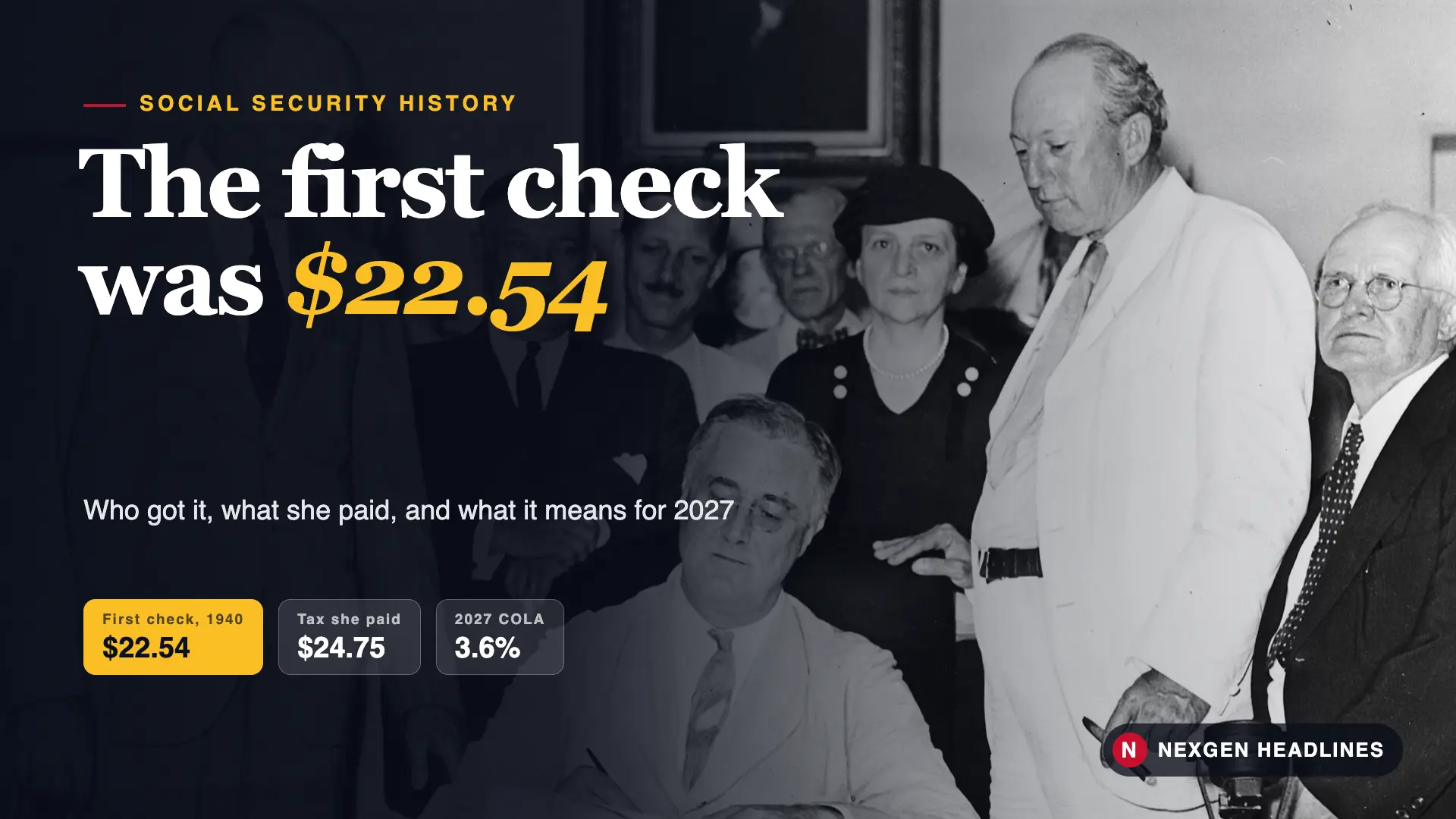

Quick answer: The first monthly Social Security check went to Ida May Fuller, a retired legal secretary from Ludlow, Vermont. It was check No. 00-000-001, dated Jan. 31, 1940, for $22.54. She had paid just $24.75 in Social Security tax, lived to 100 and collected $22,888.92.
Her story explains a lot about how Social Security still works today. It also explains why your paycheck loses 6.2% and why people worry about the trust funds. Here is the whole story, with every number checked against Social Security Administration (SSA) records.
Watch: the full story in 8 minutes, with Sam, Maya and Joe (illustrated characters, AI voices).
| At a glance | The facts |
|---|---|
| Who got the first monthly check | Ida May Fuller of Ludlow, Vermont |
| Check number and date | No. 00-000-001, dated Jan. 31, 1940 |
| Amount | $22.54 |
| Tax she paid | $24.75, over about three years (1937 to 1939) |
| Total she collected | $22,888.92 before she died in 1975, at age 100 |
| Law that created it | Social Security Act, signed Aug. 14, 1935 |
| Your 2027 raise | 3.6% cost-of-living adjustment (COLA), starting with January 2027 checks |
Who was Ida May Fuller?
Ida May Fuller was born on Sept. 6, 1874, on a farm outside Ludlow, Vermont. According to the SSA Historian’s Office, she went to school in Rutland, where one of her classmates was Calvin Coolidge.
She worked as a schoolteacher first. In 1905, she became a legal secretary. She never married and had no children. Friends and family called her “Aunt Ida.”
She was not trying to make history. She filed her claim on Nov. 4, 1939, after stopping by the Social Security office in Rutland while running an errand. The SSA quotes her as saying she knew she had been paying for “something called Social Security” and wanted to ask about it.
How did she get check No. 00-000-001?
It came down to paperwork. Claims were grouped in batches of 1,000 and sent to the Treasury Department on certification lists. Her claim was the first one on the first list. So the Treasury issued her the very first monthly check.
It was dated Jan. 31, 1940, and paid $22.54. She was 65 when her benefits started.
How much did she pay in, and how much did she get?
This is the part that makes people’s jaws drop. SSA records show her covered wages from 1937 to 1939 totaled $2,475. At the 1% tax rate of the time, her total Social Security tax was $24.75.
| Ida May Fuller | Amount |
|---|---|
| Wages taxed (1937 to 1939) | $2,475 |
| Social Security tax she paid | $24.75 |
| First monthly check | $22.54 |
| Total benefits collected (1940 to 1975) | $22,888.92 |
Her first check almost paid back everything she had put in. She then collected checks for 35 years, until she died in 1975.
Why did Social Security start in the first place?
The Great Depression wiped out jobs, farms and savings in the early 1930s. Banks failed. Long lines of people waited for free bread in big cities.
Older Americans had it especially hard. When you got too old to work, your income usually stopped. A few companies paid pensions, and some states paid small old-age pensions. But most people relied on family, charity or the local poorhouse.
President Franklin Roosevelt signed the Social Security Act on Aug. 14, 1935. Its core idea was to pay retired workers 65 and older a steady income for life.
Social Security timeline: the key dates
| Year | What happened |
|---|---|
| 1935 | Roosevelt signs the Social Security Act (Aug. 14) |
| 1937 | Payroll tax starts: 1% from workers and 1% from employers, on the first $3,000 of pay |
| 1939 | Amendments add benefits for spouses, children and survivors, and move monthly checks up from 1942 to 1940 |
| 1940 | First monthly check goes to Ida May Fuller (Jan. 31); a little over 222,000 people get monthly benefits that year |
| 1956 | Disability benefits for workers 50 to 64; women can claim reduced benefits at 62 |
| 1961 | Men can claim reduced benefits at 62 |
| 1965 | President Lyndon Johnson signs Medicare (July 30), with Harry Truman beside him |
| 1975 | Automatic yearly COLAs begin, under a 1972 law |
| 1983 | Amendments tax some benefits, add new federal workers and raise full retirement age to 67 over time |
The 17-cent payout
Before monthly checks began, Social Security paid one-time lump sums to workers who reached 65. The SSA says the first went to Ernest Ackerman, who retired one day after the program began. A nickel was taken from his pay. He got back 17 cents.
The average lump-sum payment in that period was $58.06. The smallest ever paid was 5 cents.
1939: it became a family program
The original law paid only the retired worker. The 1939 amendments added benefits for a retired worker’s spouse and young children. They also added survivors benefits for families when a worker died early.
That is why a child can still get Social Security today if a working parent dies. The SSA calls it the change that turned Social Security into “a family-based economic security program.”
Also read: How to Check Your Social Security Statement Online
Why Ida May Fuller’s deal can’t happen today
Early retirees got a great deal because they paid in for only a few years, at a low rate. The system was brand new. Taxes from younger workers paid most of their benefits.
That basic setup has not changed. The taxes you pay now mostly fund today’s retirees. But today’s workers pay much higher rates over a whole career, so nobody gets a 900-to-1 return anymore.
Made-up example (for illustration only)
Maya, 27, earns $52,000 a year. She pays 6.2% for Social Security, or $3,224 a year. Her employer pays the same $3,224. In just one year, her own share is about 130 times what Ida May Fuller paid in her whole working life. These are made-up people and numbers to show the math, not a forecast of Maya’s benefits.
What Social Security means for your money in 2027
Here are the official 2027 numbers from the SSA’s COLA fact sheet:
| Item | 2026 | 2027 |
|---|---|---|
| Cost-of-living adjustment | 2.8% | 3.6% |
| Social Security tax rate (each, worker and employer) | 6.2% | 6.2% |
| Medicare tax rate (each) | 1.45% | 1.45% |
| Maximum pay taxed for Social Security | $184,500 | $192,300 |
| Average retired worker check (estimated, January 2027) | $2,095 before COLA | $2,170 after COLA |
| Maximum check at full retirement age | $4,152 | $4,188 |
| Earnings limit if under full retirement age | $24,480 | $25,560 |
The 3.6% raise starts with benefits for December 2026, which are paid in January 2027. The SSA sends most people a personal COLA notice in early December.
What is my full retirement age?
Thanks to the 1983 law, full retirement age is 67 if you were born in 1960 or later. You can still start at 62, but your monthly check is permanently smaller. If you wait past full retirement age, your check grows until 70.
Will Social Security run out?
No, it will not vanish. But there is a real shortfall coming, and Congress has to act.
The 2026 Social Security Trustees Report, released June 9, 2026, projects:
- The retirement trust fund (OASI) runs out of reserves in the fourth quarter of 2032. After that, incoming taxes would still pay about 78% of scheduled benefits.
- Counting the disability fund too, combined reserves run out in 2034, with about 83% of benefits still payable.
These are projections, not certainties. Workers keep paying payroll taxes, so benefits would not drop to zero. Congress fixed a similar crunch with the 1983 amendments, and it can change taxes or benefits again before 2032.
3 things to do this week
- Open your free my Social Security account at SSA.gov. You can see your earnings record and benefit estimates.
- Check your earnings record year by year. A missing year can lower your benefit for life. You can ask SSA to correct it with proof, like a W-2 or tax return.
- Compare your estimate at 62, 67 and 70. Your statement shows all three. The gap is often hundreds of dollars a month.
Common mistakes to avoid
- Assuming 65 is full retirement age. For anyone born in 1960 or later, it is 67.
- Ignoring the earnings test. If you claim early and keep working, SSA withholds $1 for every $2 you earn above $25,560 in 2027.
- Thinking “running out” means zero. The 2026 projection still shows most benefits payable after 2032.
- Never checking your record. Errors are easier to fix while you still have your old pay stubs and W-2s.
FAQ
Who received the first Social Security check?
Ida May Fuller of Ludlow, Vermont, got the first monthly check, No. 00-000-001, for $22.54, dated Jan. 31, 1940. Before that, one-time lump sums were paid starting in 1937. Ernest Ackerman got one of 17 cents.
How much did Ida May Fuller pay into Social Security?
$24.75, on $2,475 of wages over about three years. She collected $22,888.92 in benefits before she died in 1975 at age 100.
When was Social Security signed into law?
President Franklin Roosevelt signed the Social Security Act on Aug. 14, 1935. Payroll taxes started in 1937, and monthly checks began in 1940.
How much is the Social Security raise for 2027?
The 2027 COLA is 3.6%. The SSA estimates the average retired worker’s check rises from $2,095 to $2,170 a month, starting with checks paid in January 2027.
Is Social Security going broke?
Not to zero. The 2026 Trustees Report projects the retirement fund’s reserves run out in late 2032, after which about 78% of benefits would still be payable unless Congress acts.
Bottom line
Social Security started with a $22.54 check to a Vermont secretary who just stopped by to ask a question. More than 90 years later, it is the base of retirement for millions of families. Your best move is simple: open your SSA account, check your record and plan your claiming age with real numbers.
Last reviewed: Nov. 7, 2026. We will update this guide when the SSA or the Trustees publish new numbers.
Sources: SSA Historian’s Office, The First Social Security Beneficiary, SSA Research Note #3, Ida May Fuller’s payroll tax contributions, SSA, Brief History of Social Security, SSA 2027 COLA Fact Sheet, SSA press release on the 2026 Trustees Report (June 9, 2026).
Featured image credit: President Roosevelt signs the Social Security Act, Aug. 14, 1935. Photo: Social Security Administration, via Wikimedia Commons, public domain; edited by Nexgen Headlines.