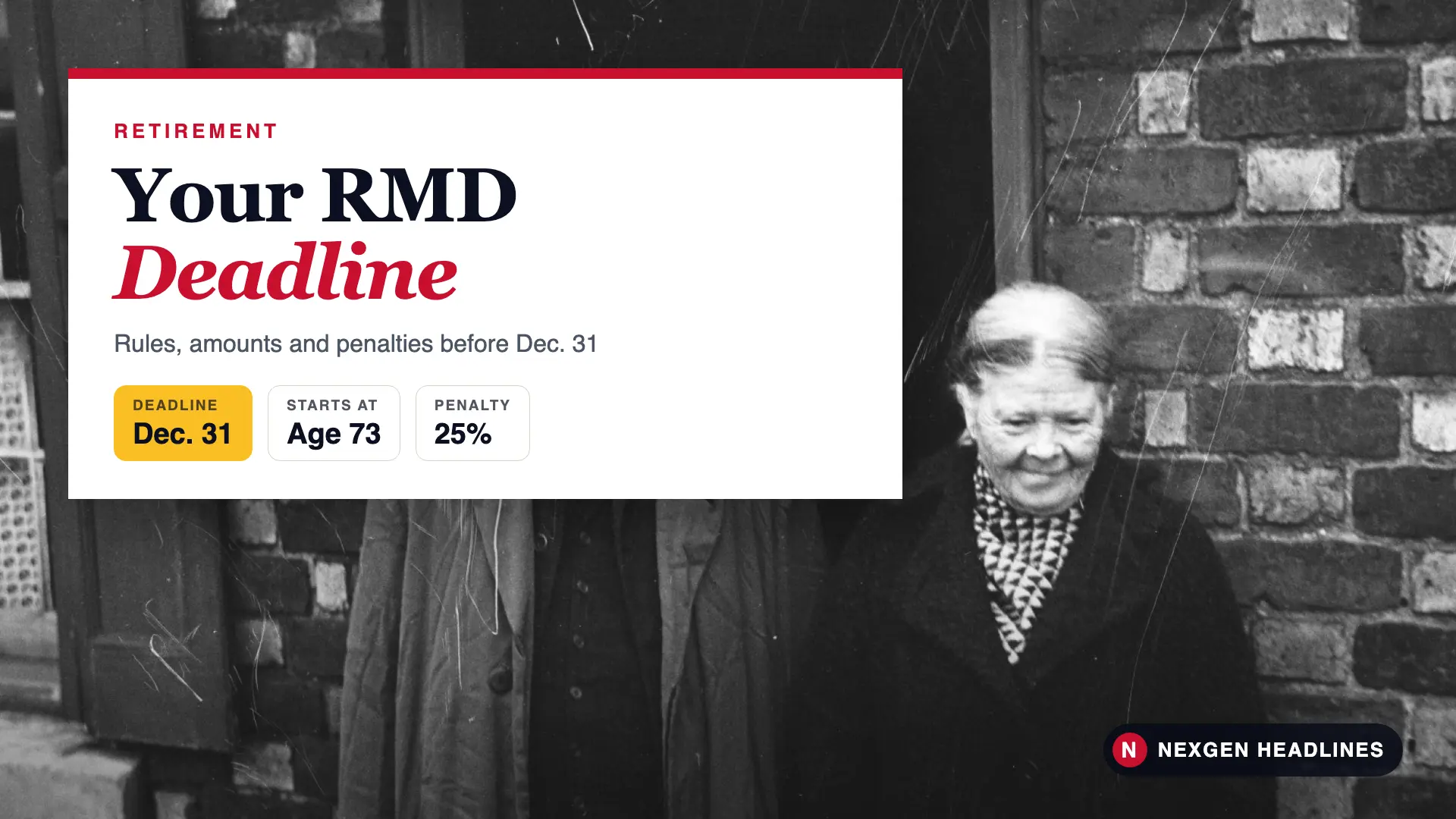

Quick answer: If you are 73 or older, you generally must take a required minimum distribution (RMD) from traditional IRAs and most workplace retirement plans by Dec. 31, 2026. Your very first RMD can wait until April 1 of the following year, but then you take two in one year. Missing an RMD can cost a 25% penalty on the amount you should have withdrawn, cut to 10% if you fix it in time. For people born in 1960 or later, RMDs start at 75.
RMDs are one of the few retirement rules with a hard deadline and a real penalty. Banks and brokers usually send reminders, but the responsibility is yours. If you or a parent has retirement savings, take ten minutes to check that this year’s withdrawal is planned before the holiday rush.
Who needs to pay attention this year
- Anyone born in 1953 or earlier with a traditional IRA or old 401(k).
- People born in 1953 who turned 73 this year and must decide whether to take the first RMD now or by April 1.
- Adult children helping a parent manage retirement accounts.
- Anyone who inherited an IRA or retirement plan in recent years.
What is a required minimum distribution?
Traditional IRAs, 401(k)s and similar plans let your money grow without being taxed each year. In exchange, the IRS requires you to start taking money out, and paying tax on it, once you reach a certain age. The required amount is called your RMD.
When do RMDs start?
| If you were born | RMDs start at age |
|---|---|
| 1951 to 1959 | 73 |
| 1960 or later | 75 |
Older retirees who already started under earlier rules keep taking RMDs each year.
Key RMD deadlines
| Situation | Deadline |
|---|---|
| Your first RMD | April 1 of the year after you reach RMD age |
| Every RMD after that | Dec. 31 each year |
| 2026 RMD (if not your first) | Dec. 31, 2026 |
The April 1 catch: if you delay your first RMD to April 1, you must still take your second RMD by Dec. 31 of that same year. Two taxable withdrawals in one year can push you into a higher tax bracket and raise how much of your Social Security is taxed. Many people take the first one by Dec. 31 instead.
Which accounts have RMDs?
- Yes: traditional IRAs, SEP IRAs, SIMPLE IRAs, 401(k), 403(b) and most 457(b) plans.
- No, while the owner is alive: Roth IRAs.
- No longer for Roth 401(k)s: starting in 2024, Roth accounts in workplace plans are not subject to RMDs while the owner is alive.
- Still working? Many workplace plans let you delay RMDs from your current employer’s plan until you retire, unless you own 5% or more of the company. This does not apply to IRAs.
How the amount is calculated
- Find each account’s balance on Dec. 31 of last year.
- Find your “distribution period” for your age in the IRS Uniform Lifetime Table (in IRS Publication 590-B).
- Divide the balance by that number.
Your bank or broker usually calculates this for you and shows it on your account. If your spouse is the only beneficiary and more than 10 years younger, a different IRS table applies and your RMD may be lower.
Made-up example (not a real person): Robert is 76 and had $300,000 in his traditional IRA on Dec. 31, 2025. The IRS table gives a distribution period of 23.7 for age 76. His 2026 RMD is about $12,658 ($300,000 ÷ 23.7). He sets up an automatic withdrawal for early December and asks the broker to withhold federal tax, so there is no surprise in April.
Several accounts? How to take RMDs
- IRAs: calculate the RMD for each IRA, but you can take the total from one or any combination of your IRAs.
- 403(b)s: similar to IRAs, you can total them and withdraw from any of your 403(b) accounts.
- 401(k)s: each 401(k) generally needs its own RMD from that plan.
- You can’t mix types: an IRA withdrawal does not count toward a 401(k) RMD.
Also read: Roth IRA vs Traditional IRA: Which Is Better?
What happens if you miss an RMD?
- Penalty: 25% of the amount you should have taken but did not.
- Reduced penalty: 10% if you correct the mistake within the IRS correction window, generally by the end of the second year after it was due.
- Possible waiver: the IRS may waive the penalty for a reasonable error if you take the missed amount and explain on Form 5329.
If you realize you missed one, take the withdrawal as soon as possible, then file Form 5329 with your tax return.
Ways to lower the tax bite
- Qualified charitable distribution (QCD): if you are 70½ or older, you can send money directly from your IRA to a qualified charity. It can count toward your RMD and is not included in your taxable income. The yearly limit is set by the IRS and adjusted for inflation.
- Have tax withheld from the RMD so you don’t owe a large bill when you file.
- Spread withdrawals across the year if you need the income, instead of one big withdrawal.
- Consider Roth conversions in earlier years, before RMD age, to reduce future RMDs. Talk to a tax professional first.
Should you take your RMD early in the year or late?
There is no single right answer. Taking it in January means the job is done and you can’t forget. Taking it in December lets the money stay invested longer. Many retirees split the difference with monthly or quarterly withdrawals that act like a paycheck. Whatever you choose, set it up as an automatic instruction with your bank or broker, so a busy month or a hospital stay doesn’t lead to a missed deadline.
Don’t need the money? You still have to take it
An RMD has to come out of the tax-deferred account, but you don’t have to spend it. You can:
- Move it to a regular brokerage account and keep it invested (you will owe tax on the withdrawal, but future growth is taxed normally).
- Put it in a high-yield savings account as an emergency fund.
- Fund a Roth IRA for a working spouse, if your household has earned income, within the normal contribution rules.
- Give it to charity through a qualified charitable distribution, if you are 70½ or older.
What you can’t do is roll an RMD into another IRA. RMD money is not eligible for rollover.
RMDs for inherited accounts
Inherited IRAs and retirement plans follow different rules. Many non-spouse beneficiaries must empty the account within 10 years, and some must also take yearly withdrawals during that time. Spouses have more options. These rules are complex, so check IRS Publication 590-B or ask the account custodian.
Your year-end RMD checklist
- Confirm whether you, a spouse or a parent must take an RMD this year.
- Check each account’s RMD amount with the bank or broker.
- Decide whether to take it as cash, a QCD to charity, or both.
- Choose how much tax to withhold.
- Request the withdrawal by early December. Firms get busy, and processing can take days.
- Keep the confirmation with your tax records.
Helping an aging parent with RMDs
Missed RMDs often happen when a parent’s health or memory changes. If you help with a parent’s finances, ask the bank or broker about setting up automatic yearly RMDs, and make sure you have the right authorization, such as a power of attorney, to speak with them.
Helpful tools for retirement paperwork
Disclosure: As an Amazon Associate, Nexgen Headlines earns from qualifying purchases.
FAQ
What age do RMDs start?
Age 73 for people born from 1951 to 1959, and age 75 for people born in 1960 or later.
What is the deadline for my 2026 RMD?
Dec. 31, 2026, unless it is your first RMD, which can be delayed until April 1, 2027.
What is the penalty for missing an RMD?
25% of the amount you failed to withdraw, reduced to 10% if you correct it in time. The IRS may waive it for reasonable errors.
Do Roth IRAs have RMDs?
No, not while the original owner is alive. Since 2024, Roth accounts in workplace plans also have no RMDs for the owner.
Can I give my RMD to charity?
Yes. If you are 70½ or older, a qualified charitable distribution sent directly from your IRA to a charity can count toward your RMD and is excluded from taxable income.
Bottom line
If you are 73 or older, check your RMD now and request it by early December. Withhold tax, consider a charitable distribution, and keep the paperwork. Missing the Dec. 31 deadline is an expensive mistake that takes just a few minutes to avoid.
Last reviewed: Nov. 1, 2026. This is general information, not tax advice; ask a tax professional about your situation.
Sources: IRS: RMD FAQs; IRS Publication 590-B; Kiplinger: First RMD deadline; IRS Form 5329.
Featured image: A retired couple, archive photo. Photo: Geoff Charles via Wikimedia Commons, CC BY-SA 4.0; edited by Nexgen Headlines.