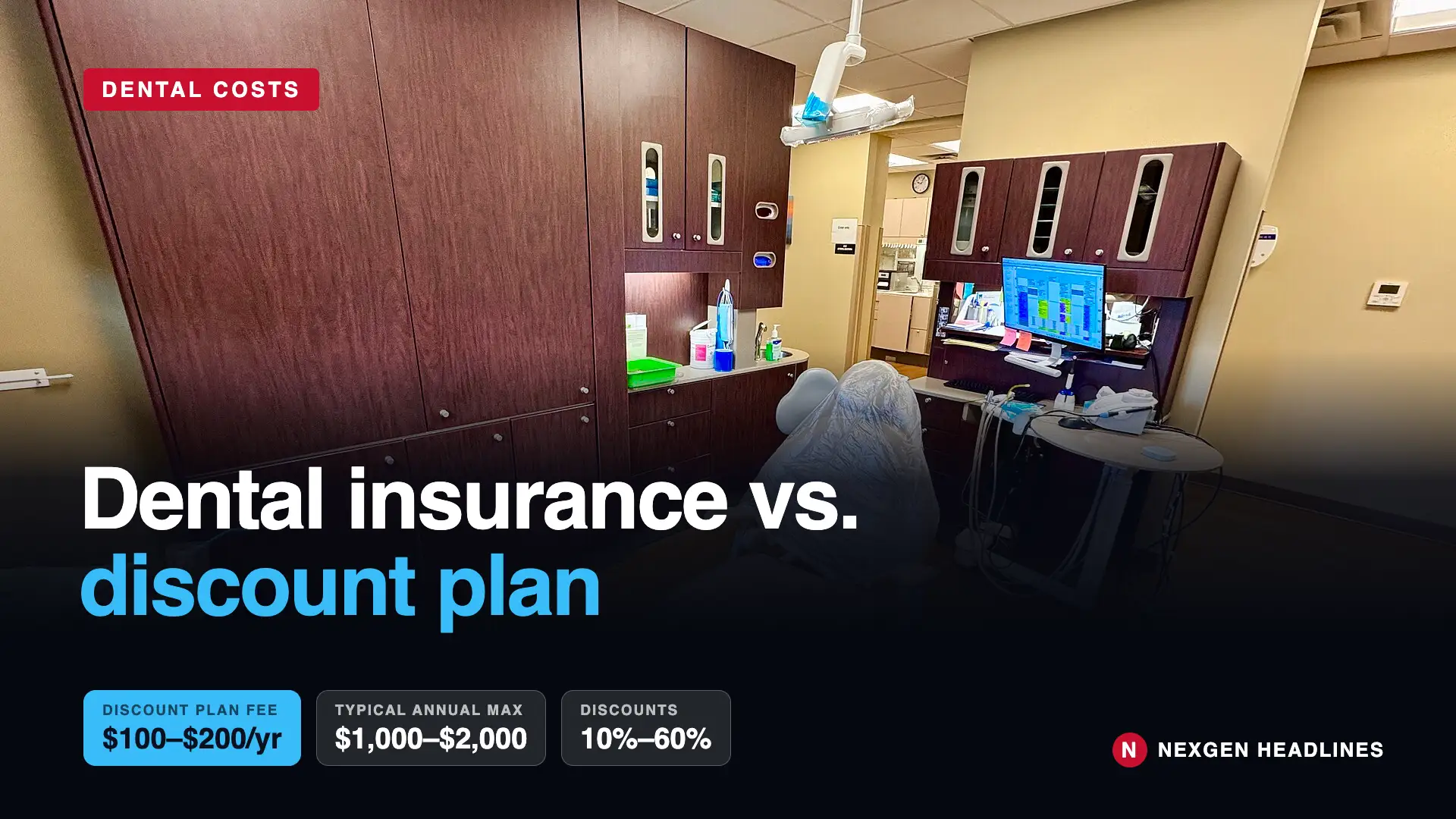

Quick answer: Dental insurance pays part of your dental bills after you pay a monthly premium, but it usually has an annual maximum (often $1,000 to $2,000) and waiting periods for bigger work. A dental discount plan isn’t insurance: you pay a yearly fee (often about $100 to $200) and get reduced prices at member dentists, usually with no waiting period and no yearly cap. Insurance tends to win for steady cleanings plus surprise work; discount plans can win when you need major work right away.
Open enrollment and year-end budgeting push many Americans to look at dental coverage now. The two options look similar on a sales page, but they work very differently. Here’s how to compare them using your own mouth and budget.
Dental insurance vs. discount plan at a glance
| Feature | Dental insurance | Dental discount plan |
|---|---|---|
| Is it insurance? | Yes | No, it’s a membership |
| Typical cost | Monthly premium, often about $20–$50 per person | Yearly fee, often about $100–$200 |
| How you save | Plan pays a share of covered care | You pay the dentist a discounted price |
| Preventive care | Often 100% covered | Discounted; you still pay something |
| Annual maximum | Yes, commonly $1,000–$2,000 | Usually none |
| Deductible | Often $50–$100 | None |
| Waiting periods | Common for basic and major work | Usually none; use it in days |
| Dentist choice | Network (PPO/DHMO) or any dentist (indemnity) | Only participating dentists |
| Paperwork | Claims and EOBs | None; show your card |
Price ranges are typical figures reported by insurers and consumer sites. Your quotes will vary by state, age and plan.
How dental insurance works
Most private dental plans follow a “100-80-50” style:
- Preventive (cleanings, exams, routine X-rays): often 100% covered, usually twice a year.
- Basic (fillings, simple extractions): often about 80% after the deductible.
- Major (crowns, bridges, dentures, root canals on some plans): often about 50%.
The plan stops paying once it hits the annual maximum. Many plans’ maximums haven’t grown much in decades, while dental prices have. A single crown can use a big share of a $1,500 maximum.
New individual plans also often have waiting periods, commonly around 6 months for basic care and 12 months for major care. Employer plans often have fewer or none.
How a dental discount plan works
You pay a membership fee to a company that has negotiated lower prices with a network of dentists. At the visit, you show your card and pay the discounted fee in full. Savings commonly range from about 10% to 60% off the dentist’s usual fee, depending on the service.
- No claim forms
- No annual maximum
- No pre-existing condition limits in most plans
- You can usually start within a few days
The catch: you pay every bill yourself, just at a lower price. And your dentist must be in the plan’s network.
Important: some plans call themselves “dental plans” without making clear they aren’t insurance. The FTC has warned about discount plans that overpromise. Always look for the words “this is not insurance” and check that your dentist participates before you pay.
How to choose: step by step
- List the dental work you expect next year. Cleanings only? A crown your dentist mentioned? Braces for a child?
- Ask your dentist for prices. Get the regular fee and any in-network or discount-plan fee for each item.
- Price an insurance plan. Add 12 months of premiums, the deductible and your share of each procedure. Stop the plan’s payments at the annual maximum.
- Price a discount plan. Add the yearly fee to the discounted price of each procedure.
- Check waiting periods. If you need work in the next 6 to 12 months, a waiting period may wipe out the insurance value.
- Confirm your dentist is in the network for whichever option you pick.
- Read the cancellation and refund rules before you pay.
Made-up example (for illustration):
Kevin needs two cleanings and one crown this year. His dentist’s regular prices: $120 per cleaning and $1,300 for the crown.
Insurance option: $35 a month ($420 a year), $50 deductible, 100% cleanings, 50% crowns, 12-month wait for major work. Cleanings cost him $0, but the crown isn’t covered until next year. Total this year: $420 + $1,300 = $1,720.
Discount option: $150 a year. Cleanings drop to $70 each and the crown to $800 at a member dentist. Total: $150 + $140 + $800 = $1,090.
For Kevin’s year, the discount plan saves about $630. If he only needed cleanings, the insurance plan would cost $420 against $290 for the discount plan, and insurance would protect him from a surprise later. All prices are made up for illustration.
Who should pick dental insurance
- Your employer pays part of the premium. Group plans are often the cheapest coverage you can get.
- You have kids who need regular cleanings, sealants and possible orthodontics.
- You want protection against unexpected fillings or a broken tooth.
- Your dentist only works with insurance networks.
Who should pick a discount plan
- You need major work soon and can’t wait out a 12-month waiting period.
- You’ve already used up your insurance annual maximum.
- You’re on Original Medicare, which doesn’t cover most routine dental care.
- You’re self-employed or between jobs and want low monthly costs.
- You want cosmetic work that insurance often excludes, like whitening.
Also read: Open enrollment checklist for 2027 benefits
Can you have both?
Yes. Some people keep insurance for preventive care and use a discount plan once they hit the annual maximum. Others use a discount plan on procedures the insurer won’t cover. The two usually can’t be combined on the same procedure, so ask the dentist which applies.
Other ways to lower dental costs
- HSA or FSA money can pay for dental care with pre-tax dollars.
- Dental schools often charge less for care done by supervised students.
- Community health centers may offer sliding-scale fees based on income. Find one at findahealthcenter.hrsa.gov.
- Ask for the cash price and a payment plan before work starts.
- Medicare Advantage plans often include some dental benefits. Check limits carefully.
Questions to ask before you sign up
- Is my dentist in the network? Call the office, not just the plan, and ask by plan name.
- What’s the waiting period for each type of care? Ask for it in writing.
- What’s the annual maximum, and does unused money roll over? A few insurance plans offer rollover.
- Are implants, orthodontics or cosmetic work covered or discounted? Many plans limit or exclude them.
- Is there a missing-tooth clause? Some insurance plans won’t pay to replace a tooth lost before coverage began.
- Can I cancel and get a refund? Discount plans often offer a 30-day refund window. Check yours.
If a salesperson can’t answer these clearly, look elsewhere. You can also check complaints about a company with your state insurance department or the Better Business Bureau.
Mistakes to avoid
- Buying insurance for a crown you need next month without checking the waiting period.
- Assuming your dentist accepts a discount plan because it’s “nationwide.”
- Ignoring the annual maximum when planning big work. Splitting treatment across two plan years can help.
- Paying for a plan from a pushy phone call. Buy only from companies you look up yourself.
- Skipping cleanings. Preventive care is the cheapest dental care there is.
Recommended products
Home care that can help you avoid bigger dental bills.
Disclosure: As an Amazon Associate, Nexgen Headlines earns from qualifying purchases.
FAQ
Is a dental discount plan worth it?
It can be if you need work soon, have no employer plan, or have used up your insurance maximum. If you only need cleanings, compare carefully; insurance may be similar in cost.
Do dental discount plans have waiting periods?
Most don’t. You can usually use the plan within a few days of joining. Check the plan’s terms.
What is a typical dental insurance annual maximum?
Commonly $1,000 to $2,000 per person per year, though some plans go higher or lower.
Does Medicare cover dental?
Original Medicare doesn’t cover most routine dental care like cleanings, fillings or dentures. Many Medicare Advantage plans include some dental benefits.
Can I use HSA money with a discount plan?
You can generally use HSA or FSA funds for the dental care itself. Whether the membership fee qualifies depends on IRS rules; ask your plan administrator.
Bottom line
Dental insurance is a safety net with a ceiling: low cleaning costs, help with surprises, but an annual maximum and waiting periods. A discount plan is a cheaper membership with no cap and no wait, but you pay every bill. Price your expected care both ways, confirm your dentist is in network, and pick the one that costs less for your year.
Last reviewed: Nov. 22, 2026. Prices are typical ranges, not quotes. This is general information, not insurance advice.
Sources: HealthInsurance.org: dental discount plan, FTC: discount plans, Medicare.gov: dental services, HRSA: find a health center, IRS Publication 502, Aflac: dental insurance vs. discount plans.
Featured image: Dental chair in a North Carolina clinic. Photo: Harrison Keely / Wikimedia Commons, CC BY 4.0; edited by Nexgen Headlines.