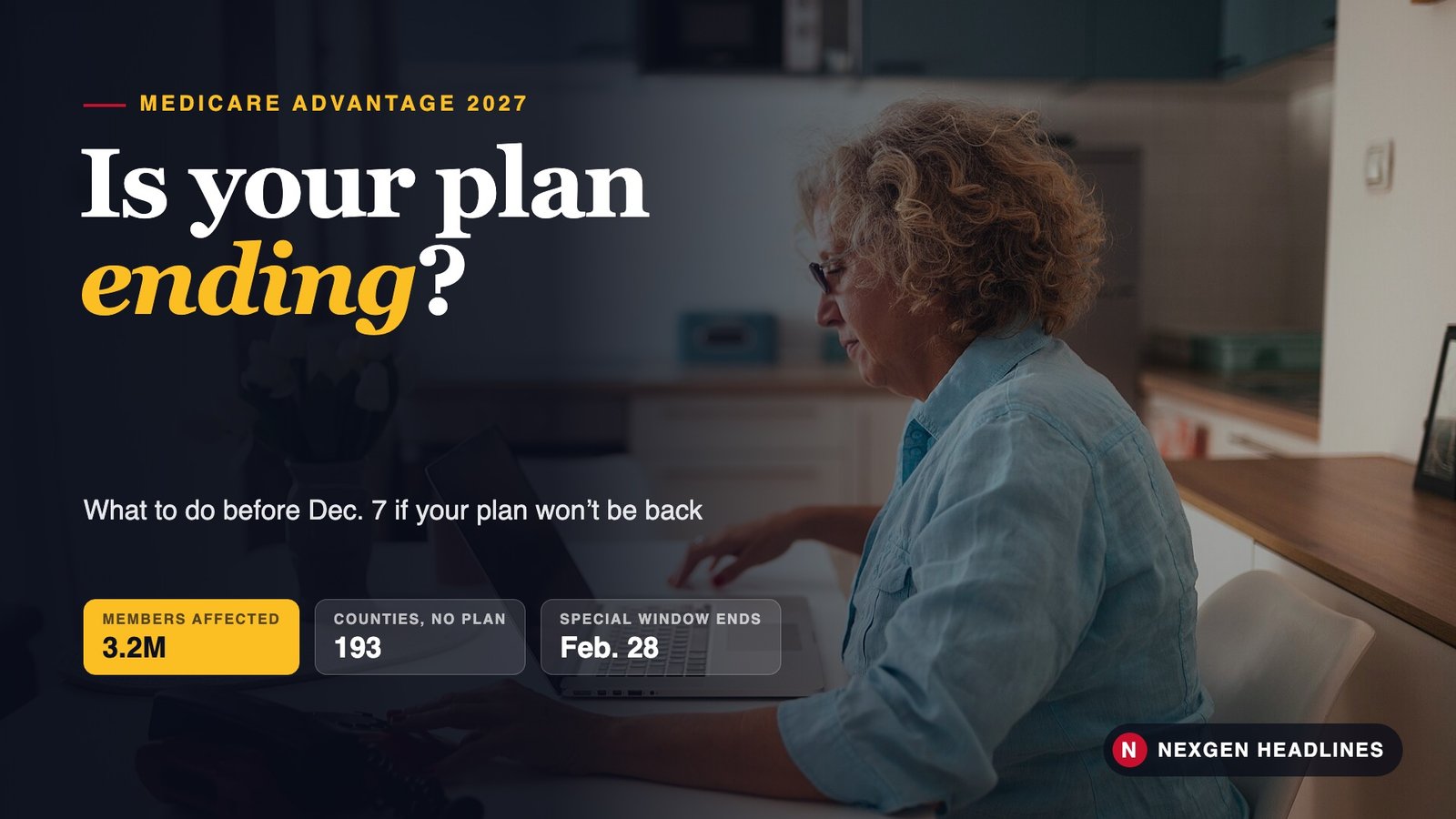

Quick answer: As of Oct. 24, 2026, nearly 3.2 million Medicare Advantage members are in plans that end on Dec. 31, according to an analysis of CMS data by Medicare Market Insights, reported by CNN. If your plan is one of them, you should have a non-renewal letter.
You can pick a new plan by Dec. 7 for coverage on Jan. 1. If you miss that, a special window runs from Dec. 8 through Feb. 28, 2027. Do nothing, and you land in Original Medicare, often with no drug coverage.
What to do this week if your plan is ending
- Find the letter. Look for a notice titled something like “plan non-renewal” or “your plan is leaving Medicare.” Plans had to send these by early October.
- List your doctors, hospitals and drugs. Write down every prescription with its dose. You will need this list for any plan search.
- Compare plans on Medicare.gov. Use the Plan Finder and enter your drugs and pharmacy. Check that your doctors are in network.
- Get free help. Call 1-800-MEDICARE (1-800-633-4227) or your State Health Insurance Assistance Program (SHIP). SHIP counselors do not earn commissions.
- Enroll by Dec. 7 so your new plan starts Jan. 1 with no gap.
- Keep the letter and its envelope. They prove your plan ended if you later want a Medigap policy.
The story at a glance
| Detail | What we know |
|---|---|
| Members in plans ending for 2027 | Nearly 3.2 million, about 11% of Medicare Advantage enrollees (Medicare Market Insights, via CNN) |
| Same number for 2026 and 2025 | About 2.9 million and about 2 million |
| Broader count, including plans merged into others | More than 6.3 million members, about 18.5% of enrollment (Wakely) |
| Counties with no Medicare Advantage drug plan | 193 in 2027, up from 123 in 2026 (KFF) |
| People living in those counties | About 638,000 Medicare beneficiaries, up from 399,000 (KFF) |
| Average plan choices | 28 Medicare Advantage drug plans per person in 2027 (KFF) |
| Open enrollment deadline | Dec. 7, 2026 |
| Special window if your plan ends | Dec. 8, 2026, through Feb. 28, 2027 |
What is happening, in plain English
Medicare Advantage plans are run by private insurers. Each year they choose which plans to sell and where. For 2027, many of them pulled back.
This is the third straight year of large cuts. CNN described it as a third year of turmoil. The number of people forced to switch has grown each year, from about 2 million for 2025 to nearly 3.2 million for 2027.
The cuts are not spread evenly. Some areas lost several insurers at once. KFF found that four Minnesota counties (Brown, Lake of the Woods, Morrison and Renville) each lost three insurers.
In a few places, no general Medicare Advantage drug plan is left at all. KFF counts 193 such counties for 2027. All of Alaska is in that group, affecting about 110,000 people.
Timeline: how we got here
| Date | What happened |
|---|---|
| Sept. 2026 (late) | CMS released its 2027 plan data. Healthcare Dive reported on Sept. 29 that every major insurer cut individual plans. CMS called the outlook “stable.” |
| Oct. 1, 2026 | Bloomberg reported cuts at UnitedHealth and Humana. A UnitedHealth spokesperson said about 390,000 members are in discontinued plans. |
| Oct. 2, 2026 | Quartz reported Humana’s cuts affect around 600,000 enrollees. Non-renewal letters were due to members around this date. |
| Oct. 9, 2026 | KFF published its county analysis: 193 counties with no general Medicare Advantage drug plan. |
| Oct. 15, 2026 | Open enrollment began. CNN reported nearly 3.2 million members must find new plans. |
| Oct. 23, 2026 | PBS NewsHour aired a segment on seniors scrambling to find coverage after their plans shut down. |
Which insurers are pulling back
KFF counted county exits and entries for 2027. These numbers are counties, not people, so a big number does not always mean the most members.
| Insurer | Counties exited | Counties entered |
|---|---|---|
| Health Care Service Corporation (Blue Cross plans in several states) | 498 | 0 |
| Centene | 359 | 15 |
| UnitedHealth Group | 228 | 9 |
| CVS Health (Aetna) | 186 | 63 |
| Blue Cross Blue Shield of Michigan | 177 | 1 |
| Elevance Health | 66 | 10 |
| Humana | 62 | 4 |
| Devoted Health | 0 | 342 |
Two insurers are leaving the Medicare Advantage drug plan market completely: Group 1001 (sold as Clear Spring Health) and Molina Healthcare. KFF notes Molina will still offer special needs plans in many counties.
Why insurers are cutting plans
Insurers say costs are higher than expected. People are using more care, and drug costs keep rising. Healthcare Dive reported that nearly 70% of health plan leaders expect less generous benefit packages for 2027, citing a HealthScape Advisors survey.
On PBS NewsHour, health care podcast host Dan Weissmann put it simply. Insurers are companies that answer to shareholders, so they drop plans that are less profitable.
CMS has taken a calmer view. It said more than 99% of beneficiaries will have at least one Medicare Advantage plan. It added that about 8 in 10 can keep their plan at the same or lower premium.
Both things can be true. Most people keep their plan. But for the millions who don’t, the change is real and the clock is running.
Also read: Medicare Open Enrollment 2027: Dates, Costs and What Changed, for the full list of 2027 dates and costs.
Key dates to watch
| Date | What it means for you |
|---|---|
| Oct. 15 – Dec. 7, 2026 | Open enrollment. Pick a new plan now and it starts Jan. 1, 2027. |
| Nov. 1, 2026 | For a plan ending Dec. 31, the Medigap protection window opens (60 days before coverage ends). |
| Dec. 8, 2026 – Feb. 28, 2027 | Special Enrollment Period for people whose plan did not renew. |
| Dec. 31, 2026 | Ending plans stop covering care. |
| Jan. 1, 2027 | If you did not choose, you are in Original Medicare. |
| March 4, 2027 | 63 days after a Dec. 31 end date: the last day to use your Medigap guaranteed issue right in that example. |
Dates in the Medigap rows are our calculation from the federal 60-day and 63-day rules. Your own dates depend on when your plan ends, so check your letter.
Who decides what
| Who | What they control |
|---|---|
| Insurers | Which plans they sell, where, and at what price and benefits |
| CMS (Centers for Medicare & Medicaid Services) | Approves plans, sets enrollment rules and the special windows |
| Your state insurance department | Medigap rules; some states give stronger protections than federal law |
| Your SHIP office | Free, unbiased one-on-one counseling |
| You | Which plan you join, and whether you switch to Original Medicare |
Your three main choices
1. Join another Medicare Advantage plan
This is the simplest route for most people. You keep an all-in-one plan, usually with drug coverage. Check the network first. A plan with your doctor last year may not have them in 2027.
Look at the maximum out-of-pocket limit too. Healthcare Dive reported average limits rising about 10% for 2027, and average Part D deductibles up about 30%.
2. Switch to Original Medicare plus a drug plan
Original Medicare lets you see any doctor who takes Medicare. But it generally covers 80% of outpatient costs and has no yearly cap on what you pay.
That is why many people add a Medigap (Medicare Supplement) policy. You also need a separate Part D drug plan. Going without drug coverage can trigger a lifetime late penalty.
3. Do nothing
This is the risky choice. You are moved to Original Medicare on Jan. 1. If your old plan had drug coverage, you lose it. You would then need to pick a drug plan during the special window.
Your Medigap rights if your plan ends
Normally, Medigap insurers in most states can turn you down or charge more because of your health. A plan ending changes that for a short time.
When a Medicare Advantage plan leaves Medicare or stops serving your area, you get a guaranteed issue right. Medicare’s Medigap guide says you can apply from 60 days before your coverage ends to 63 days after it ends.
During that window, the insurer must sell you a covered policy. It cannot charge more for past health problems. Keep your non-renewal letter, because the insurer may ask for proof.
Some states, such as New York, Connecticut, Massachusetts and Maine, have broader Medigap protections. Ask your SHIP office what applies where you live.
Two made-up examples
These are made-up examples to show how the rules work. They are not real people.
Linda, 72, in Ohio: Her plan’s letter says it ends Dec. 31. She checks the Plan Finder in early November, finds a plan with her cardiologist and her three drugs, and enrolls by Dec. 7. Her new plan starts Jan. 1 with no gap.
Ray, 68, in rural Minnesota: No Advantage plan with his doctors is left in his county. He applies for a Medigap policy in December, using his guaranteed issue right, and picks a separate Part D plan. He pays more each month but can see any doctor who takes Medicare.
Common mistakes to avoid
- Tossing the letter. It looks like junk mail to many people. It is your proof for Medigap.
- Waiting for January. The special window helps, but enrolling by Dec. 7 avoids a coverage gap.
- Choosing by premium alone. A $0 plan can cost more if your doctors are out of network or your drugs sit on a high tier.
- Skipping drug coverage. If you move to Original Medicare, add Part D or other creditable drug coverage.
- Trusting cold calls. Medicare will not call you to sell a plan. Hang up and call 1-800-MEDICARE yourself.
- Assuming next year’s plan is the same. Even if your plan renews, read the Annual Notice of Change.
What if my plan is renewing but changing?
Many people are not losing their plan but are being moved into a different one by the same insurer. This is called a crosswalk. Wakely counted these in its 6.3 million figure.
A crosswalk means you are not left without coverage. But the new plan may have different doctors, costs and drug lists. Treat it like a new plan and compare during open enrollment.
What happens next
Expect more mail, more TV ads and more calls from brokers through Dec. 7. Some popular plans may fill up. PBS NewsHour noted that some insurers got federal permission to cap enrollment in certain plans.
Insurer projections put 2027 Medicare Advantage enrollment at about 34 million, down roughly 2 million, Healthcare Dive reported. CMS says it expects actual enrollment to come in higher. That is a projection, and the real number will be known early next year.
We will update this page if CMS extends any deadline or more insurers announce changes.
FAQ
How do I know if my Medicare Advantage plan is ending in 2027?
Your plan must send you a non-renewal notice. You can also search for your plan on Medicare.gov’s Plan Finder or call 1-800-MEDICARE and ask.
What happens if I don’t pick a new plan?
You are enrolled in Original Medicare on Jan. 1, 2027. If your old plan included drug coverage, you will not have it until you join a Part D plan.
Can I still join a plan after Dec. 7?
Yes, if your plan did not renew. Medicare gives you a Special Enrollment Period from Dec. 8 through the last day of February. Coverage starts later, so a gap is possible.
Can a Medigap insurer turn me down?
Not if you use your guaranteed issue right in time. The window runs from 60 days before your plan ends to 63 days after. Outside it, most states let insurers check your health.
Where can I get free, unbiased help?
Call your state’s SHIP office or 1-800-MEDICARE. SHIP counselors are federally funded and do not sell plans.
Bottom line
If a non-renewal letter came this fall, don’t set it aside. Make your drug and doctor list, compare plans on Medicare.gov, and enroll by Dec. 7. If Original Medicare makes more sense, use your Medigap right before the 63-day window closes.
Last reviewed: Oct. 24, 2026. This is a developing story. We will add dated updates if deadlines or plan counts change.
Sources: KFF county analysis (Oct. 9, 2026), CNN (Oct. 15, 2026), Healthcare Dive (Sept. 29, 2026), Wakely, Quartz via Yahoo Finance (Oct. 2, 2026), PBS NewsHour (Oct. 23, 2026), Medicare.gov Special Enrollment Periods, Medicare “Choosing a Medigap Policy” guide.