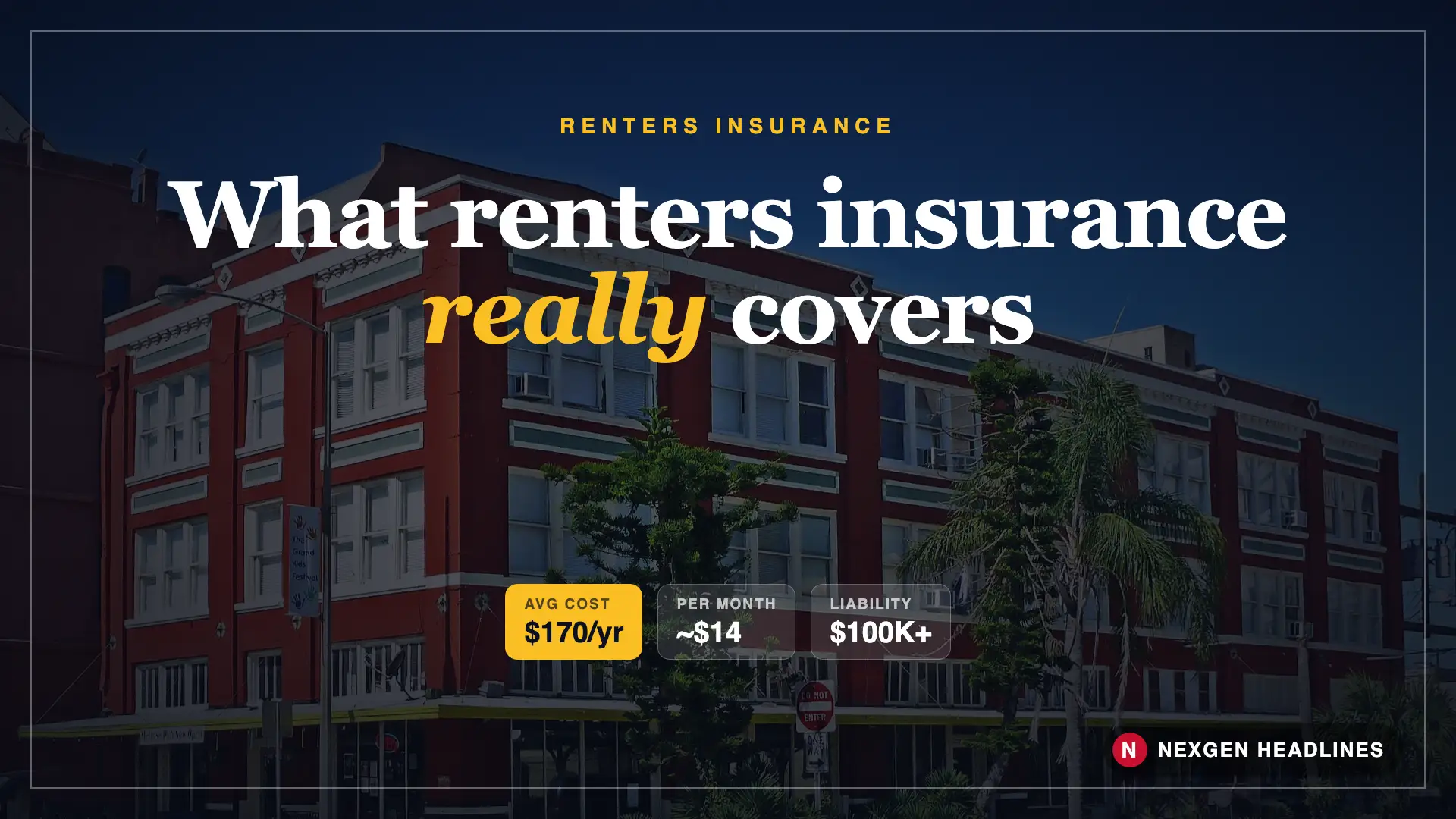

Quick answer: Renters insurance costs about $170 a year (roughly $14 a month) on average in the US, according to NAIC data reported by the Insurance Information Institute. A typical policy covers your belongings (theft, fire, smoke, some water damage), personal liability if someone gets hurt or you damage someone else’s property, and extra living costs if your rental becomes unlivable. It does not cover floods, earthquakes, or the building itself.
Your landlord’s insurance protects the building, not your couch, laptop or clothes. Here’s what renters insurance costs, what it really pays for, and how to buy the right amount without overpaying.
Renters insurance at a glance
| Part of the policy | What it pays for | Common amount |
|---|---|---|
| Personal property | Your stuff, at home or away (stolen bike, laptop taken from a car) | $20,000 to $50,000 |
| Personal liability | Injuries to others and damage you cause, plus legal defense | $100,000 to $300,000 |
| Loss of use (additional living expenses) | Hotel, meals and extra costs if a covered loss forces you out | Often 20% to 30% of property coverage |
| Medical payments to others | Small medical bills for guests hurt at your place, regardless of fault | $1,000 to $5,000 |
| Deductible | What you pay before property coverage kicks in | $500 or $1,000 |
How much does renters insurance cost?
The most widely cited national figure is about $170 a year, based on National Association of Insurance Commissioners (NAIC) data. That average is for roughly $35,000 of property coverage. Other surveys land anywhere from about $150 to $260 a year because they use different coverage amounts.
Costs are highest in parts of the South and the Gulf Coast. The III reports Mississippi as the most expensive state, at about $262 a year.
What changes your price
- Where you live. Areas with more theft or severe weather cost more.
- How much coverage you buy. More property coverage and higher liability limits raise the price, but not by much.
- Your deductible. A $1,000 deductible costs less than $500.
- Replacement cost vs. actual cash value. Replacement cost costs a bit more but pays far more after a loss.
- Claims history. Past claims can raise your rate.
- Credit-based insurance score. Most states let insurers use it. California, Massachusetts and a few others limit or ban it.
- Safety features. Smoke detectors, deadbolts and alarm systems can earn discounts.
- Bundling. Buying renters and auto insurance from the same company often cuts both.
What renters insurance covers
1. Your belongings
Standard policies cover your stuff against named risks such as:
- Fire, lightning and smoke
- Theft and vandalism
- Windstorm and hail
- Sudden water damage from plumbing, a burst pipe or an upstairs neighbor’s overflow
- Explosion, riot and falling objects
- Weight of ice and snow
Coverage usually follows you. If your bag is stolen at the airport, your policy can pay, minus the deductible.
2. Liability
If a guest slips in your kitchen, or your bathtub overflows and damages the unit below, liability coverage can pay their costs and your legal defense. Many policies also cover dog bites, though some insurers exclude certain breeds.
3. Loss of use
If a fire makes your apartment unlivable, this pays the extra cost of living somewhere else. It covers the difference between your normal costs and the new ones, like a hotel and restaurant meals.
What renters insurance does not cover
- Floods from rising water. You need separate flood insurance. The federal National Flood Insurance Program sells contents-only policies for renters.
- Earthquakes. Buy an add-on or a separate policy.
- The building itself. That’s the landlord’s job.
- Your roommate’s stuff, unless they’re named on your policy.
- Pest damage like bedbugs, mice or termites.
- Business property beyond a small limit.
- Your car. Auto insurance covers the car; renters insurance may cover belongings stolen from it.
Special limits to know
Policies cap payouts on certain items, often at $1,000 to $2,500 for jewelry, watches, cash, firearms, collectibles and some electronics. If you own an engagement ring or expensive camera gear, add a scheduled personal property rider. It costs a few dollars a month and often has no deductible.
Made-up example (for illustration):
Jasmine rents a one-bedroom in Atlanta. A kitchen fire in the unit next door fills her place with smoke. Her couch, mattress and most of her clothes are ruined, and she can’t stay there for three weeks.
Her $30,000 replacement-cost policy with a $500 deductible pays to replace her damaged items at today’s prices. Her loss-of-use coverage pays for the extra hotel and meal costs. She paid about $16 a month for the policy.
How much coverage do you need?
- Make a home inventory. Walk through each room with your phone and record everything. Note brand, age and rough cost.
- Add it up. Most people underestimate. Clothes, kitchen gear and electronics add up fast.
- Pick a property limit at or above that total.
- Choose replacement cost. Actual cash value subtracts depreciation, so a five-year-old laptop might pay only a fraction of a new one.
- Pick liability. $100,000 is common. Go to $300,000 if you have savings to protect or a dog.
- Choose a deductible you could pay tomorrow without stress.
Also read: Is umbrella insurance worth it?
Is renters insurance required?
No state law requires it. But many landlords and apartment complexes require it in the lease, often with at least $100,000 of liability. They may ask you to list them as an “interested party” so they’re notified if the policy lapses.
Some landlords offer to add you to their own master policy for a monthly fee. Compare carefully. Those plans often cover only liability to the landlord, not your belongings.
How to buy renters insurance
- Get three quotes, including from your auto insurer.
- Compare the same coverage amounts on each quote.
- Check the insurer’s complaint record on your state insurance department website or the NAIC’s Consumer Insurance Search.
- Ask about discounts: bundling, alarms, paying yearly, paperless billing.
- Read the exclusions section before you pay.
- Save your policy and inventory in cloud storage, not just at home.
How to file a renters insurance claim
- Make sure everyone is safe. Call 911 for fire or a break-in.
- File a police report for theft or vandalism. Insurers usually ask for it.
- Take photos and video of all damage before cleaning up.
- Prevent more damage, like covering a broken window. Keep receipts.
- Call your insurer or file in the app as soon as you can.
- Send your inventory and any receipts.
- Keep receipts for hotel and meals for loss-of-use coverage.
Think twice before filing a small claim just above your deductible. A claim can raise your rate at renewal.
Mistakes renters make
- Assuming the landlord covers your stuff. They don’t.
- Buying too little property coverage.
- Choosing actual cash value to save a couple of dollars.
- Forgetting to add a roommate or partner.
- Skipping flood coverage in a flood zone.
- Never updating the policy after buying expensive items.
Ways to lower your renters insurance bill
Renters insurance is already cheap, but a few moves can trim it further without cutting the coverage that matters.
- Bundle with auto insurance. This is usually the biggest discount. Some drivers find the bundle discount on their car policy is close to the full cost of the renters policy.
- Pay for the year up front. Many insurers charge a small fee for monthly billing.
- Raise your deductible from $500 to $1,000 if you have an emergency fund.
- Tell the insurer about safety features like smoke detectors, sprinklers, deadbolts and a monitored alarm.
- Ask about group discounts through your employer, alumni group or a membership club.
- Shop again every year or two. Prices change, and loyalty doesn’t always pay.
Don’t save money by dropping liability coverage or switching to actual cash value. Those cuts save a few dollars and can cost thousands after a loss.
Renters insurance when you move
Update your policy before moving day. Most policies cover your belongings in transit for some risks, but limits apply. Give your insurer the new address, and ask whether the price changes. A new ZIP code can raise or lower your rate. If you’re moving in with a partner, decide whether to share one policy or keep two.
Recommended products
Simple ways to protect your rental and lower your premium.
Disclosure: As an Amazon Associate, Nexgen Headlines earns from qualifying purchases.
FAQ
Is renters insurance worth it?
For most renters, yes. For about $14 a month, it can replace thousands of dollars of belongings and protect you from a liability lawsuit.
Does renters insurance cover my roommate?
Only if they’re named on the policy. Many insurers let roommates share a policy, but separate policies avoid fights during a claim.
Does renters insurance cover water damage?
It covers sudden, accidental water damage such as a burst pipe. It does not cover floods or slow leaks you ignored.
Can I cancel renters insurance anytime?
Usually yes, with a refund of unused premium. Check your lease first if your landlord requires coverage.
Does renters insurance cover stolen items from my car?
Usually yes, under personal property, minus your deductible. Damage to the car itself goes through auto insurance.
Bottom line
Renters insurance averages about $170 a year, and it covers your belongings, liability and temporary housing after a covered loss. Make an inventory, buy replacement-cost coverage, choose at least $100,000 of liability, and add flood or jewelry coverage if you need it.
Last reviewed: Nov. 22, 2026. Prices are national averages; your quote will differ. Coverage rules vary by insurer and state.
Sources: Insurance Information Institute: renters insurance, NAIC consumer guide, FloodSmart.gov (FEMA), GEICO (citing NAIC/III).
Featured image: Melrose Apartment Building, Galveston, Texas. Photo: Wiki name / Wikimedia Commons, CC BY-SA 3.0; edited by Nexgen Headlines.