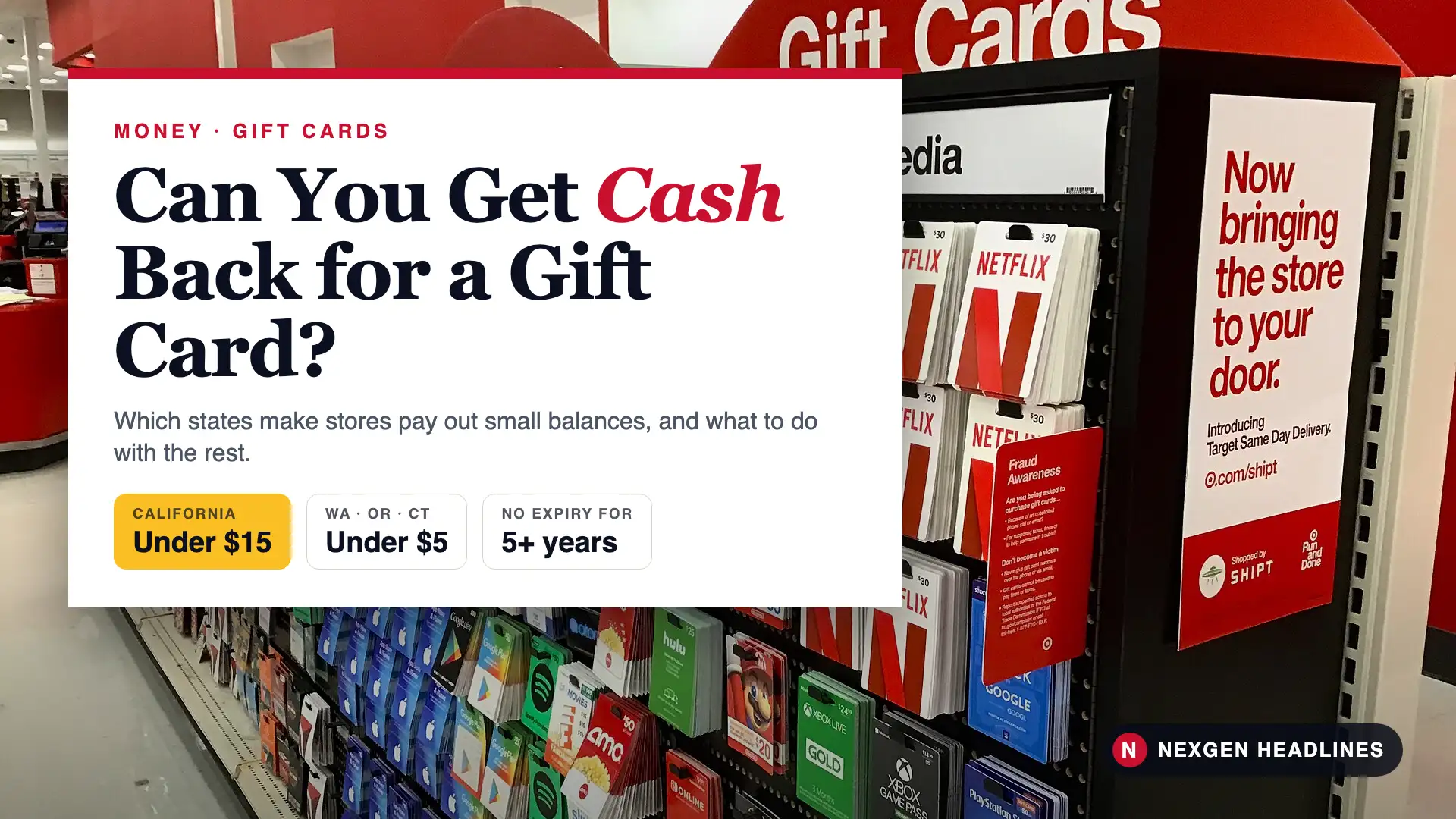

Quick answer: Usually only for small leftover balances, and only in some states. California stores must pay cash for balances under $15 (since April 1, 2026). Washington, Oregon, Connecticut and several other states require cash for balances under about $5. Federal law doesn’t require cash back, but it does stop most gift cards from expiring in under five years.
That leftover $3.47 on a coffee card is annoying. So is a $40 card for a store you never visit. The good news: you have more options than tossing it in a drawer.
This guide covers which states force stores to pay cash, what federal law protects, and what to do with cards that don’t qualify.
Gift card cash-back rules by state
These states require a store to give you cash for a small remaining balance when you ask. In most cases you must ask at the register; stores don’t hand it over on their own.
| State | Cash back required when the balance is… | Fine print |
|---|---|---|
| California | Under $15 | Raised from under $10 on April 1, 2026 (SB 22). Covers e-gift cards too. |
| Colorado | $5 or less | Retailer-issued gift cards |
| Connecticut | Under $5 | After a purchase; applies to most cards sold in the state |
| Maine | Under $5 | Only if the card started above $5 |
| Massachusetts | 10% or less of the original value | After you’ve used at least 90% of the card |
| Montana | Under $5 | Only if the card started above $5 |
| New Jersey | Under $5 | After the card has been used at least once |
| Oregon | Under $5 | Small-balance rule for retailer cards |
| Rhode Island | Under $1 | Very small balances only |
| Vermont | $1 or less | Very small balances only |
| Washington | Under $5 | Retailer-issued gift cards |
Thresholds come from state consumer agencies and legal summaries as of November 2026. State laws change, and some cards are excluded, such as promotional cards, loyalty rewards and certain bank-issued cards. If a store refuses, ask for the manager and mention your state’s gift card law.
Live in a state that isn’t listed? Then stores generally don’t have to give cash back. You can still ask; some chains cash out small balances everywhere as a policy.
What federal law protects on every gift card
The Credit CARD Act of 2009 set nationwide gift card rules. The Consumer Financial Protection Bureau (CFPB) enforces them today. They apply to store gift cards and general prepaid gift cards, like Visa or Mastercard gift cards.
- No early expiration: the money on a card can’t expire for at least five years. The clock starts when the card is issued or last reloaded.
- No surprise fees in year one: inactivity, dormancy or service fees are banned unless you haven’t used the card for at least 12 months.
- One fee a month at most: after a year of no use, a card can charge only one such fee per month. The fee must be disclosed on the card or package.
- Expired card ≠ lost money: if the card’s plastic expires but the funds haven’t, you can ask for a free replacement.
What federal law doesn’t do: it doesn’t require stores to give cash for a balance. It also doesn’t cover promotional cards, like a “$10 bonus card” you got for spending $50, or loyalty rewards.
How to get cash for a small balance: step by step
- Check the balance. Use the number on the back of the card, the store’s website or the receipt. Write the exact amount down.
- Check your state’s threshold in the table above. If your balance is under it, you qualify.
- Go to the register and ask for the balance in cash. Use the words “cash redemption.” Bring the physical card or the e-gift card on your phone.
- If the cashier says no, ask for a manager. Many employees don’t know the rule. Politely name your state’s law.
- If the store still refuses, file a complaint with your state attorney general’s consumer protection office. Keep the card and the receipt.
Tip: you can also use the small balance first, then pay the rest with another card. Most stores let you split a purchase between a gift card and cash or debit. That empties the card without a fight.
What to do with a gift card you’ll never use
If your balance is too high for a cash-out, you still have options:
| Option | Best for | Watch out for |
|---|---|---|
| Use it on everyday items | Big stores that sell groceries, household basics or gas | Spend it before you forget it |
| Give it to someone who will use it | Family, friends, coworkers | Check the balance first so they aren’t surprised |
| Sell it on a gift card exchange | Popular stores and restaurants | You get less than face value; use well-known sites only |
| Trade it at an exchange kiosk | Quick cash in person | Payouts are below face value and some brands aren’t accepted |
| Donate it | Charities and schools that accept cards | Ask the charity first; not all can use store cards |
| Ask the store for a different card | Parent companies that own several brands | Policy, not law; ask politely |
Selling a card means accepting less than its face value. Compare a few offers before you sell, and never sell to strangers who ask you to read them the card number first.
Also read: Gift Card Scams to Avoid This Holiday Season (and What to Do If You Paid)
These are made-up examples to show how the rules work.
Maria in Los Angeles has $12.40 left on a clothing store card. California’s limit is under $15, so she asks at the register and leaves with $12.40 in cash.
Jake in Seattle has $7.80 left on a coffee card. Washington’s limit is under $5, so the store doesn’t have to cash it out. He buys a drink and pays the difference with his debit card.
Denise in Ohio has a $50 card for a store 40 miles away. Ohio isn’t on the list. She compares offers on two well-known exchange sites, then decides to give the card to her sister, who shops there weekly.
Common gift card mistakes that cost you money
- Waiting too long. The five-year rule protects the money, but after a year of no use some cards can start charging monthly fees. Spend cards within a year.
- Losing the card number. Take a photo of the front and back, including the PIN area after you scratch it. Some stores can replace lost cards if you have the number and receipt.
- Forgetting store bankruptcy risk. If a chain closes or files for bankruptcy, its gift cards may stop working. Use cards from struggling stores quickly.
- Buying cards from a picked-over rack. Check that the package isn’t torn and the PIN isn’t scratched. Scammers tamper with cards on store racks.
- Paying anyone with gift cards. No real government agency, utility or tech support company asks for payment in gift cards. The FTC says anyone who demands it is a scammer.
What if a gift card has fees or an expiration date that seems illegal?
Read the back of the card and the package. Then check these points:
- Does it say the money expires in less than five years? That breaks federal rules for most cards.
- Was a fee charged within the first 12 months? That’s not allowed on covered cards.
- Is it a promotional or rewards card? Those have weaker protections and can expire sooner.
If something looks wrong, call the number on the card first. If that doesn’t fix it, file a complaint. Use the CFPB at consumerfinance.gov/complaint for prepaid and bank-issued cards. Use your state attorney general for store cards.
Store gift cards vs. Visa and Mastercard gift cards
They look similar but work differently:
- Store gift cards work at one brand. State cash-back laws are mostly written for these.
- Prepaid Visa, Mastercard or American Express gift cards work almost anywhere. They often carry a purchase fee when bought. Small leftover balances can be hard to spend because a card can be declined if the price is higher than the balance.
How to use up a prepaid card’s last few dollars: tell the cashier the exact amount to charge to the card. Then pay the rest another way. Online, you can often use the leftover balance to buy a store gift card in that exact amount.
Recommended products
- Gift card holder and organizer: keep cards and receipts in one place
- RFID-blocking card wallet: carry cards safely
- Holiday gift card boxes: give cards that don’t get lost in the wrapping
Disclosure: As an Amazon Associate, Nexgen Headlines earns from qualifying purchases.
FAQ
Can I return a gift card for a refund?
Usually not. Most stores treat gift cards as final sales. A few will refund an unused card with the receipt, but that’s store policy, not law. The state cash-back rules above apply only to small leftover balances.
Do gift cards expire?
Under federal law, the money on most store and prepaid gift cards can’t expire within five years of issue or the last reload. Some states go further and ban expiration dates on many store cards. Promotional and rewards cards can expire sooner.
Does California really give cash back under $15?
Yes. Since April 1, 2026, California stores must redeem gift card balances under $15 in cash when you ask. The old limit was under $10. The rule also covers e-gift cards.
Can a store charge fees on an unused gift card?
Not in the first 12 months on covered cards. After a full year with no use, a card can charge one inactivity fee per month. The fee must have been disclosed when you bought it.
What if a store refuses to cash out my balance?
Ask for a manager and name your state’s gift card law. If that fails, file a complaint with your state attorney general’s consumer protection office and keep the card as proof.
Bottom line
You can get cash back for a gift card in California (under $15) and about a dozen other states (mostly under $5). You have to ask for it. Everywhere else, federal law keeps your money from expiring for at least five years, but it won’t force a cash refund.
For bigger balances, spend the card on everyday items, give it to someone who’ll use it, or sell it through a well-known exchange. Never pay a bill or a “fee” with gift cards.
Last reviewed: Nov. 27, 2026. This is general information, not legal advice.
Sources: CFPB: Giving or receiving gift cards; Regulation E, 12 CFR 205.20 (gift card rules); Federal Reserve: final gift card rules (2010); California Legislative Information; Morgan Lewis: California raises cash-out threshold to $15; Connecticut Department of Consumer Protection; NCSL: Gift card statutes.
Featured image: Target gift card display. Photo: Mike Mozart / Wikimedia Commons, CC BY 2.0; edited by Nexgen Headlines.