
Quick answer: A gift card scam is any request to pay with a gift card for something that is not a gift. No real government agency, utility, bank or tech company will ever ask you to pay with a gift card. If you already paid, call the gift card company right away using the number on the back of the card, keep the card and receipt, and report it at ReportFraud.ftc.gov. Before you buy gift cards as presents this season, check the packaging for tampering and keep your receipt.
Gift cards are one of the most common ways scammers get paid, and the holiday season is when they are easiest to hide. Millions of cards change hands in November and December, so a stranger asking for one does not seem strange. This guide explains how the scams work, the warning signs and exactly what to do if it happens to you or someone you love.
Why scammers want gift cards
- They work like cash. Once a scammer has the card number and PIN, they can spend or resell the balance in minutes.
- They are hard to trace. Unlike a credit card charge, there is usually no bank dispute process for a gift card.
- They are everywhere. Any grocery store, pharmacy or gas station sells them, so scammers can send a victim to buy them on the spot.
The FTC once named gift cards the number one payment method scammers asked for. Fraud overall is huge: the FTC told Congress in March 2026 that Americans reported losing $15.9 billion to fraud in 2025, with impostor scams the most common type.
The 6 most common gift card scams
| Scam | What the scammer says |
|---|---|
| Government impostor | “This is the IRS / Social Security. You owe money and will be arrested unless you pay with gift cards.” |
| Utility shutoff | “Your power will be cut off in one hour. Pay with a gift card to stop it.” |
| Tech support | “Your computer is hacked. Buy gift cards to pay for the repair.” |
| Family emergency | “Grandma, I’m in jail. Please send gift card numbers and don’t tell Mom.” |
| Boss or coworker | An email or text “from your manager” asking you to buy gift cards for clients. |
| Prize or refund | “You won a prize” or “we overpaid your refund”, and you must pay a fee in gift cards. |
Warning signs to watch for
- Anyone asks you to pay a bill, fine or fee with a gift card. That alone means it is a scam.
- They want the card number and PIN read over the phone or sent as a photo.
- They create urgency: arrest, shutoff, a loved one in danger, or a deal that ends in minutes.
- They tell you to keep it secret, or to lie to the store cashier about why you are buying the cards.
- They tell you which store to go to and stay on the phone while you buy.
Made-up example (not a real person): Linda, 71, gets a call from “Social Security” saying her number was used in a crime. The caller keeps her on the phone and tells her to buy $1,500 in gift cards at a pharmacy. The cashier notices her buying six cards while on the phone, asks what they are for, and tells her it sounds like a scam. Linda hangs up and calls her daughter. Cashiers stop many of these scams, so if one asks you questions, listen.
Already paid? What to do in the first hour
- Call the gift card company right away. Use the phone number on the back of the card or on the company’s official website. Say the card was used in a scam and ask them to freeze any remaining balance and refund you.
- Keep the card and the receipt. The card number and receipt help the company trace the money.
- Report it to the FTC at ReportFraud.ftc.gov. It is free, and the FTC shares reports with law enforcement.
- If you shared bank or card details too, call your bank and change your passwords.
- Tell family members. Scammers often try the same story on other relatives.
Speed matters most. If the scammer has not spent the balance yet, the card company may be able to freeze it.
Also read: How to Spot and Report Scam Texts
Buying gift cards as presents? Avoid tampered cards
Some scams target honest shoppers. Thieves steal card numbers from cards on store racks, then wait for someone to load money onto them. To protect yourself:
- Check the packaging for tears, stickers or a scratched-off PIN area. Pick a card from the back of the rack.
- Buy from behind the counter or online directly from the retailer when you can.
- Keep the receipt and give it with the gift, so the recipient can report a problem.
- Use the balance soon. Tell recipients to register or spend the card quickly.
- Consider an e-gift card sent from the retailer’s own website.
New twists to watch for this year
- “Pay with a gift card” text messages. Scam texts now claim to be from delivery companies, toll agencies or your bank, and ask you to settle a small “fee” with a gift card or by sharing a card you already own.
- Online marketplace sellers. A seller on a buy-and-sell app asks you to pay with a gift card instead of the app’s own checkout. That removes any buyer protection you had.
- Fake gift card balance sites. Ads and search results can lead to lookalike “check your balance” pages that steal your card number. Type the retailer’s address yourself or use the number on the back of the card.
- Romance and friendship scams. Someone you met online, often after weeks of friendly messages, suddenly needs gift cards for an emergency, a visa or a plane ticket.
What happens after you report it
Gift card companies handle scam reports differently. Some can freeze a balance in minutes if you call fast enough; others may say the money is already gone. Ask for a case or reference number and write down the date, time and name of the person you spoke with. That record helps if you later contact your state attorney general or need to show your bank what happened.
Your FTC report usually will not get your money back on its own, but it matters. The FTC shares reports with thousands of law enforcement agencies, and patterns in those reports help shut down scam operations and, in some cases, lead to refund programs for victims.
How to protect older relatives
- Agree on one rule as a family: nobody pays anyone with gift cards, ever.
- Set up a family code word for real emergencies, so “grandparent scams” fall apart.
- Put scam numbers on the fridge: the FTC’s ReportFraud.ftc.gov and the AARP Fraud Watch helpline (877-908-3360).
- Turn on call filtering on their phone to cut down on robocalls.
- Ask their bank about alerts for unusual spending, so a sudden large purchase at a pharmacy or grocery store gets flagged quickly.
- Check in during the holidays. A short call asking “has anyone asked you for money lately?” can stop a scam in progress.
Gift card scam vs. a real gift card request
| Real | Scam |
|---|---|
| A friend asks for a gift card as a birthday present | A caller asks you to pay a bill or fine with gift cards |
| A store offers a gift card as a reward | Someone asks you to read the card number and PIN aloud |
| Your workplace gives gift cards at a party | An email from “your boss” asks you to buy cards urgently and send photos |
Tools that help block scam calls
Disclosure: As an Amazon Associate, Nexgen Headlines earns from qualifying purchases.
FAQ
Can I get my money back from a gift card scam?
Sometimes. Call the gift card company immediately, using the number on the back of the card. If the balance has not been spent, they may freeze it and refund you.
Will the IRS or Social Security ever ask for gift cards?
No. No government agency accepts gift cards as payment. Anyone who asks is a scammer.
Where do I report a gift card scam?
Report it to the FTC at ReportFraud.ftc.gov, and tell the gift card company. You can also file a report with local police.
Is it safe to buy gift cards off a store rack?
Usually, but check the packaging for tampering, pick a card from the back, and keep your receipt.
Bottom line
Gift cards are for gifts, not payments. If anyone asks you to pay a bill, fine or fee with one, hang up. If it already happened, call the card company within the hour, keep the receipt and report it to the FTC.
Last reviewed: Nov. 1, 2026.
Sources: FTC: Avoiding and reporting gift card scams; FTC testimony to Congress (2026); FTC Data Spotlight on gift card scams; AARP Fraud Watch Network Helpline.
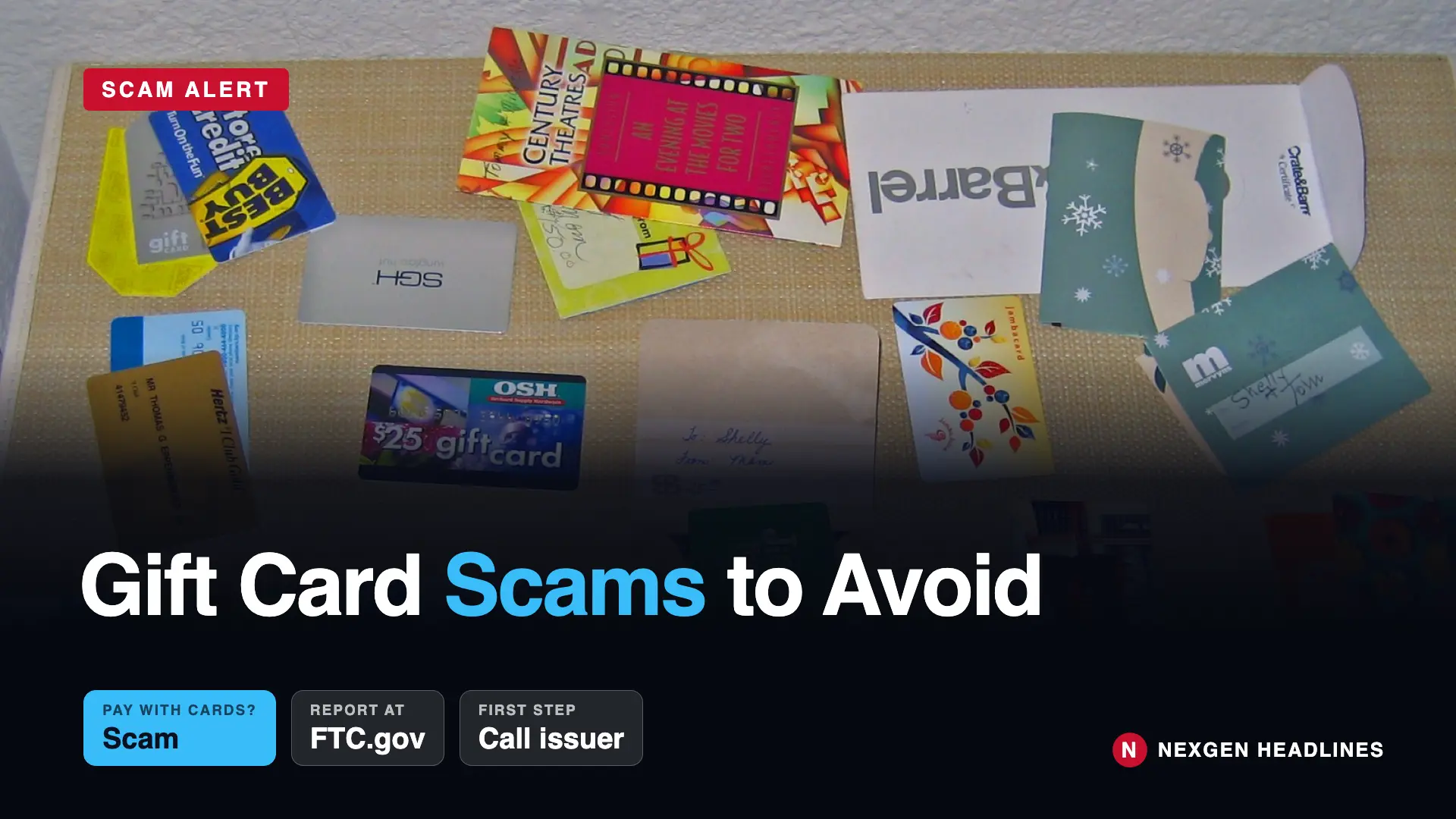
Featured image: Assorted gift cards. Photo: Tom Eppenberger Jr. via Wikimedia Commons, CC BY 2.0; edited by Nexgen Headlines.