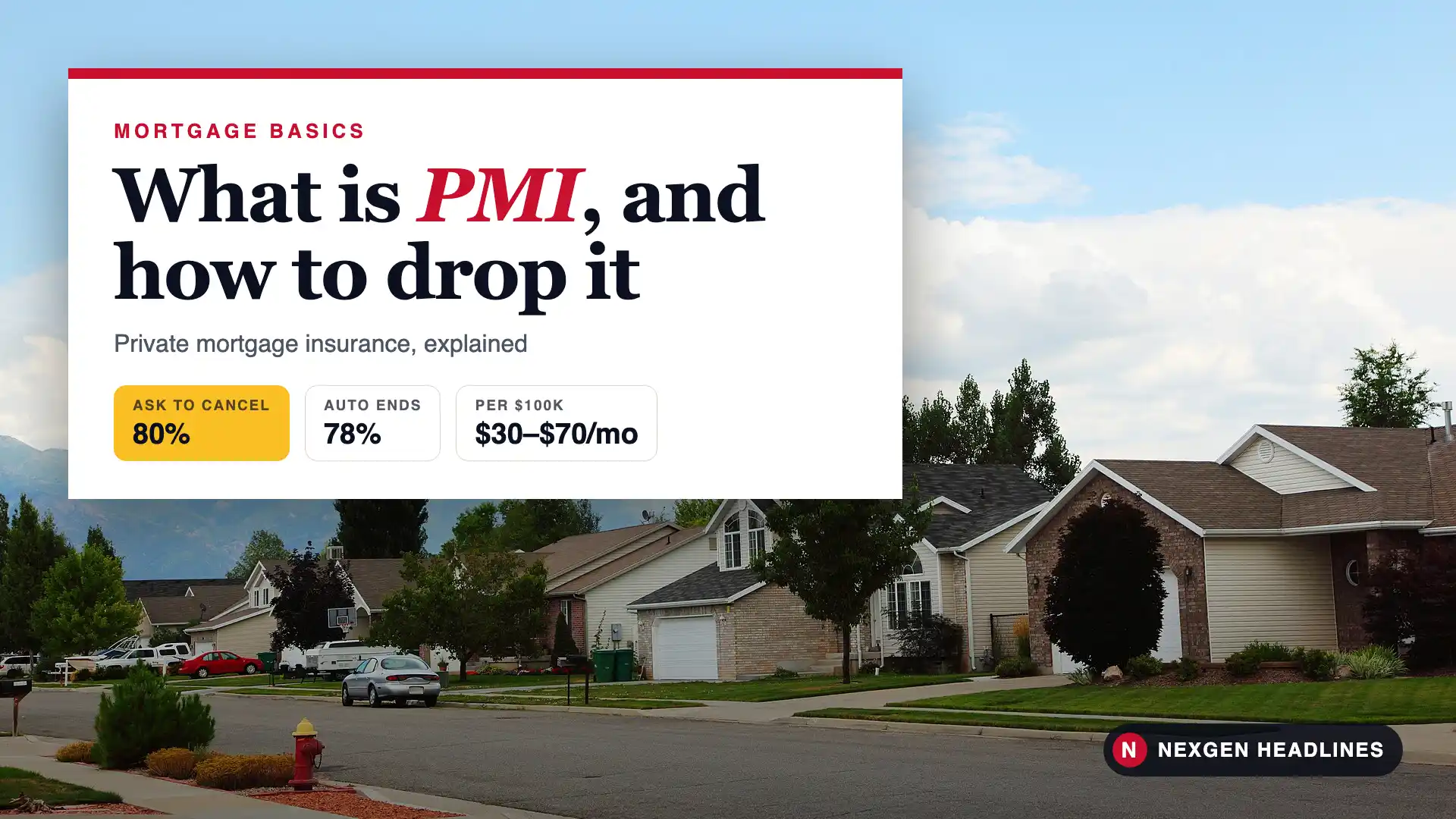

Quick answer: Private mortgage insurance (PMI) is insurance that protects your lender, not you, if you stop paying a conventional mortgage. You usually pay it when your down payment is under 20%. Freddie Mac says it typically costs about $30 to $70 a month for every $100,000 borrowed. You can ask to cancel it when your balance reaches 80% of the home’s original value, and it must end automatically at 78%.
PMI is the price of buying a home with less than 20% down. It’s not a penalty, and for many buyers it’s worth it, because it gets them into a home years sooner. But it’s easy to pay it longer than you need to. Here’s how PMI works, what it costs, and the fastest legal ways to get rid of it.
PMI at a glance
| Question | Answer |
|---|---|
| Who needs it? | Conventional loan borrowers with less than 20% down |
| Who does it protect? | The lender |
| Typical cost | About $30–$70 per month per $100,000 borrowed (Freddie Mac) |
| Ask to cancel | When the balance hits 80% of the original value |
| Automatic end | At 78% on the original schedule, or the loan’s midpoint |
| FHA loans | Use MIP instead of PMI, with different rules |
| VA loans | No monthly mortgage insurance (a funding fee applies) |
| Tax deduction | Restored starting with the 2026 tax year, if you itemize (income limits) |
What PMI is and why lenders require it
When you put less than 20% down, the lender takes more risk. If you default and the home sells for less than you owe, the lender loses money. PMI covers part of that loss.
You pay the premium, but the insurance company pays the lender if something goes wrong. PMI doesn’t protect your equity or help you if you lose your job. It doesn’t stop a foreclosure.
The upside is real, though. Without PMI, most lenders wouldn’t offer conventional loans with 3%, 5% or 10% down. PMI is what makes those loans possible.
How much does PMI cost?
Freddie Mac’s homebuyer guide estimates $30 to $70 per month for every $100,000 you borrow. Your exact price depends on:
- Your credit score. Higher scores get much lower rates.
- Your down payment. 15% down costs less than 5% down.
- The loan type and term. Fixed-rate 15-year loans often price lower than 30-year loans.
- Your debt-to-income ratio and whether the home is your main residence.
| Loan amount | Monthly PMI at $30 per $100k | Monthly PMI at $70 per $100k |
|---|---|---|
| $200,000 | $60 | $140 |
| $300,000 | $90 | $210 |
| $400,000 | $120 | $280 |
| $500,000 | $150 | $350 |
Estimates based on Freddie Mac’s typical range. Your quote will vary.
The 4 ways to pay for PMI
- Borrower-paid monthly PMI. The most common. It’s added to your monthly mortgage payment, and you can cancel it later.
- Single-premium PMI. You pay it all up front at closing. No monthly bill, but you don’t get it back if you sell or refinance early.
- Split-premium PMI. Part at closing, part monthly.
- Lender-paid PMI (LPMI). The lender pays it and charges you a higher interest rate instead. You can’t cancel it; the higher rate stays unless you refinance.
Made-up example (for illustration):
Marcus and Jen buy a $375,000 home with 10% down. Their loan is $337,500. With good credit, their lender quotes PMI of about $135 a month, close to $40 per $100,000.
The 80% mark on the original value is $300,000. Following their regular payment schedule, their balance would reach that point in roughly eight to nine years. By paying an extra $300 a month toward principal, they get there years earlier and send their servicer a written cancellation request. That drops $135 from their monthly bill.
Timelines are rough estimates and depend on the interest rate.
How to get rid of PMI: your options
The Homeowners Protection Act gives you federal rights on most conventional loans for a primary home made after July 29, 1999.
- Ask at 80%. When your balance reaches 80% of the home’s original value (usually the lower of the price or appraisal), you can request cancellation in writing. You must have a good payment history, be current, and the lender may require proof the home hasn’t lost value and that there’s no second mortgage.
- Automatic at 78%. Your servicer must end PMI when your balance is scheduled to hit 78% of the original value, if you’re current.
- Final termination at the midpoint. If PMI is still there, it must end the month after the loan reaches the halfway point of its term (year 15 of a 30-year loan), if you’re current.
- Get there sooner with extra payments. Extra principal moves you to 80% faster.
- Use a new appraisal. If your home’s value has jumped, many lenders (following Fannie Mae and Freddie Mac rules) may drop PMI based on current value. They often want at least two to five years of ownership and a lower loan-to-value. Ask your servicer for their rules first, and expect to pay for the appraisal.
- Refinance. If you now have 20% equity, a new loan won’t need PMI. Only do this if the rate and closing costs make sense.
Also read: What is escrow on a mortgage?
PMI vs. FHA mortgage insurance (MIP)
| Feature | Conventional PMI | FHA MIP |
|---|---|---|
| Upfront fee | Usually none | 1.75% of the loan |
| Annual premium | Based on credit and down payment | 0.55% for most new borrowers |
| Can it be removed? | Yes, at 80%/78% | After 11 years if you put 10%+ down; otherwise for the life of the loan |
| Best for | Good credit, 3%–19% down | Lower credit scores |
The only way to drop lifetime FHA insurance is usually to refinance into a conventional loan once you have enough equity.
Is PMI tax-deductible?
For the 2026 tax year (returns filed in 2027), yes for many people. The 2025 federal tax law permanently treats mortgage insurance premiums on home purchase debt as deductible mortgage interest, starting in 2026. Key limits:
- You must itemize; most people take the standard deduction instead.
- The deduction phases out at higher incomes (it starts shrinking above $100,000 of adjusted gross income).
- It doesn’t apply to your 2025 return.
Ask a tax professional how it fits your situation.
Is it worth paying PMI?
Often, yes. Saving 20% on a $375,000 home means $75,000 in cash. Waiting years to save that while prices and rents rise can cost more than PMI. A few hundred dollars a month for a few years may be a fair trade.
PMI may not be worth it if it leaves you with no emergency fund, or if a small extra saving would get you to 20% soon.
Mistakes to avoid
- Waiting for automatic removal. Asking at 80% saves months of payments.
- Missing payments. A late payment history can block cancellation.
- Not knowing your PMI type. Lender-paid PMI can’t be canceled.
- Confusing PMI with mortgage life insurance. PMI never pays off your loan for your family.
- Not checking your annual statement. Servicers must tell you about your cancellation rights.
Recommended products
Disclosure: As an Amazon Associate, Nexgen Headlines earns from qualifying purchases.
FAQ
Can I avoid PMI with less than 20% down?
Sometimes. VA loans have no monthly mortgage insurance, some lenders offer lender-paid PMI with a higher rate, and some credit unions run special programs. A “piggyback” second loan is another option, but it adds a second payment.
Does PMI go away on its own?
Yes. On most conventional loans it ends automatically at 78% of the original value on your regular schedule, or at the loan’s midpoint. You can ask to cancel earlier, at 80%.
Does my home value increase help me drop PMI?
It can. Many servicers allow removal based on a new appraisal after a set number of years. The federal 80%/78% rules use the original value, so this is a lender policy, not a legal right. Ask first.
Is PMI the same as homeowners insurance?
No. Homeowners insurance protects your house and belongings. PMI protects the lender if you default.
How do I find out how much PMI I pay?
Check your monthly mortgage statement, your annual escrow statement or your Closing Disclosure. Your servicer can also tell you the date you’ll reach 78%.
Bottom line
PMI lets you buy with less than 20% down, at a typical cost of $30–$70 a month per $100,000 borrowed. Treat it as temporary. Know your 80% date, pay extra principal if you can, and send a written cancellation request the moment you qualify. That’s real money back in your budget every month.
Last reviewed: Nov. 22, 2026. Lender rules vary; confirm with your servicer.
Sources: CFPB: When can I remove PMI?, FDIC: Homeowners Protection Act, Freddie Mac: What is PMI?, HUD (FHA mortgage insurance), Thomson Reuters on the 2025 tax law, Bankrate.
Featured image: Suburban homes in Layton, Utah. Photo: Pink Sherbet Photography / Wikimedia Commons, CC BY 2.0; edited by Nexgen Headlines.