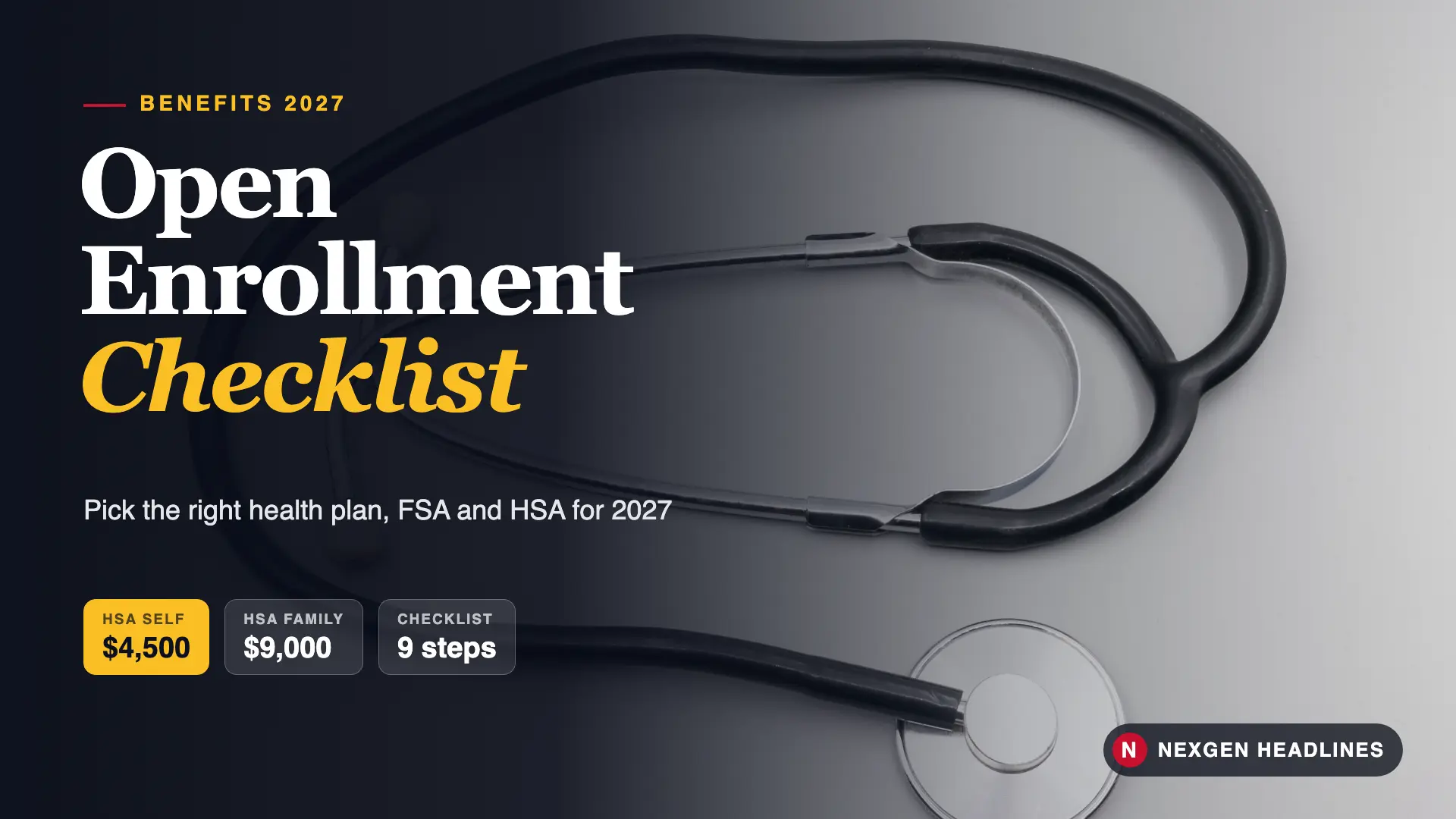

Quick answer: Workplace open enrollment is your once-a-year chance to change health insurance, FSA, HSA, life and disability coverage for 2027. Many employers hold it in November, and the choices you make usually lock in for the whole year. Don’t just click “keep my current plan”: compare premiums and deductibles, check that your doctors and prescriptions are still covered, and set new FSA or HSA amounts. For 2027 the IRS raised the HSA limit to $4,500 for self-only coverage and $9,000 for family coverage.
Open enrollment emails are easy to ignore. Most people re-enroll in last year’s plan without looking, then find out in March that their prescription moved to a higher price tier or their doctor left the network. Thirty minutes with this checklist can save hundreds or even thousands of dollars next year.
Your open enrollment checklist
- Find your deadline. Check your HR email or benefits portal. Missing it usually means you are stuck with your current choices until next year, unless you have a qualifying life event.
- Read what changed. Look for your plan’s “summary of benefits and coverage” and any notice of changes for 2027.
- List your expected medical needs for next year: regular prescriptions, specialists, planned surgery, a new baby or physical therapy.
- Check your doctors and drugs. Use each plan’s provider directory and drug list (formulary) to confirm coverage.
- Compare total cost, not just premiums. Add yearly premiums plus your likely out-of-pocket costs.
- Set your FSA or HSA contribution.
- Review life, disability and other extras.
- Update dependents and beneficiaries.
- Save your confirmation. Take a screenshot or download the summary after you submit.
Why this year deserves a closer look
Health plan costs change every year, and employers often pass part of rising costs on through higher premiums, bigger deductibles or narrower networks. Even if you liked your plan in 2026, the 2027 version may be different. Drug lists change too: a medicine that cost a $10 copay this year could move to a higher tier next year. The only way to know is to look at the 2027 plan documents, not last year’s.
How to compare health plans
| Term | What it means |
|---|---|
| Premium | What comes out of your paycheck for coverage, whether you use care or not |
| Deductible | What you pay for covered care before the plan starts sharing costs |
| Copay / coinsurance | Your share of each visit or service after the deductible |
| Out-of-pocket maximum | The most you would pay in a year for covered in-network care |
| Network | The doctors and hospitals the plan covers at the lowest cost |
A simple way to compare: for each plan, add 12 months of premiums to the out-of-pocket costs you expect. Then look at the out-of-pocket maximum as your “bad year” number. The cheapest plan in a healthy year is not always the cheapest in a hard one.
Made-up example (not a real person): Priya compares two plans. Plan A costs $160 a month with a $500 deductible. Plan B, a high-deductible plan, costs $70 a month with a $1,800 deductible, and her employer adds $750 to an HSA. She expects only a few doctor visits and one generic prescription. Plan B saves her $1,080 in premiums, and the $750 employer HSA money covers most of her likely costs. She picks Plan B and puts some of the savings into her HSA for a bad year.
HSA vs FSA: which one, and how much?
| HSA (health savings account) | Health FSA (flexible spending account) | |
|---|---|---|
| Who can use it | Only people in an HSA-eligible high-deductible health plan | Offered by many employers, with most plan types |
| Rolls over? | Yes, the money is yours to keep, even if you change jobs | Mostly “use it or lose it,” though some plans allow a small carryover or grace period |
| 2027 limit | $4,500 self-only / $9,000 family, plus $1,000 catch-up at 55+ | Set by the IRS each year; check your employer’s 2027 limit |
| Can it be invested? | Often, yes | No |
For 2027, a plan generally counts as HSA-eligible only if its deductible is at least $1,750 for self-only or $3,500 for family coverage, according to IRS Revenue Procedure 2026-24.
Setting an FSA amount: add up costs you are almost sure to have, such as prescriptions, glasses, dental work or a planned procedure. Because unused FSA money can be lost, it is better to be a little low than too high.
Also read: Use Your FSA Money Before Dec. 31
Don’t skip the “extras”
- Dental and vision: worth it if you or your kids need regular cleanings, glasses or braces. Compare the premium to what you would pay out of pocket.
- Life insurance: many employers offer basic coverage for free. Extra coverage can be cheap, but it may not follow you if you leave the job.
- Disability insurance: replaces part of your income if you cannot work due to illness or injury. Often overlooked and very valuable.
- Dependent care FSA: lets you pay for child care or adult day care with pre-tax money.
- Legal, pet or identity theft plans: optional. Buy only if you would really use them.
Life changes that affect your choices
- Getting married or divorced: compare your plan against your spouse’s plan and look at family coverage costs.
- Having a baby: check maternity coverage, pediatricians in network and the out-of-pocket maximum.
- Kids turning 26: they can usually stay on a parent’s plan until age 26, then need their own coverage.
- Planning a surgery: a plan with a lower out-of-pocket maximum may cost less overall.
- Turning 65: learn how employer coverage works with Medicare before you make changes.
Questions to ask HR before you choose
- Will my premium go up for 2027, and by how much?
- Is the employer adding money to an HSA, and when is it deposited?
- Does the FSA allow a carryover or a grace period, and how much?
- Are there wellness credits or lower premiums for completing a health screening?
- Is there a telehealth option, and what does a virtual visit cost?
- Do spouses have a surcharge if they can get coverage through their own job?
Write the answers down. They often change the math between two plans.
Don’t forget your retirement plan
Open enrollment is a good moment to check your 401(k) or 403(b) too, even though changes are usually allowed year-round. Make sure you contribute at least enough to get your full employer match, which is part of your pay. If you got a raise this year, consider raising your contribution by 1% at the same time; you are less likely to miss money you never saw in your paycheck. The IRS announces new contribution limits for the coming year each fall, so check your plan’s 2027 limit before you set a new amount.
Common open enrollment mistakes
- Auto-renewing without checking changes in premiums, networks or drug lists.
- Choosing by premium alone and ignoring the deductible and out-of-pocket maximum.
- Over-funding an FSA and losing the leftover money.
- Not using free employer HSA money, which some companies give just for enrolling.
- Forgetting beneficiaries on life insurance and retirement accounts.
- Missing the deadline and getting stuck with coverage that no longer fits.
No workplace plan? Use the ACA marketplace
If your job does not offer health insurance, or you are self-employed, you can shop for 2027 coverage on HealthCare.gov or your state’s marketplace. You may qualify for savings based on your income. See our guide to ACA open enrollment for 2027.
Keep your health paperwork organized
Disclosure: As an Amazon Associate, Nexgen Headlines earns from qualifying purchases.
FAQ
When is workplace open enrollment?
It depends on your employer. Many hold it in November for coverage starting Jan. 1. Check your HR emails or benefits portal for your exact dates.
What happens if I miss open enrollment?
You usually keep your current coverage or go without until next year, unless you have a qualifying life event such as marriage, a new baby or losing other coverage.
What are the 2027 HSA limits?
$4,500 for self-only coverage and $9,000 for family coverage, plus a $1,000 catch-up contribution if you are 55 or older.
Should I pick a high-deductible plan?
It can save money if you are generally healthy and can afford the deductible, especially if your employer adds money to an HSA. Compare total yearly costs first.
Can I change my FSA amount during the year?
Usually only after a qualifying life event. Otherwise the amount you choose during open enrollment applies for the whole plan year.
Bottom line
Open enrollment takes about 30 minutes and affects a whole year of your health costs. Check what changed, confirm your doctors and drugs, compare total costs and set your FSA or HSA amount before the deadline.
Last reviewed: Nov. 1, 2026.
Sources: IRS Revenue Procedure 2026-24 (2027 HSA limits); Ascensus: 2027 HSA limits released; HealthCare.gov; US Department of Labor, Employee Benefits Security Administration.
Featured image: A stethoscope. Photo: Jacek Halicki via Wikimedia Commons, CC BY-SA 4.0; edited by Nexgen Headlines.