
Quick answer: Polls first close at 6 p.m. ET on Tuesday, Nov. 3, in parts of Indiana and Kentucky. Many races will be projected on election night. Close races, and states that accept mail ballots for days after Election Day, such as California, Oregon and Nevada, can take days or even weeks. A news projection is not the official result. Official results come when each state certifies, mostly in mid-November to mid-December.
What’s on the ballot
- All 435 House seats. Every member of the House is up every two years.
- 35 Senate seats. That is the regular 33 plus two special elections, in Ohio and Florida.
- 36 governor races, plus many state legislatures, ballot measures and local offices.
Control of Congress can be clear on election night, or it can hinge on a few close House seats in slow-counting states. In recent midterms, it has sometimes taken more than a week to know which party won the House.
Election night timeline (Eastern Time)
| Time (ET) | What happens |
|---|---|
| 6 p.m. | First polls close in parts of Indiana and Kentucky |
| 7 p.m. | Georgia, Virginia, South Carolina, Vermont and most of Florida close |
| 8 p.m. | Large group closes, including Pennsylvania, most of Michigan, most of Texas and much of the Northeast |
| 9 p.m. | Arizona, New York, Wisconsin, Minnesota and others close |
| 10 p.m. | Nevada, Utah, Montana and most of Idaho close |
| 11 p.m. | California, Oregon and Washington close |
| Midnight–1 a.m. | Hawaii and Alaska close; Alaska’s far-west polls close last |
Times are a general guide based on state schedules compiled by Ballotpedia. Some states span two time zones, so a few counties close an hour later. Always check your own state’s hours.
Why some states count faster than others
The speed of the count comes down to one question: when is a state allowed to start processing mail ballots? Processing means checking envelopes, verifying signatures and, in many states, scanning ballots into machines before results are released.
- Fast starters. According to the Center for Election Innovation & Research, at least 33 states let officials scan mail ballots into tabulators before Election Day. Results are still not released until polls close, but the work is done early. Florida is the classic example. It usually reports most of its vote within hours.
- Election Day starters. About 14 more states allow scanning on Election Day, before polls close. Pennsylvania is in this group. It cannot start processing mail ballots until 7 a.m. on Election Day, so its mail vote can take longer to count.
- After-polls-close states. Only three states, Alabama, Alaska and Mississippi, do not allow scanning until polls close.
North Carolina changed its rules this year. A law passed in August 2026 requires county boards to begin counting early and mail votes during the day on Election Day, instead of waiting for polls to close. That should speed up its results.
States that accept ballots after Election Day
The other big factor is late-arriving mail. In June 2026, the U.S. Supreme Court ruled in Watson v. Republican National Committee that federal law does not stop states from counting mail ballots that arrive after Election Day, as long as they were postmarked by Election Day. So it is up to each state.
| State | Late ballot window (postmarked by Election Day) | What it means |
|---|---|---|
| California | Up to 7 days | Close House races can shift for a week or more. Counties certify by Dec. 3, the state by Dec. 11. |
| Oregon | Up to 7 days | Mail-only state; close races can take several days. |
| Nevada | Until 5 p.m. on the fourth day after the election | Statewide races can stay uncalled for days. |
| Ohio | None | A 2025 law ended counting of mail ballots that arrive after Election Day. |
Rules can change and some states have other exceptions, such as for military and overseas voters. Check your state election office for the exact rule.
What to watch in the first few hours
Early returns can mislead. In some states, the first numbers are early and mail votes, which have leaned one way in recent elections. In others, the first numbers are Election Day votes, which can lean the other way. As more ballots come in, the lead can shift. Analysts sometimes call this a “red mirage” or “blue shift.” It’s not a sign that anything changed. It’s just the order ballots are counted in.
A better signal than the raw lead is how much of the expected vote has been counted. Most results pages show an estimate, such as “75% of expected vote in.” Until that number is high, a lead is only a snapshot.
Runoffs and recounts can add weeks
Georgia requires a majority to win. If no candidate gets more than 50%, a runoff is set for Dec. 1. That means a Georgia race could stay open until December.
Many states also have automatic recounts when the margin is very thin, often half a percentage point or less. A recount can’t start until the first count is done, so it adds days or weeks.
Projection vs. official result
On election night, you will hear that a race has been “called.” That is a projection by a news organization, such as the Associated Press, based on votes counted so far and where the remaining ballots are. It is usually right, but it is not legal.
The official result comes when the state certifies. That happens after counties finish counting, verify ballots and audit. In Arizona, the state certification is listed for Nov. 23 and in Nevada Nov. 24, while California’s statewide certification is set for Dec. 11. Pennsylvania has no single fixed date.
A slow count is not a sign of fraud. It usually means the state is doing what its law requires: verifying signatures, counting late-arriving mail and fixing small problems, called “curing,” on ballots with a missing signature.
How I’ll follow it (and you can too)
Refreshing five different maps at once is the fastest way to go to bed more confused than when you started. My plan this year is simpler. Picture Mike, a nurse in Ohio who gets off shift at 7 p.m. (Mike is an illustrative example.) He doesn’t need every update. He needs three check-ins.
I’ll watch the 7 p.m. and 8 p.m. closings for early signals, then check back at 11 p.m. ET when the West Coast closes. If the House is still close by midnight, I’ll stop. It will not be settled that night. I’ll check the AP’s race calls and my own state’s official results page the next morning, and again after the weekend for California and Nevada.
Where to get reliable results
- Your state election office or Secretary of State website. This is where official numbers come from. Find yours at USA.gov.
- Your county election office, for local races and ballot counts in your area.
- Major news organizations that publish results feeds and explain their race calls, such as the AP.
Be careful with screenshots on social media that claim a winner before polls close. Results are not released anywhere until a state’s polls close.
If you haven’t voted yet
- Polls are open on Tuesday, Nov. 3. If you are in line when polls close, stay in line. You can still vote.
- Find your polling place and ID rules at Vote.gov or your state election site.
- If you have a mail ballot, check your state’s deadline. In many states it must be received, not just postmarked, by Election Day. If it’s late, drop it at an official drop box or election office instead of the mail.
Also read: Election Day 2026: how to check your voter registration and ways to vote
Frequently asked questions
What time do polls close on Nov. 3, 2026?
The first polls close at 6 p.m. ET in parts of Indiana and Kentucky. The last close in Alaska after midnight ET. Most states close between 7 p.m. and 9 p.m. local time.
Will we know who controls Congress on election night?
Maybe. If the result is lopsided, yes. If control comes down to a handful of close House seats in California or other slow-counting states, it could take days.
Why does California take so long to count?
California mails a ballot to every voter and accepts ballots postmarked by Election Day that arrive up to seven days later. Counties also verify signatures and let voters fix problems.
Does a slow count mean something is wrong?
No. Slow counts mostly reflect state laws on when mail ballots can be processed and how long late ballots are accepted.
When are results official?
When each state certifies. Dates vary, from late November in states like Arizona and Nevada to Dec. 11 in California.
The bottom line
Expect some answers on Tuesday night and the rest over the next days and weeks. Watch the poll closing times, trust official state sources, and don’t read too much into early numbers in states that count mail last. If a race is close, patience is the right call, not a red flag.
Last reviewed: Oct. 27, 2026. Election rules can change close to Election Day; check your state election office.
Sources: Ballotpedia, State Poll Opening and Closing Times (2026); Center for Election Innovation & Research, Pre-Processing Timelines (Fall 2026); Voting Rights Lab, 2026 Battleground Report; USA.gov; Vote.gov.
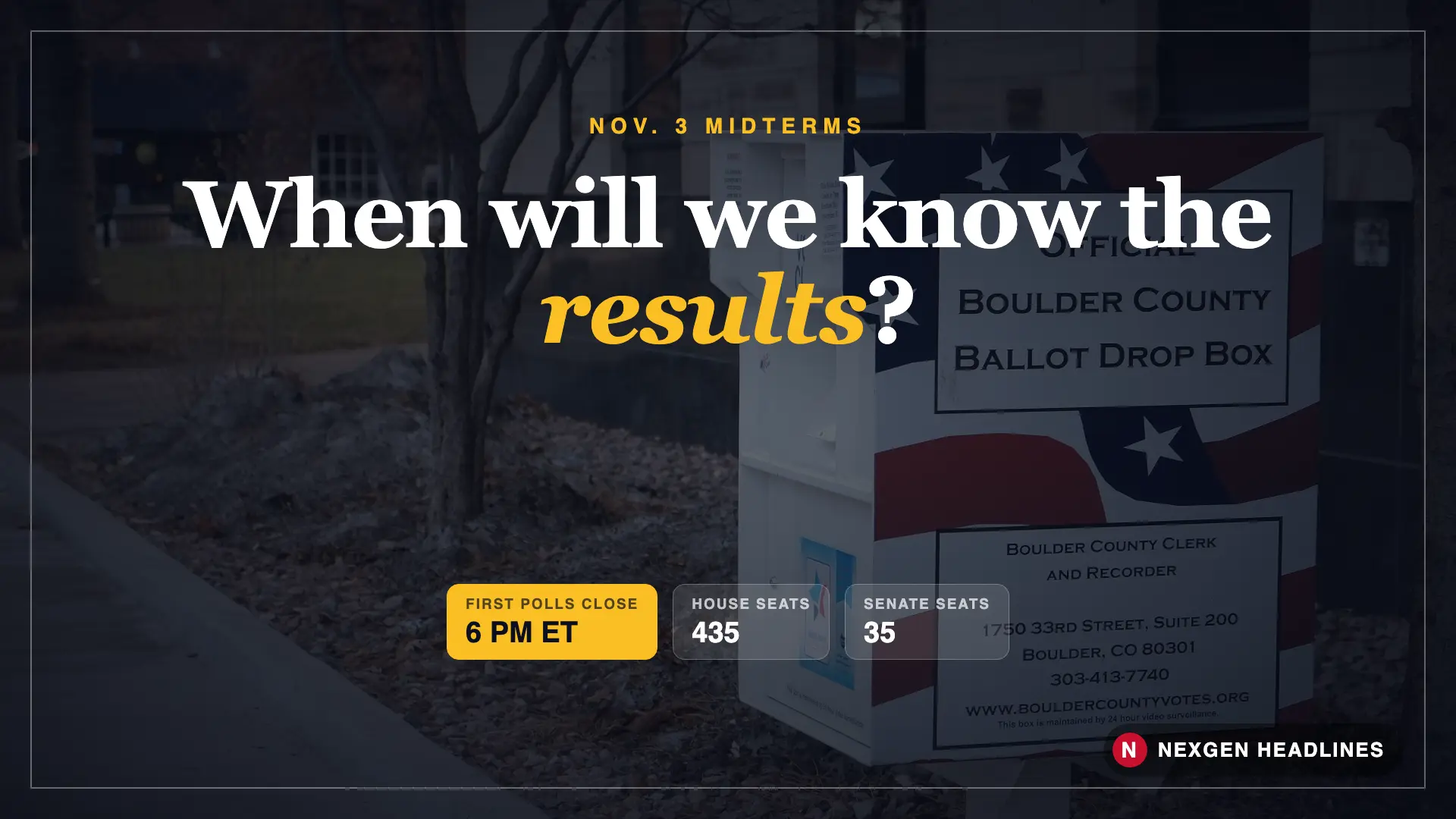
Featured photo: Official ballot drop box, Boulder County, Colo. Paul Sableman / Wikimedia Commons, CC BY 2.0. File photo.