Spiritual Luxury in China is becoming an increasingly visible consumer trend as younger shoppers move beyond traditional status symbols and look for products and experiences that offer emotional meaning, personal identity, relaxation, or a sense of good fortune.
For years, China’s young luxury consumers were closely associated with major international fashion houses and recognizable logos. Designer sneakers, handbags, watches and accessories became powerful symbols of success. But a new generation of shoppers appears to be asking a different question: Does this purchase make me feel better, calmer, happier or more connected to who I am?
That change is creating a fascinating new market for crystals, lucky jewelry, fragrances, wellness experiences, temple visits, travel and products inspired by traditional Chinese philosophies. Recent reporting by CNN found that young consumers are increasingly spending on items with what they describe as “emotional value,” rather than simply buying products because they carry a famous logo.
From Famous Logos to Emotional Value
The change does not mean young Chinese consumers have stopped buying luxury brands.
Instead, the meaning of luxury appears to be evolving.
A designer handbag may once have communicated wealth and social status. Today, some consumers are more interested in whether an item has a story, represents their personality or provides an emotional connection.
One example highlighted in recent reporting is 22-year-old student Zirui Yang, who said his shopping habits changed from branded clothing and accessories toward smaller purchases such as plush toys, fragrances, travel and other items that provide emotional value.
That shift reflects a broader idea: luxury does not always have to be visible to other people.
Sometimes, consumers want something that feels valuable primarily to themselves.
What Is ‘Spiritual Luxury’?
The term Spiritual Luxury in China describes a broad range of purchases and experiences connected to emotional well-being, traditional beliefs, self-expression and personal comfort.
The trend can include:
- Crystal bracelets
- Lucky jewelry
- Feng shui-inspired products
- Zen-style clothing
- Fragrances
- Wellness retreats
- Meditation experiences
- Temple visits
- Spiritual tourism
- Astrology and fortune-telling services
Not everyone who participates in these trends considers themselves religious.
For many young consumers, the appeal is simply about finding a moment of calm or optimism during an uncertain period.
Economic Uncertainty Is Part of the Story
China’s changing economic environment is an important part of this consumer shift.
Young adults face concerns about employment, salaries, housing and future opportunities. Against that backdrop, small purchases that provide emotional comfort can become particularly attractive.
CNN reported that China’s personal luxury market contracted by as much as 5% in 2025, according to Bain & Company, while certain categories connected to spiritual and emotional consumption continued attracting attention.
The contradiction is striking.
People may be more cautious about expensive traditional luxury purchases while still spending money on products that promise a feeling of comfort, identity or hope.
Crystals Become a New Kind of Treat
Crystal jewelry has become one of the clearest examples of the trend.
According to e-commerce data cited by CNN, sales of crystal bracelets in China rose 320% year over year in 2024. The data also indicated that crystal bracelets represented more than one-third of an estimated 3 billion yuan online crystal market.
For some consumers, crystals are simply attractive accessories.
For others, they are associated with ideas about energy, luck, relationships, career success or emotional protection.
The important point for retailers is that the product can offer both aesthetic and symbolic value.
Luxury Jewelry Gets a Spiritual Meaning
Even expensive international jewelry brands are being interpreted through this new consumer mindset.
Certain jewelry designs have acquired symbolic meanings among Chinese social-media users.
Clover-shaped jewelry, for example, can be associated with luck. Other shapes or colors may be linked online with career success, relationships or financial fortune.
That means a luxury item can serve two purposes at once: it can be a status symbol and a personal talisman.
This gives traditional luxury products a new emotional layer without necessarily changing the product itself.
Temple Tourism Is Booming
The trend extends far beyond shopping.
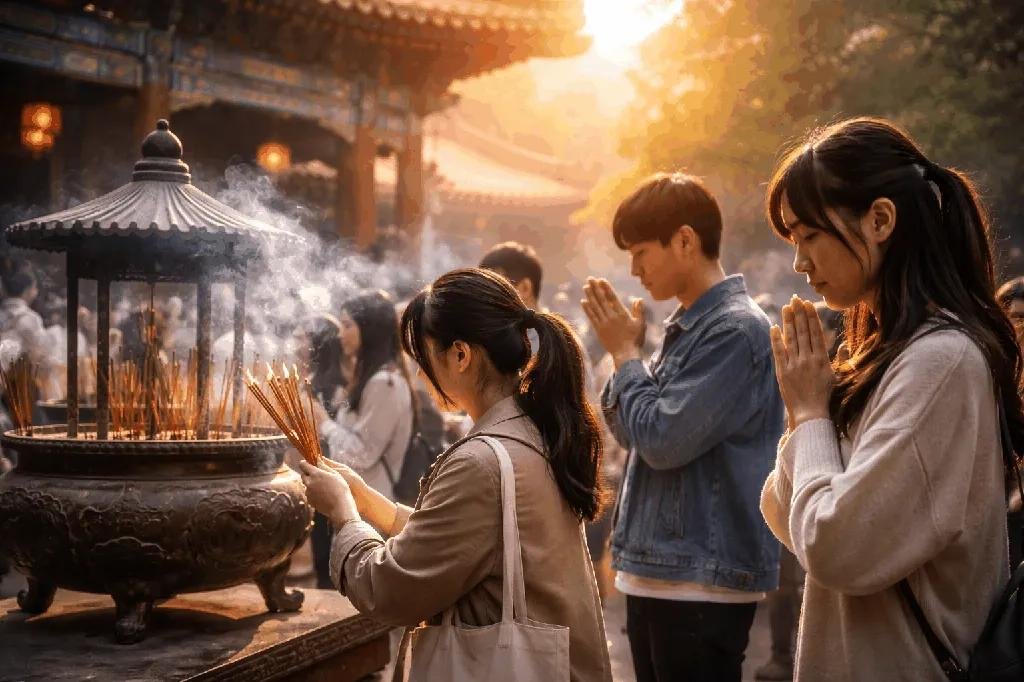
Young Chinese consumers are increasingly visiting temples and historic spiritual sites as part of travel experiences.
Mount Emei in Sichuan, along with temples across the country, has become part of a growing culture of spiritual tourism and wellness travel. Some visitors go for religious reasons, while others are looking for quiet surroundings, reflection, cultural experiences or simply an escape from busy city life.
For some young people, a weekend at a temple can offer something a luxury shopping trip cannot: time away from constant digital stimulation.
Social Media Is Driving the Trend
Chinese social media platforms are playing an enormous role in spreading spiritual consumer culture.
The hashtag #xuanxue, referring broadly to spiritual mysticism or esoteric practices, has accumulated more than 5 billion views on Xiaohongshu, according to CNN. A separate “Zen style” trend has also attracted hundreds of millions of views.
Influencers share temple trips, lucky accessories, wellness routines and spiritual-inspired fashion.
What begins as a personal interest can quickly become a social trend.
Brands Are Paying Attention
Major consumer brands have noticed the opportunity.
CNN reported that companies including Lululemon and coffee chain M Stand have incorporated spirituality-related themes into marketing campaigns in China.
Some collaborations have been particularly unexpected. Molly Tea worked with a historic temple in Hangzhou, while Burger King partnered with the Taoist site Mount Longhu for a Lunar New Year promotion.
These partnerships show how spiritual culture is moving from the margins of consumer life into mainstream marketing.
Local Brands Take a Different Approach
Chinese brands are also finding ways to connect luxury with emotional well-being without relying on obvious religious imagery.
The handbag label Songmont, for example, has developed branding around ideas such as slowing down, creativity and self-acceptance.
This approach represents an important change in luxury marketing.
Instead of telling consumers, “Buy this because everyone will recognize the logo,” brands can say, “Buy this because it reflects the person you want to be.”
That is a much more personal relationship between a consumer and a product.
A New Definition of Success
Perhaps the most important part of Spiritual Luxury in China is what it says about changing ideas of success.
Traditional luxury often communicates achievement through visible possessions.
The emerging model is more private.
A person may spend money on a wellness retreat, a meaningful fragrance, a handcrafted accessory or a temple trip without caring whether anyone else recognizes its value.
The luxury is the experience itself.
Not Everyone Sees the Trend Positively
There are also concerns.
Chinese state media has warned that spiritual and mystical trends can expose consumers to scams and excessive superstition. CNN reported that Chinese commentary has cautioned people against becoming overly dependent on such practices.
That distinction matters.
There is a difference between buying a bracelet because its design feels meaningful and believing that an expensive object can guarantee financial success or protect someone from every problem.
Consumer awareness will therefore remain important as the market grows.
What This Means for Global Luxury Brands
The rise of Spiritual Luxury in China offers an important lesson for international companies.
Young consumers increasingly want brands to provide more than products.
They want stories, experiences, cultural connections and emotional value.
A logo may still matter, but it may no longer be enough.
Brands that understand local traditions and create authentic experiences could have an advantage over companies that simply place familiar logos on products.
The Future of Luxury Could Be More Personal
Spiritual Luxury in China
China’s young consumers are not necessarily rejecting luxury.
They are redefining it.
A beautiful object can still be desirable, but its emotional meaning may now matter just as much as its price or brand name.
Wellness, travel, spirituality, cultural heritage and self-expression are increasingly becoming part of the luxury conversation.
That could eventually influence consumer behavior well beyond China.
Summary
Spiritual Luxury in China reflects a powerful change in how younger consumers think about spending and personal identity. Instead of focusing exclusively on famous logos and visible status, many are exploring crystals, lucky jewelry, wellness retreats, temple tourism, fragrances and culturally inspired products that offer emotional or symbolic value. Economic uncertainty and social media are helping accelerate the trend, while brands are responding with new experiences and marketing strategies. The result is a fascinating new definition of luxury—one centered less on impressing others and more on finding meaning, comfort and personal connection.
THNAKS FOR READING