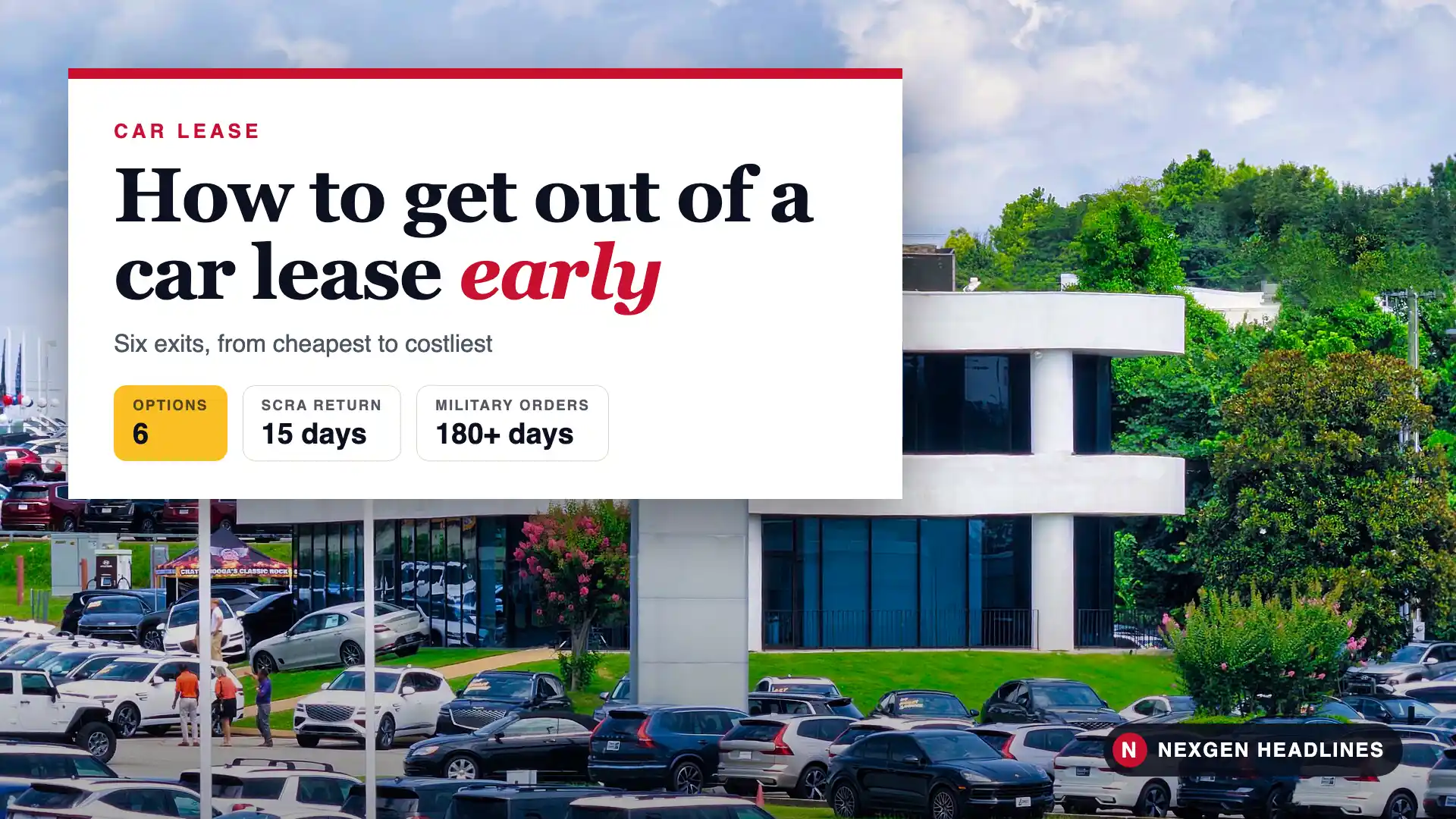

Quick answer: You have six main ways to get out of a car lease early: transfer it to someone else, sell the car to a dealer, buy it out yourself, trade it in, return it and pay the early termination charge, or use the Servicemembers Civil Relief Act (SCRA) if you qualify. A lease transfer or a dealer sale is usually the cheapest. Plain early termination is usually the most expensive. Your first step is a call to your leasing company for the payoff amount.
Leases are built to run to the end. Breaking one early almost always costs something. But “something” can be a few hundred dollars or several thousand, depending on the route you pick. Here’s how to compare them without guessing.
Your options at a glance
| Option | Typical cost to you | Best when |
|---|---|---|
| 1. Lease transfer (swap) | Transfer fee plus listing fee; you may still be liable if the new driver defaults (lender rules vary) | Your monthly payment is attractive and your lender allows transfers |
| 2. Sell to a dealer or online buyer | Nothing, or you pay the gap if the offer is below payoff | The car is worth more than the payoff (positive equity) |
| 3. Buy out the lease | The payoff amount, plus tax and fees | You want to keep the car or sell it privately |
| 4. Trade in for another car | Any negative equity gets rolled into the next deal | You were buying a new car anyway |
| 5. Early termination | Often thousands: remaining payments or a set formula, plus fees | Last resort |
| 6. SCRA termination | No early termination charge; prorated payments until you return the car | You’re active-duty military with qualifying orders |
Step 1: Find out what you owe and what the car is worth
Every decision comes down to one comparison: payoff amount vs. market value.
- Call your leasing company (or check its app) and ask for the dealer payoff and the personal payoff. They can differ. Some lenders charge more, or refuse, when a third-party dealer buys the car.
- Get three real offers for the car. Try your local dealer, the brand’s dealer, and online buyers such as CarMax or Carvana. Instant online offers take about 10 minutes.
- Subtract. If offers are above the payoff, you have positive equity and you may walk away with cash. If they’re below, you have negative equity, and that gap is your real cost of leaving.
- Read the early termination section of your lease contract. Federal rules under the Consumer Leasing Act require the lease to explain how early termination is figured.
Used-car prices have been firm in recent years, so many drivers are surprised to find their leased car is worth more than the payoff. Check before assuming the worst.
Option 1: Transfer the lease to someone else
A lease transfer, or “lease swap,” hands your remaining months to a new driver. Sites such as Swapalease and LeaseTrader list cars and match you with takers. The new driver takes over the payments and returns the car at the end.
- Check your lender first. Not every captive lender allows transfers, and some only allow them within the same state.
- Expect fees. The lender usually charges a transfer fee, and the listing site charges its own fee. Ask for both numbers up front.
- Ask about liability. Some lenders fully release you. Others keep you on the hook if the new driver stops paying. Get the release terms in writing.
Transfers work best when your payment is low compared with today’s lease deals. A cheap monthly payment with lots of miles left is easy to hand off.
Option 2: Sell the car to a dealer or online buyer
If the car is worth more than the payoff, a dealer or online buyer pays off the lease and sends you the difference. If it’s worth a bit less, you pay the gap and you’re done.
Before you sign, confirm the buyer can actually buy from your lender. Since 2020, several brands’ finance arms have limited or blocked third-party buyouts, or they charge a higher dealer payoff. If your lender blocks it, the brand’s own dealer may still be able to buy the car.
Option 3: Buy out the lease yourself
You can pay the payoff amount and own the car. Then you can keep it, or sell it privately for more than a dealer would pay. Most drivers fund a buyout with a used-car loan from a bank or credit union.
Remember that your state may charge sales tax on the buyout, and the DMV charges title and registration fees. Add those to your math. If you sell privately afterward, you handle the paperwork and the buyer screening yourself.
Option 4: Trade it in for another car
Dealers love this one, because it leads to a new sale. The dealer pays off your lease and folds any shortfall into your next loan or lease.
That’s the catch. Rolling negative equity into a new deal means you pay interest on money you lost on the old car. Ask the dealer to show the payoff, the trade value and the amount rolled over as three separate lines. If the rolled amount is large, consider waiting.
Made-up example (for illustration):
Maria has 14 months left on a lease at $389 a month. Her lender quotes a payoff of $24,600. She gets online offers of $25,900, $25,200 and $24,100.
Option A, plain early termination: her contract formula would charge her most of the remaining payments, roughly $5,000 or more. Option B, selling to the top bidder: the buyer pays $24,600 to the lender and sends Maria about $1,300. She sells, and walks away with cash instead of a bill.
These numbers are made up to show the math. Your payoff and offers will differ.
Option 5: Return it and pay the early termination charge
This is the “just give it back” route. It’s simple, but usually the most costly. The charge is often based on the gap between your remaining balance and the car’s wholesale value, plus a disposition fee and any past-due amounts. Some contracts simply bill all remaining payments.
Ask for a written estimate before you drop off the keys. You can also be charged for excess wear and extra miles on top of the termination charge.
Also read: What happens if you miss a car payment
Option 6: Military members can end a lease under the SCRA
The Servicemembers Civil Relief Act lets qualifying service members end a vehicle lease with no early termination charge. According to Military OneSource, it applies when:
- You signed the lease before active duty, and you’re called to active duty for 180 days or more; or
- You signed it during service, and you get PCS orders to a location outside the continental U.S., or deployment orders for 180 days or more.
You must send written notice with a copy of your orders and return the car within 15 days. You still owe payments prorated up to the return date. A move between two stateside bases usually doesn’t qualify. Your base legal office can review your case for free.
What if you just can’t afford the payments?
Don’t simply stop paying. A repossession hurts your credit for years, and you can still owe the gap after the car is auctioned.
- Call the lender early. Ask about a payment deferral or extension. Many lenders have hardship programs.
- Check your gap coverage. Most leases include gap protection, which covers the shortfall if the car is totaled, not if you just want out.
- Compare against keeping it. Sometimes the cheapest move is to keep paying and cut costs elsewhere.
Common mistakes to avoid
- Accepting the first trade-in offer. Offers on the same car can differ by $1,000 or more.
- Ignoring the dealer payoff vs. personal payoff gap. Ask for both.
- Forgetting sales tax on a buyout. It can add hundreds or thousands.
- Not getting a release in a transfer. Without one, the new driver’s missed payments can land on your credit report.
- Skipping a pre-inspection. Many lenders offer a free inspection before return. Fix small dings first if it’s cheaper.
Does ending a lease early hurt your credit?
Not if you do it properly. A completed transfer, sale, buyout or trade shows the lease as paid or closed. Your credit takes a hit only if you miss payments, leave a balance unpaid, or have the car repossessed. If you finance a buyout, the new loan will show a hard inquiry and a new account.
Timing tips that can save money
- Check equity every few months. Values move with the market. A car that’s underwater in spring may be above payoff by fall.
- Watch your mileage. If you’ll blow past your allowance, leaving early can avoid big per-mile charges.
- Look at the last few months. Many brands waive the last one to three payments if you lease a new car from them. Ask your dealer about “pull-ahead” offers.
Recommended products
Useful tools before you hand over or sell a leased car.
Disclosure: As an Amazon Associate, Nexgen Headlines earns from qualifying purchases.
FAQ
Can I just return my leased car early?
Yes, but you’ll usually pay an early termination charge set by your contract, plus fees. Selling or transferring the car is often cheaper.
What is the cheapest way to get out of a car lease?
If the car is worth more than the payoff, selling it to a dealer or online buyer is often cheapest and can even pay you. Otherwise, a lease transfer usually costs less than termination.
Can a dealer buy out my lease?
Often yes, but some lenders limit third-party buyouts or charge a higher dealer payoff. Ask your lender before you shop offers.
Can I get out of a car lease if I’m deployed?
Yes, under the SCRA, if your orders meet the rules (180+ days of active duty or deployment, or PCS outside the continental U.S.). You owe prorated payments until you return the car.
Will breaking a lease show up on my credit report?
Only if something goes unpaid. A properly closed lease shows as paid.
Bottom line
Get your payoff amount, then get three offers on the car. If the offers beat the payoff, sell and walk away. If not, try a lease transfer before you pay an early termination charge. Military members with qualifying orders should use the SCRA.
Last reviewed: Nov. 13, 2026. Lease terms vary by lender; check your contract.
Sources: Military OneSource: terminate your lease (SCRA), CFPB: Regulation M (Consumer Leasing Act), FTC: Financing or leasing a car, Experian: How to get out of a car lease.
Featured image: A Volvo car dealership in Chattanooga, Tennessee. Photo: Harrison Keely / Wikimedia Commons, CC BY 4.0; edited by Nexgen Headlines.