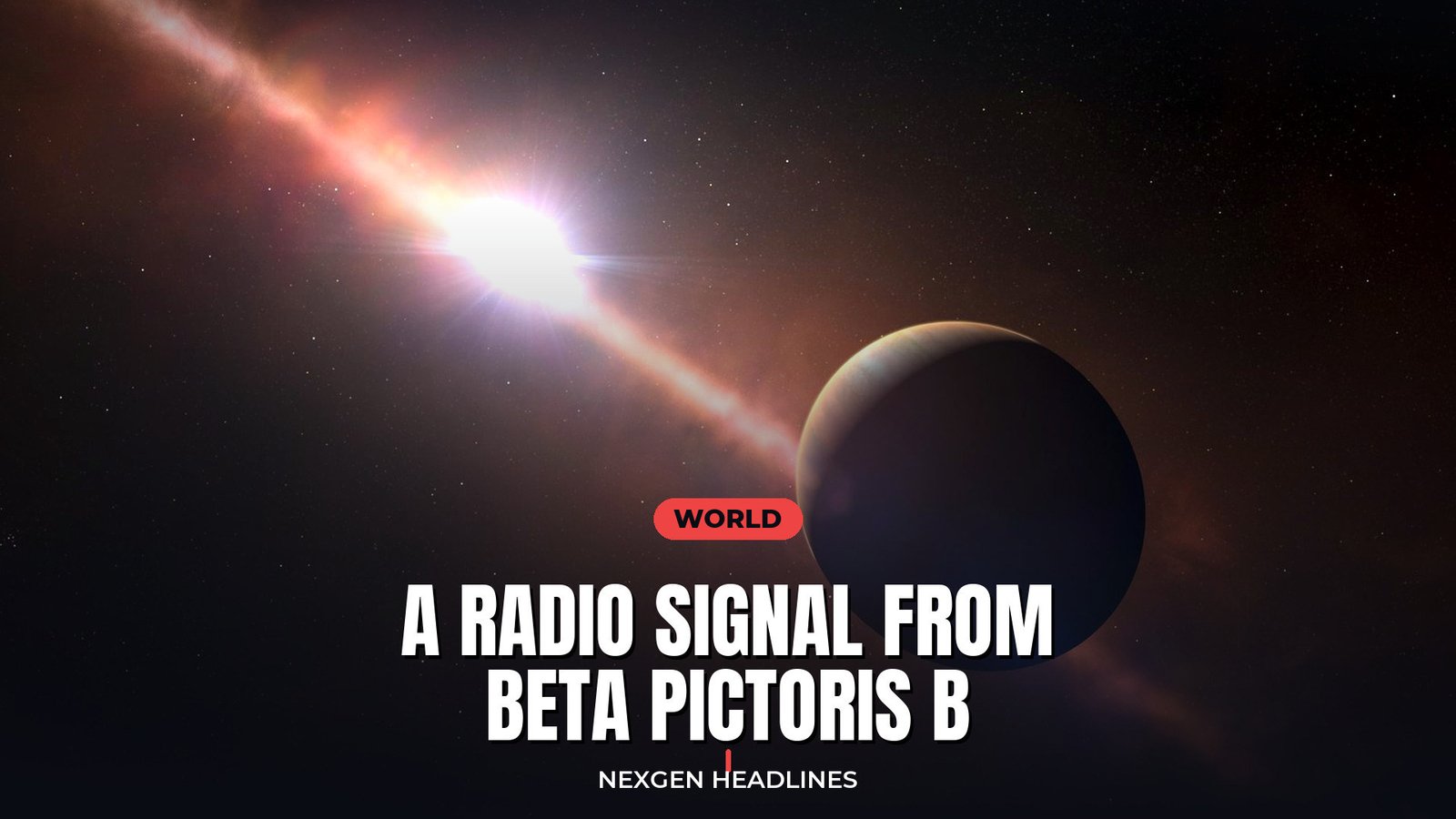


Beta Pictoris b Radio Signal Marks a Major Space Discovery
Beta Pictoris b Radio Signal has given astronomers an extraordinary new way to study a planet located far beyond our solar system.
Researchers say they have directly detected radio emission coming from the exoplanet Beta Pictoris b, a giant world located about 63 light-years from Earth.
The discovery is considered significant because astronomers had previously detected possible radio emissions associated with exoplanets, but they could not always prove that the signal came from the planet itself rather than its host star.
This time, researchers say they were able to localize the emission to the planet.
The discovery provides a new method for studying magnetic fields on worlds outside our solar system.
This Is Not a Signal From Aliens
The phrase “radio signal from another planet” may immediately make people think about extraterrestrial intelligence.
Scientists, however, are emphasizing that this discovery has nothing to do with evidence of an alien civilization.
The detected radio waves are believed to be a natural phenomenon caused by the planet’s powerful magnetic field.
Edo Berger, a Harvard University astronomy professor and co-author of the research, specifically distinguished the discovery from searches for intelligent life.
Instead of a message from an alien civilization, the signal appears to be telling scientists something about the physical environment surrounding Beta Pictoris b.
That distinction is important.
The discovery is exciting precisely because it provides a new way to investigate the invisible magnetic environment of a distant planet.
A Planet About 63 Light-Years Away
Beta Pictoris b is part of the Beta Pictoris planetary system, located roughly 63 light-years from Earth.
In astronomical terms, that is relatively close, although the distance is still enormous.
The planet is a gas giant with a mass estimated at about 12 times that of Jupiter.
It orbits a young star that is approximately 1.75 times as massive as our Sun.
The entire Beta Pictoris system is also extremely young compared with our own solar system.
Scientists estimate its age at roughly 23 million years, while the solar system is about 4.5 billion years old.
That makes Beta Pictoris b particularly interesting because researchers can study a young planetary system during an important stage of its development.
A well-studied star system
There had been hints of radio emissions from exoplanets before, but none had been confirmed, largely because it couldn’t be ruled out that the source was actually the host star, said Joseph Callingham, an associate professor at the Anton Pannekoek Institute for Astronomy of the University of Amsterdam in the Netherlands.
“What is unique for this study is that they localise the emission to the planet itself, separate from the star,” Callingham, who was not involved in the new research, wrote in an email.
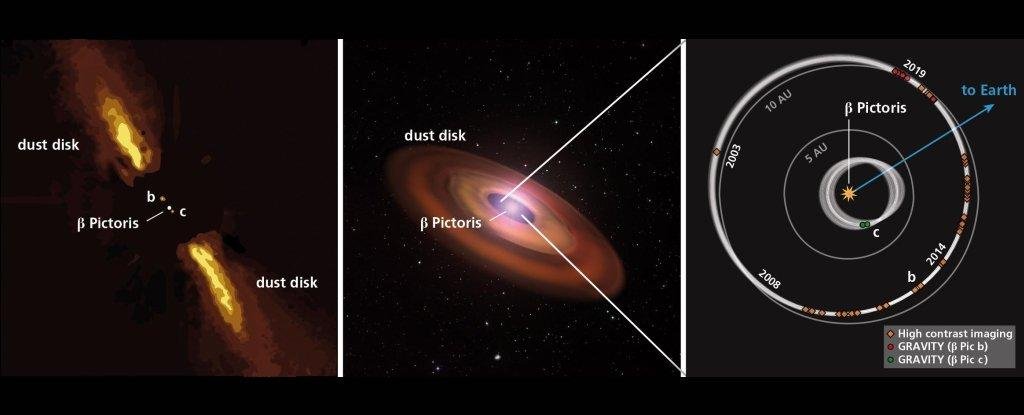
The Beta Pictoris system is astronomically very young at about 23 million years old compared with our own solar system’s age of 4.5 billion years. Beta Pictoris b — the planet from which the radio signal potentially originates — was discovered in 2008. Two additional planets, Beta Pictoris c and Beta Pictoris d, were discovered in 2019 and 2026, respectively.
The planetary system is among the most studied in our galaxy, and its star is known to host 30 orbiting comets and a giant disk of dust and debris, which NASA’s Hubble Space Telescope photographed in detail in 2015. Some of the debris swirling in the rotating disk is a remnant from planetary formation.
The Powerful Magnetic Field Behind the Signal
The most important scientific finding may not actually be the radio waves themselves.
It is the strength of the magnetic field that appears to be producing them.
The researchers estimate that Beta Pictoris b has a magnetic field of at least about 1.25 kilogauss, according to their preprint.
That is an extraordinary measurement for an exoplanet.
News reports comparing the result with Jupiter have described the magnetic field as at least around 200 times stronger than Jupiter’s field in the relevant context.
A planet’s magnetic field can play an important role in how it interacts with charged particles and stellar winds.
For astronomers, measuring that field can provide clues about the planet’s interior and atmosphere.
How Radio Waves Are Produced
The Beta Pictoris b Radio Signal is believed to be an example of what astronomers call auroral radio emission.
The basic process is related to the same kind of magnetic activity that produces auroras.
Charged particles can become trapped or guided by a planet’s magnetic field.
As high-energy particles move through the magnetic environment, they can produce radio waves.
On Earth, magnetic activity contributes to the auroras seen near the planet’s polar regions.
Jupiter provides an even more powerful example.
Its enormous magnetic field interacts with charged particles and produces both spectacular auroras and strong radio emissions.
Scientists believe Beta Pictoris b is producing a similar type of natural radio emission, although under much more powerful conditions.
MeerKAT Telescope Made the Detection Possible
The discovery was made using MeerKAT, a powerful radio telescope array located in South Africa.
MeerKAT consists of 64 radio dishes that work together to observe the universe at radio wavelengths.
Researchers were studying radio sources when they detected repeating bursts associated with the Beta Pictoris system.
According to Berger, the discovery was unexpected.
The research team had not necessarily expected to find such a strong signal from this particular planetary system.
The observation instead emerged from a survey designed to look for radio sources associated with objects beyond our solar system.
The discovery demonstrates how modern radio astronomy can reveal information that cannot easily be obtained using ordinary visible-light observations.
Why Scientists Had Difficulty Detecting Exoplanet Radio Emissions
Finding radio waves from an exoplanet is extremely challenging.
One major problem is the planet’s host star.
Stars can also produce radio emissions, making it difficult to determine whether a detected signal is actually coming from the planet.
That problem has prevented earlier candidate detections from being confirmed with confidence.
Joseph Callingham, an astronomy researcher at the University of Amsterdam who was not involved in the study, noted that the important feature of the new research is that the emission was localized to the planet rather than simply being associated with the overall star system.
That localization is a major reason researchers consider the finding important.
The Radio Bursts Were Highly Distinctive
The research team reported rapidly repeating radio bursts with strong circular polarization, along with persistent radio emission.
The observations covered frequencies between approximately 0.85 and 3.5 gigahertz.
The researchers identify the emission as radiation produced through a process called electron cyclotron maser emission.
The highest frequency of this type of emission can be used to estimate the strength of the magnetic field where the radiation originates.
That allowed the team to make the first direct measurement of an exoplanetary magnetic field strength through radio observations.
Beta Pictoris Is a Fascinating Young Planetary System
The Beta Pictoris b Radio Signal is especially interesting because of the larger planetary system surrounding the star.
Beta Pictoris is one of the most extensively studied young planetary systems in our galaxy.
Astronomers have identified multiple planets around the star, including Beta Pictoris b and other planets discovered through continuing observations.
The star also has a large disk of dust and debris.
That material is believed to contain remnants from the formation of the planetary system.
Scientists have even observed numerous comets associated with the system.
Because the system is relatively young, it provides researchers with an opportunity to study planetary formation and evolution in a very different stage from our mature solar system.
A New Way to Study Distant Worlds
One of the most exciting implications of the discovery is what it could mean for future exoplanet research.
Astronomers have discovered thousands of planets beyond our solar system.
However, many details about these worlds remain difficult to determine.
Scientists can often estimate a planet’s size, mass, orbit and atmospheric composition.
Magnetic fields are much harder to measure.
The Beta Pictoris b Radio Signal demonstrates that radio astronomy may provide a new way to investigate these invisible planetary environments.
Strong magnetic fields can influence atmospheric loss, interactions with stellar winds and the broader space environment around a planet.
That makes magnetic-field measurements valuable when scientists are trying to understand how planets develop and change.
Could Other Exoplanets Produce Similar Signals?
The discovery also raises a new question: How common are powerful magnetic fields among exoplanets?
Researchers have long suspected that some giant planets could generate strong radio emissions.
Jupiter, Saturn and other planets in our solar system demonstrate that planetary magnetic fields can produce detectable radio waves.
But distant exoplanets are much harder to observe.
Now that scientists have demonstrated that an exoplanet’s radio emission can be localized, astronomers may have a clearer strategy for searching for similar signals from other worlds.
Future observations could reveal whether Beta Pictoris b is an unusual exception or part of a broader population of strongly magnetized planets.
More Observations Are Needed
Although the discovery is significant, scientists are not treating the result as the final word.
The research paper was posted as a preprint and has not yet completed the peer-review process.
Independent scientific review is an important step because other researchers examine the methods, evidence and conclusions before a study is formally published.
Additional observations will also help researchers understand the radio emission and confirm how the signal changes over time.
Future radio observations could provide more information about the planet’s magnetic field and its interaction with its young host star.
What This Discovery Means for Space Science
The Beta Pictoris b Radio Signal represents a new window into a distant world.
Astronomers can now study an exoplanet not only by watching how it moves around its star or how it affects starlight, but also by examining radio waves produced by its magnetic environment.
That could eventually transform how scientists study the invisible properties of planets beyond the solar system.
The discovery also demonstrates why radio astronomy remains such an important part of modern space science.
Some of the most valuable information about distant worlds may not arrive as visible light.
Instead, it can appear as faint radio waves traveling across enormous distances before being collected by powerful instruments on Earth.
A Remarkable Signal From a Distant World
The first direct detection of radio emission from an exoplanet is a remarkable step in the study of worlds beyond our solar system.
Beta Pictoris b is not sending a deliberate message to Earth, and scientists have found no evidence of intelligent life associated with the signal.
Instead, the planet appears to be producing natural radio waves through a powerful magnetic environment.
For astronomers, that may be even more valuable.
The signal offers a direct clue about the invisible magnetic forces surrounding a distant planet and provides a new technique for studying exoplanets.
As scientists continue observing Beta Pictoris b and search other planetary systems, this discovery could become the starting point for a new era of exoplanet radio astronomy.
Important News Takeaway
The Beta Pictoris b Radio Signal is the first reported direct detection of auroral radio emission localized to an exoplanet. The planet is about 63 light-years away, and researchers say its magnetic field is extraordinarily strong. The signal appears to be a natural result of magnetic and auroral processes — not evidence of extraterrestrial intelligence. The research is currently awaiting peer review.
THANKS FOR READING