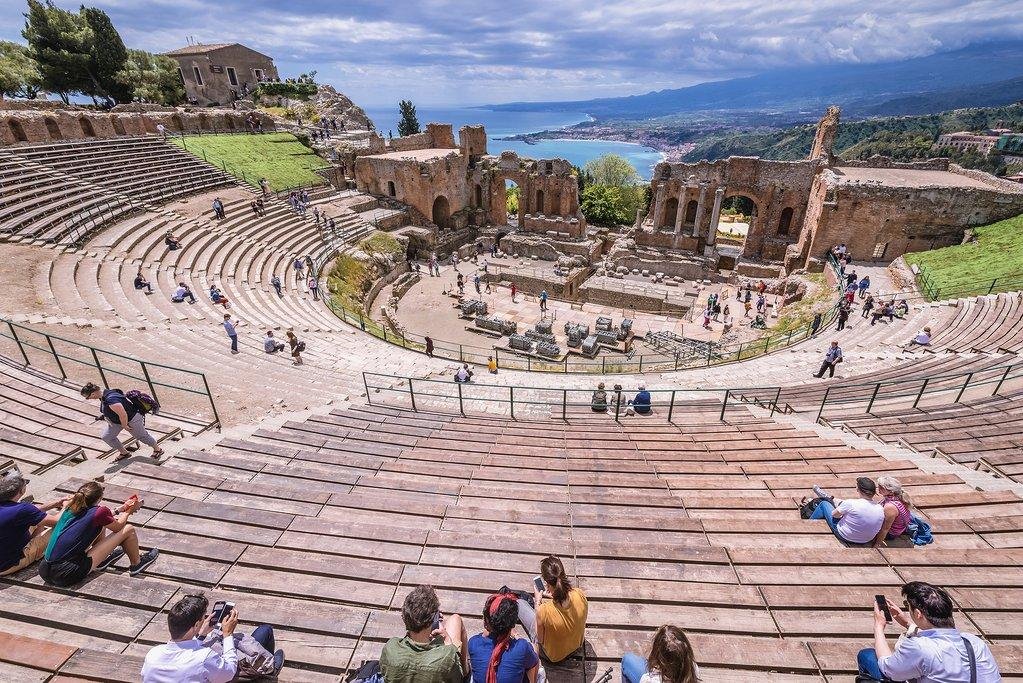
For years, tourists visiting a hillside near Arcugnano in northern Italy believed they had discovered something extraordinary: an ancient Greek theater hidden away in the countryside. The stone seats, columns, statues and scenic setting appeared to tell a story thousands of years old.
But there was one enormous problem.
The fake Greek amphitheater was not ancient. It was not Greek. It was not even Roman.
It had been built in modern times.
The unusual deception has now become a remarkable case of archaeological fraud after the man behind the site, Franco Malosso, was jailed following a decade-long legal battle. The case has raised fresh questions about how easily an impressive story, a convincing setting and a confident storyteller can persuade visitors to believe something that is simply not true.
A Beautiful “Ancient” Discovery That Wasn’t Ancient at All
The attraction, known by names including Anfiteatro Berico, Anfiteatro Marittimo Berico and Anfiteatro Porta degli Angeli, was located on a scenic hillside near Vicenza.
Visitors were reportedly told that the site represented an ancient theater created by Greeks more than 2,000 years ago. Malosso presented himself as its discoverer and guided visitors around the location, helping transform the unusual construction into what appeared to be a genuine historical experience.
The site even attracted glowing online reviews.
According to reporting on the case, all eight TripAdvisor reviews were five-star assessments. Visitors described it as an enchanting and almost timeless place, apparently accepting the story presented to them.
That combination of scenery and storytelling appears to have been central to the deception.
The “Ancient” Theater Was Built by Modern Workers
The most astonishing part of the story is how the fake Greek amphitheater was actually constructed.
Court evidence indicated that modern builders were hired to create the seating and stairways. Freshly quarried stone from Puglia and cement were used, while some elements were deliberately made to appear older than they really were.
One builder reportedly testified that Malosso instructed workers to “make it look old.”
The site also included cement columns and plaster statues. A pool had been excavated where visitors might have expected a traditional performance area.
Instead of uncovering an archaeological treasure, investigators found evidence of a modern construction project designed to resemble an ancient one.
Experts Spotted Red Flags
For archaeologists, the story quickly raised major questions.
One obvious problem was geography.
Ancient Greek colonies existed in parts of southern Italy, but the Arcugnano area near Vicenza was far too far north to support the claim that Greeks had constructed this particular theater.
There was another problem with the structure itself.
Experts pointed out that the building was shaped more like a traditional theater than an amphitheater. An amphitheater is generally oval or elliptical, while a theater has a semicircular seating arrangement facing a stage.
Even the name “Marittimo” raised questions because Arcugnano is located inland rather than beside the sea.
Archaeologist Darius Arya told CNN that the inconsistencies were striking, while other specialists noted that some of the construction materials and decorative features looked unmistakably modern.
The Claims Became Even More Extraordinary
The story surrounding the fake Greek amphitheater went beyond simply claiming that the structure was ancient.
According to evidence presented in court, visitors were reportedly told that famous historical and fictional figures had visited the site, including Julius Caesar, Cleopatra and Juliet Capulet.
That last name should have been a particularly obvious warning sign.
Juliet Capulet is a fictional character created by William Shakespeare for Romeo and Juliet. She was never a historical visitor to an archaeological site.
Yet the combination of a dramatic location and an elaborate narrative helped create an experience that some visitors apparently accepted as authentic.
It is a powerful reminder that people do not always evaluate attractions as historians would. When a place looks mysterious and the person explaining it sounds confident, visitors may be willing to believe the story.
Authorities Discovered the Scam in 2016
The unusual attraction eventually came to the attention of local authorities in October 2016.
The case was referred to Italy’s cultural heritage authorities and the Carabinieri’s specialized art-protection unit, known for investigating stolen artworks, archaeological crimes and forgeries.
The inspection reportedly took only one day.
That speed was significant. Investigators concluded that the supposed archaeological site was so obviously modern that they did not need years of excavation to establish its basic nature.
Lt. Col. Giuseppe Marseglia, who was involved with the investigation, reportedly said he had never encountered an entire archaeological site that had been fabricated in this way during his long career.
The Legal Battle Lasted About a Decade
The case did not end with the discovery.
Malosso was convicted in 2019 for offenses including forging works of art, carrying out unauthorized building work and damaging a protected landscape. He later appealed, but his challenges were unsuccessful.
Italy’s highest court ultimately rejected his final appeal.
He is now serving a 28-month prison sentence and was also ordered to pay fines and legal costs. The case followed roughly a decade of legal proceedings from the initial discovery of the site.
The legal consequences underline the seriousness of creating false historical objects and structures, particularly when protected landscapes and cultural heritage laws are involved.
The Site Was Built in a Protected Landscape
The location added another major layer to the controversy.
The theater was constructed within the Berici Hills, a protected landscape. According to court evidence, Malosso had originally sought permission for a garage but instead developed the much larger theater project.
The construction altered the protected area and involved unauthorized work.
That means the controversy was not simply about tourists paying to see something fake. Authorities also had to deal with construction, environmental damage and the protection of Italy’s cultural landscape.
What Happens to the Fake Greek Amphitheater Now?
The future of the site remains uncertain.
The theater has been placed under seizure, and Malosso was ordered to demolish the unauthorized construction. However, removing a large structure from a protected hillside could itself be expensive.
That has created an unusual problem: the government must decide what to do with a structure that should never have been presented as ancient in the first place.
Archaeologist Darius Arya has warned that demolition could be costly, while the local mayor has indicated that he does not want public money used for the removal.
A Strange Lesson About Trust and Tourism
The story of the fake Greek amphitheater is more than an unusual tourist scam.
It shows how easily people can be influenced by presentation.
A beautiful landscape, impressive stonework, enthusiastic reviews and a persuasive guide can create the feeling that something must be authentic. But history cannot be established simply because a place looks old.
Real archaeology depends on evidence, documentation, excavation and expert analysis.
The Arcugnano case offers an unforgettable lesson for travelers: when an attraction claims to have uncovered a spectacular piece of history, curiosity should come with a healthy dose of skepticism.
Because sometimes the most incredible discovery is not ancient at all.
THANKS FOR READING