
Quick answer: Go to NHTSA.gov/recalls and type in your car’s 17-character VIN (vehicle identification number). The free federal tool shows any open safety recall that hasn’t been fixed on your car. If one shows up, call any franchised dealer for your brand. By law, the safety recall repair is free. You can also call NHTSA’s Vehicle Safety Hotline at 888-327-4236.
Recall letters get lost, cars change owners, and people move. That’s why millions of recalled cars are still on the road without the fix. Checking takes two minutes. Here’s exactly how to do it and what to do next.
How to check your car for recalls: 5 steps
| Step | What to do | Time |
|---|---|---|
| 1 | Find your 17-character VIN | 1 minute |
| 2 | Enter it at NHTSA.gov/recalls (or the NHTSA SaferCar app) | 1 minute |
| 3 | Read the result: “0 unrepaired recalls” or a list of open recalls | 1 minute |
| 4 | Call a franchised dealer for your brand and book the free repair | 5 minutes |
| 5 | Sign up for NHTSA recall alerts so you hear about future recalls | 2 minutes |
Step 1: Find your VIN
Your VIN is a 17-character code of letters and numbers. It never uses the letters I, O or Q, so they won’t be confused with 1 and 0. You can find it in several places:
- The dashboard on the driver’s side, visible from outside through the bottom of the windshield
- The driver’s side door jamb, on a sticker where the door latches
- Your vehicle registration card
- Your auto insurance card or policy
- Your title or loan paperwork
Snap a photo of the dashboard VIN with your phone. It’s the easiest way to avoid typos.
Step 2: Search at NHTSA.gov/recalls
The National Highway Traffic Safety Administration (NHTSA) runs the official lookup. Go to NHTSA.gov/recalls, enter the VIN and search. The tool checks recalls from major automakers, as well as motorcycle makers.
You can also use:
- The NHTSA SaferCar app (free for iPhone and Android), which can save your vehicles and alert you to new recalls
- Your automaker’s own website, which usually has a “recalls” or “owners” page with a VIN search
- Your dealer’s service department, which can check while you’re there
Some states also show open recalls when you renew your registration. That’s helpful, but don’t wait for it.
Step 3: Understand the result
- “0 unrepaired recalls associated with this VIN” means there’s no open safety recall on that car right now. Either there never was one, or it’s already been fixed.
- “Recall INCOMPLETE” means your car has an open recall. You’ll see the recall date, NHTSA campaign number, a summary of the problem, the safety risk and the remedy.
- “Remedy not yet available” means the automaker has announced the recall but parts or a fix aren’t ready. You’ll get a second letter when they are.
Pay close attention to any recall marked “Do not drive” or “Park outside.” Those warnings mean the danger is serious, such as a fire risk or an airbag that could injure you. Call the dealer right away and ask about towing or a loaner car.
The lookup shows open recalls only. It’s not a full repair history. For records of past recall work, ask a dealer or the automaker.
Made-up example (for illustration):
Maria buys a used 2019 SUV from a private seller. The seller says it’s “never had problems.” Before driving home, she types the VIN into NHTSA.gov/recalls and finds one open recall for a fuel pump that can fail and stall the engine.
She calls a franchised dealer for that brand. The repair takes about two hours, and she pays $0. She also signs up for recall alerts on the SaferCar app, so she won’t miss the next one.
Also read: Winterize your home and car: a simple checklist
Step 4: Get the free repair
- Call any franchised dealer for your brand. It doesn’t have to be the dealer where you bought the car.
- Give them your VIN and the recall number from the NHTSA result.
- Ask if parts are in stock and how long the repair takes.
- Ask about a loaner or rental if the repair is long or the recall says not to drive.
- Get a receipt showing the recall work was done. Keep it with your records.
The automaker must fix a safety defect for free by repairing it, replacing the vehicle or part, or offering a refund. You should not be charged for the recall work itself. A dealer can still offer you other services, like an oil change. Those aren’t free, and you can say no.
What if you already paid to fix the problem?
If you paid for a repair before the recall was announced, you may be able to get your money back. Automakers must have a plan to reimburse owners who paid for a fix before a recall, within certain time limits. Look at your recall letter or the automaker’s recall page for details. Keep your repair receipts and contact the automaker’s customer service line.
What if the dealer won’t fix it?
- Ask for the service manager and show the NHTSA result.
- Call the automaker’s customer service number, which is in your owner’s manual and on the recall letter.
- File a complaint with NHTSA at NHTSA.gov or call 888-327-4236.
Waits for parts can be long during big recalls. Ask the dealer to put you on a parts list and to call you when they arrive.
Step 5: Sign up for recall alerts
Automakers must notify registered owners of safety recalls by mail. But if you bought a car used, moved or changed your address, the letter may never reach you. Protect yourself:
- Sign up for NHTSA recall email alerts for your make and model.
- Save your car in the SaferCar app.
- Register with your automaker’s owner website under your current address.
- Re-check your VIN at NHTSA.gov/recalls twice a year, for example when you change your clocks.
Buying a used car? Check before you pay
Federal law requires new cars to be fixed before a dealer sells them. Used cars are different. Federal law doesn’t require used-car dealers or private sellers to fix open recalls before a sale. Rental car companies are a separate case: federal law bars them from renting out cars with open safety recalls.
Before you buy any used car:
- Ask for the VIN and run it at NHTSA.gov/recalls.
- If there’s an open recall, ask the seller to get it fixed first, or plan to visit a dealer right after buying.
- Be extra careful with “Do not drive” recalls. Don’t drive the car home.
Don’t forget tires, car seats and equipment
The VIN lookup covers the vehicle itself. Other items have their own recalls:
- Tires: Search by the Tire Identification Number (TIN) on the sidewall at NHTSA.gov/recalls.
- Child car seats: Register your seat with the maker using the card in the box, and check NHTSA.gov/recalls by brand and model.
- Equipment: Items like aftermarket lights or dash cams can also be recalled. Search by brand.
Common mistakes
- Ignoring recall letters because they look like ads. Real recall notices name NHTSA and include a campaign number.
- Paying a third-party site for a “recall report.” The NHTSA lookup is free.
- Waiting for a letter on a used car. It may go to the last owner.
- Typing the VIN wrong. Use the photo trick and double-check zeros vs. letters.
- Driving a “Do not drive” car to the dealer. Ask for a tow.
Watch out for recall scams
Scammers send texts and make calls about fake “urgent recalls” or “extended warranty” offers. A real recall repair never requires a credit card or upfront payment. If someone asks for money or personal details for a recall, hang up and check your VIN yourself at NHTSA.gov/recalls.
Recommended products
Handy tools to keep your car safe between dealer visits.
Disclosure: As an Amazon Associate, Nexgen Headlines earns from qualifying purchases.
FAQ
Is it free to check a car for recalls?
Yes. The VIN lookup at NHTSA.gov/recalls and the SaferCar app are free. You don’t need to pay any website for a recall check.
Can I check for recalls by license plate?
The NHTSA VIN search is the most reliable way. Some automaker and state sites offer plate lookups, but the VIN is what the dealer will use.
Do recalls expire?
Safety recalls don’t have a simple expiration date for most owners. Even on an older car, call a dealer and ask. Reimbursement for past repairs does have time limits.
Can a dealer charge me for a recall repair?
No. The automaker pays for safety recall repairs. You only pay for other work you agree to.
Does a recall lower my car’s value?
An open recall can worry buyers. A completed recall, with a receipt, usually doesn’t hurt resale value.
Bottom line
To check your car for recalls, enter your 17-character VIN at NHTSA.gov/recalls. If an open recall shows up, any franchised dealer for your brand will fix it for free. Sign up for alerts, re-check twice a year, and always check before buying a used car.
Last reviewed: Nov. 13, 2026.
Sources: NHTSA: Check for recalls, NHTSA: Recalls and investigations, NHTSA: Recalls spotlight, FTC: Buying a used car from a dealer.
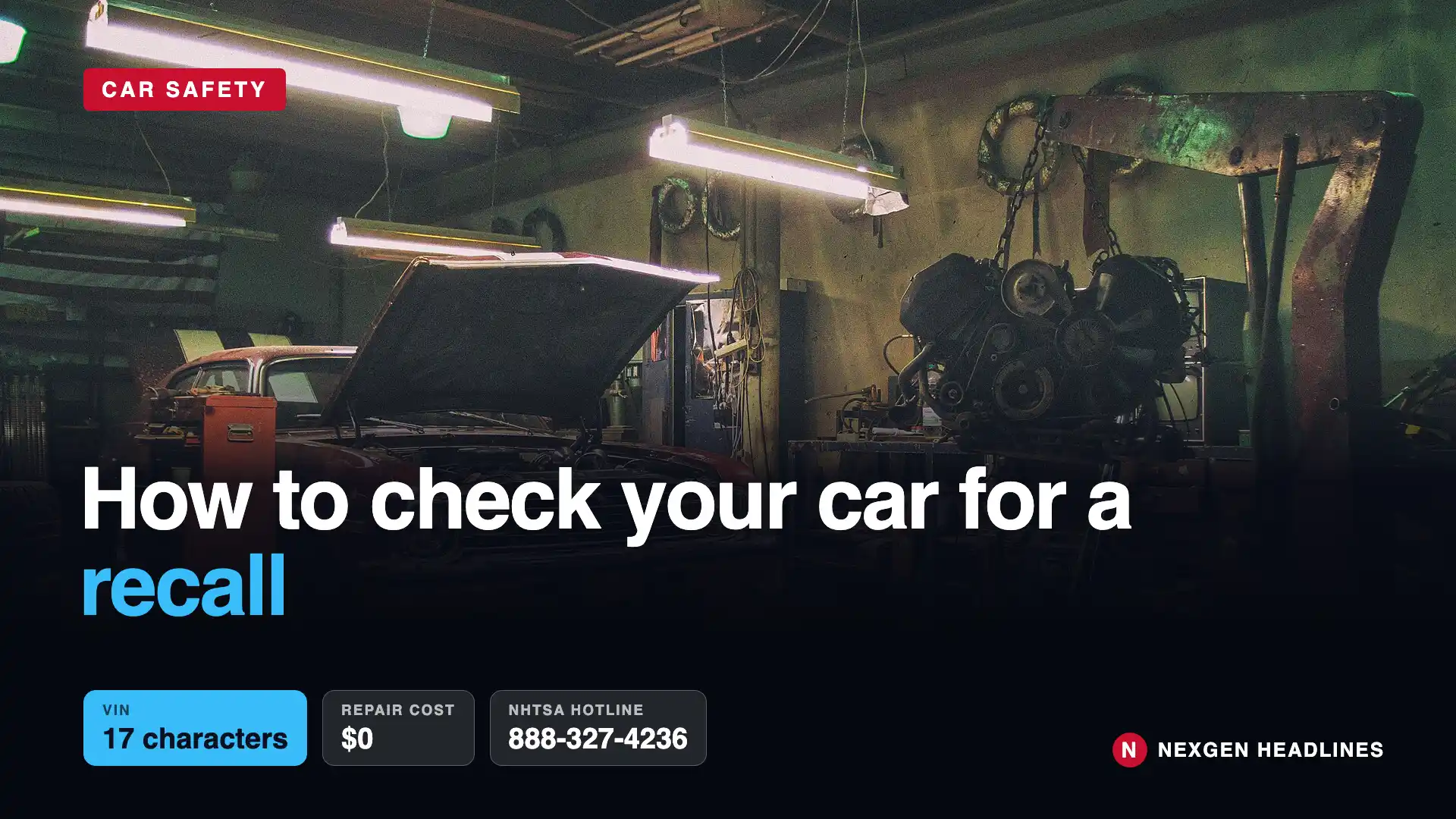
Featured image: Car repair shop. Photo: Martin Vorel / Wikimedia Commons, CC BY-SA 4.0; edited by Nexgen Headlines.