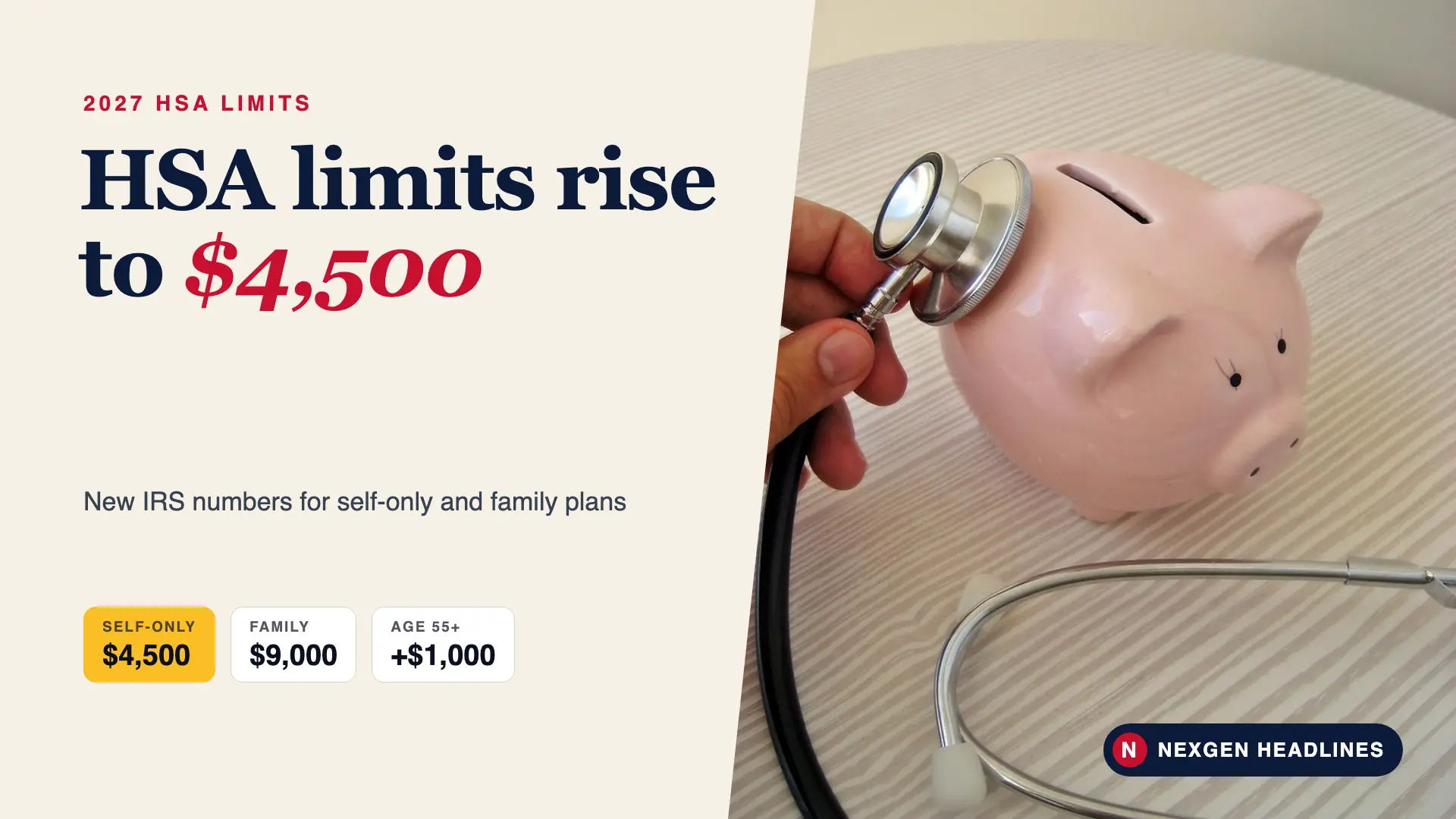

Quick answer: For 2027, you can put up to $4,500 in a health savings account (HSA) with self-only coverage, or $9,000 with family coverage. That’s up from $4,400 and $8,750 in 2026. If you’re 55 or older, you can add a $1,000 catch-up. To qualify, your high-deductible health plan (HDHP) needs a deductible of at least $1,750 (self-only) or $3,500 (family) in 2027. The IRS set these numbers in Revenue Procedure 2026-24.
An HSA is one of the few accounts with three tax breaks. Money goes in tax-free, grows tax-free and comes out tax-free for medical bills. If you have an HDHP at work or through the Marketplace, open enrollment is the right time to plan how much to save next year.
2027 HSA limits at a glance
| Limit | 2026 | 2027 |
|---|---|---|
| HSA contribution, self-only | $4,400 | $4,500 |
| HSA contribution, family | $8,750 | $9,000 |
| Catch-up, age 55+ | $1,000 | $1,000 |
| HDHP minimum deductible, self-only | $1,700 | $1,750 |
| HDHP minimum deductible, family | $3,400 | $3,500 |
| HDHP out-of-pocket max, self-only | $8,500 | $8,700 |
| HDHP out-of-pocket max, family | $17,000 | $17,400 |
Source: IRS Rev. Proc. 2025-19 (2026) and Rev. Proc. 2026-24 (2027).
The $1,000 catch-up is not adjusted for inflation. It has been $1,000 for years and stays there in 2027.
How to max out your HSA in 2027: step by step
- Confirm your plan is HSA-eligible. Ask HR or check your plan documents for “HSA-qualified HDHP.” The deductible must meet the 2027 minimums above.
- Pick your coverage type. Self-only means $4,500. Any family tier (you plus one or more) means $9,000.
- Subtract your employer’s contribution. Employer money counts toward the same limit. If your boss puts in $1,000 on self-only coverage, you can add up to $3,500.
- Divide by your pay periods. With 26 paychecks, $4,500 is about $173 per check. Payroll contributions also skip Social Security and Medicare taxes.
- Add the catch-up if you’re 55+. That’s an extra $1,000, or about $38 per paycheck.
- Invest what you won’t spend soon. Many HSAs let you invest in funds once you keep a minimum cash balance.
Who can contribute to an HSA?
You can contribute for a month only if, on the first day of that month, all of these are true:
- You’re covered by an HSA-eligible HDHP.
- You have no other disqualifying health coverage, such as a regular health plan through a spouse.
- You’re not enrolled in Medicare.
- No one can claim you as a dependent on their tax return.
A general-purpose health FSA, including a spouse’s, usually blocks HSA contributions. A limited-purpose FSA for dental and vision does not.
Made-up examples (for illustration):
Maria, 38, self-only HDHP. Her employer adds $500 a year. In 2027 she can contribute $4,000 more ($4,500 − $500). Through payroll, that’s about $154 per paycheck over 26 pay periods.
Tom and Lisa, both 57, family HDHP. The family limit is $9,000. Each spouse who is 55+ can add a $1,000 catch-up, but each catch-up must go into that spouse’s own HSA. So Tom’s HSA could hold up to $9,000 split between them plus his $1,000, and Lisa would need her own HSA for her $1,000.
The triple tax break, in dollars
Here’s what an HSA can save you, using rough numbers. Say you’re in the 22% federal bracket and put $4,500 in through payroll.
- Federal income tax saved: about $990 (22% of $4,500).
- Social Security and Medicare tax saved: about $344 (7.65% of $4,500), only for payroll contributions.
- State income tax: most states also exempt HSA money, but California and New Jersey tax HSA contributions at the state level.
These are estimates. Your savings depend on your tax bracket and state.
Also read: Use your FSA money before Dec. 31
Important dates and deadlines
| Date | What happens |
|---|---|
| Now to mid-December 2026 | Most workplace open enrollment windows; pick an HDHP and set your 2027 HSA payroll amount |
| Fall 2026 | HealthCare.gov open enrollment for 2027 plans (check the current deadline on HealthCare.gov, since a court case has affected it) |
| Jan. 1, 2027 | New 2027 limits take effect |
| April 15, 2027 | Deadline to make 2026 HSA contributions (up to $4,400 / $8,750) |
| April 2028 tax day | Deadline to make 2027 HSA contributions |
You can still add money for 2026 until the April 2027 tax deadline. If you didn’t max out this year, that’s a quick win.
What you can spend HSA money on
Qualified medical expenses include doctor visits, prescriptions, dental work, glasses, contacts, hearing aids and many over-the-counter medicines. Menstrual care products also count. IRS Publication 502 has the full list.
You don’t have to pay yourself back right away. Save your receipts, and you can reimburse yourself years later, tax-free, as long as the expense came after you opened the HSA.
Mistakes to avoid
- Going over the limit. Excess contributions face a 6% excise tax each year they stay in the account. Remove the extra (and any earnings) before your tax deadline.
- Forgetting your employer’s share. It counts toward the $4,500 or $9,000.
- Contributing after Medicare starts. Once you enroll in Medicare, including Part A, you can’t add new money. Medicare Part A can be backdated up to 6 months when you sign up after 65, so stop contributions 6 months before you apply.
- Using it for non-medical costs before 65. That money is taxed and hit with a 20% penalty. After 65, non-medical withdrawals are taxed like income but without the penalty.
- Leaving it all in cash. Long-term money in cash may lose value to inflation.
What if you change plans mid-year?
If you’re HSA-eligible for only part of 2027, your limit is usually prorated by month. For example, 6 months of self-only eligibility means about $2,250.
The “last-month rule” lets you contribute the full year’s amount if you’re eligible on Dec. 1. But you must stay eligible through the next full year (the testing period). If you don’t, the extra becomes taxable plus a 10% additional tax.
HSA vs. FSA: which is better?
| Feature | HSA | Health FSA |
|---|---|---|
| Needs an HDHP? | Yes | No |
| Money rolls over? | Yes, forever | Usually no (limited carryover or grace period) |
| You keep it if you change jobs? | Yes | No |
| Can be invested? | Often yes | No |
If you’re healthy and can cover the higher deductible, an HSA is often the better long-term deal. If you expect big medical bills and want a low deductible, a traditional plan with an FSA may cost less.
Is an HDHP with an HSA right for you?
An HSA only works with a high-deductible plan, so the real question is whether that plan fits your family. Ask yourself:
- Can you cover the deductible from savings? In 2027 that’s at least $1,750 for one person or $3,500 for a family, and many plans are higher.
- How often do you see doctors? If you mostly need checkups, an HDHP often costs less. Preventive care is usually covered before the deductible.
- Do you take costly prescriptions? You may pay full price until you hit the deductible. Compare total yearly costs, not just premiums.
- Does your employer add money? An employer HSA deposit can make an HDHP clearly cheaper.
A quick way to compare: add up a year of premiums plus the most you could pay out of pocket for each plan. Then subtract any employer HSA deposit and your tax savings from the HDHP side.
Where to open an HSA
If your employer offers an HSA, use it for payroll deductions so you save on Social Security and Medicare taxes. You can later move the money to another HSA provider with lower fees or better investments through a trustee-to-trustee transfer, which isn’t taxed and isn’t limited to once a year.
If you buy your own HDHP, you can open an HSA at many banks and brokerages. Look for no monthly fee, low-cost index funds and a low (or no) cash minimum before you can invest.
Recommended products
HSA-eligible items many families stock up on.
Disclosure: As an Amazon Associate, Nexgen Headlines earns from qualifying purchases.
FAQ
What is the HSA limit for 2027?
$4,500 for self-only coverage and $9,000 for family coverage, plus $1,000 if you’re 55 or older.
Does my employer’s contribution count toward the limit?
Yes. Employer and employee money together can’t go over the annual limit.
Can I contribute to an HSA if I’m on Medicare?
No. You can keep and spend the money you already have, but you can’t add new contributions.
When are the 2027 limits official?
The IRS published them in Revenue Procedure 2026-24 in spring 2026. They take effect Jan. 1, 2027.
What happens if I put in too much?
You owe a 6% excise tax on the excess each year unless you withdraw it, plus earnings, by your tax filing deadline.
Bottom line
For 2027, plan on up to $4,500 (self-only) or $9,000 (family) in your HSA, plus $1,000 if you’re 55+. Set your payroll amount during open enrollment, count your employer’s share, and invest money you don’t need soon. It’s one of the best tax breaks most families can get.
Last reviewed: Nov. 11, 2026.
Sources: IRS Rev. Proc. 2026-24, IRS Publication 969: HSAs, IRS Publication 502: Medical expenses, Bloomberg Tax, Mercer, HealthCare.gov.
Featured image: Stethoscope on a piggy bank. Photo: 401(k) 2012 / Wikimedia Commons, CC0; edited by Nexgen Headlines.