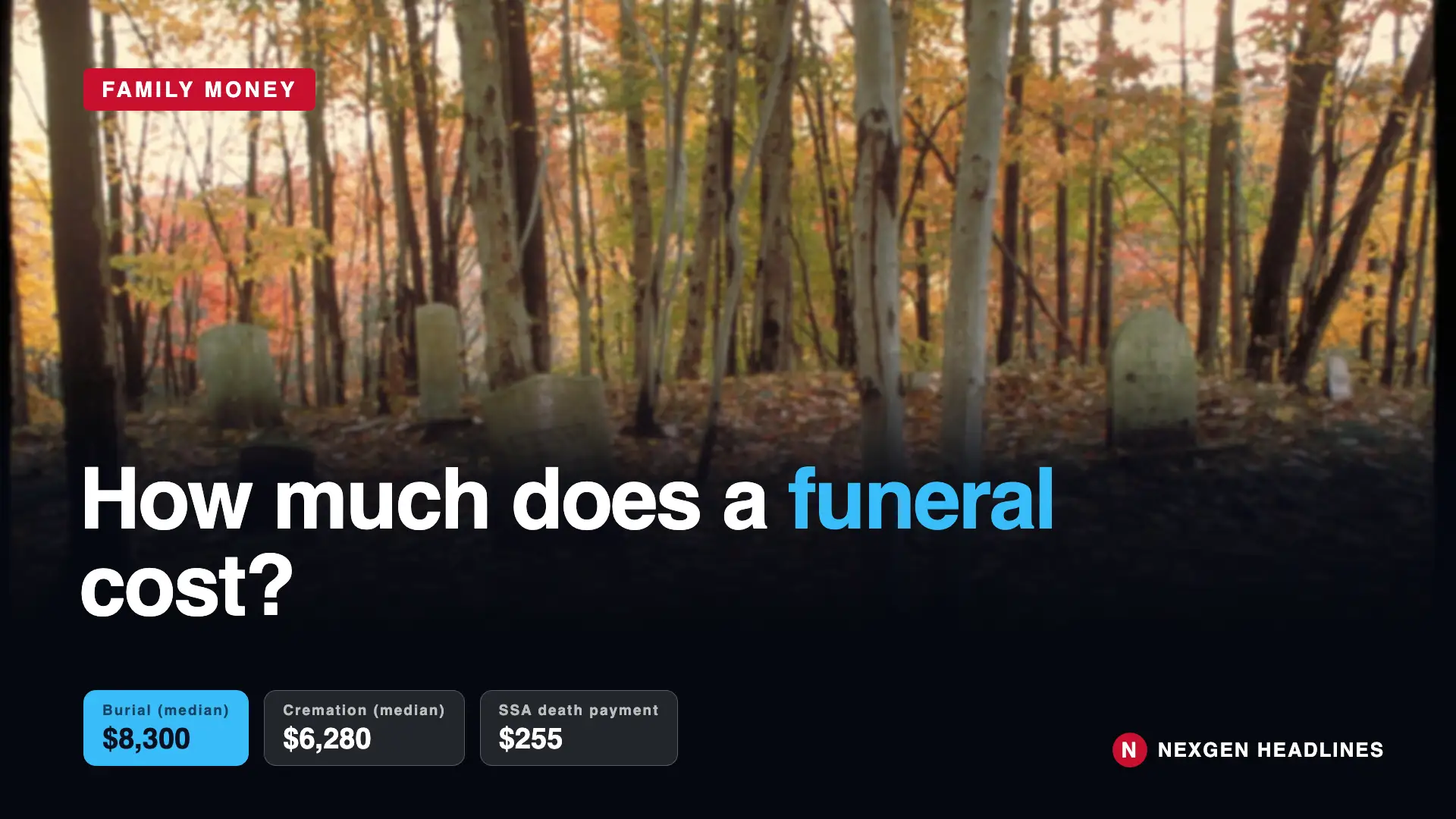

Quick answer: A traditional funeral with viewing and burial has a national median cost of about $8,300, and a funeral with viewing followed by cremation about $6,280, according to the National Funeral Directors Association. Those figures don’t include cemetery costs like a plot or headstone. Under the FTC Funeral Rule, you have the right to an itemized price list and to buy only what you want.
Planning a funeral is hard, and it usually happens fast, during grief. That’s when families overspend. This guide shows typical costs, your legal rights, how to save money without cutting corners, and which benefits can help pay.
Funeral costs at a glance
| Item | Typical national figure |
|---|---|
| Funeral with viewing and burial (median) | About $8,300 (NFDA) |
| Funeral with viewing and cremation (median) | About $6,280 (NFDA) |
| Cemetery plot, opening/closing, headstone | Extra, not included in the medians |
| Social Security lump-sum death payment | $255, to an eligible spouse or child |
| Your right to an itemized price list | Required by the FTC Funeral Rule |
Costs vary a lot by state, city and funeral home. Two homes in the same town can charge very different prices for the same service. That’s why the FTC encourages families to compare price lists, even under time pressure. A few phone calls can save hundreds or thousands of dollars.
Your rights under the FTC Funeral Rule
The Federal Trade Commission’s Funeral Rule protects you when you buy funeral goods and services. Under it, funeral homes must:
- Give you prices by phone if you ask.
- Give you a written, itemized General Price List when you ask in person about arrangements.
- Show you casket and outer burial container price lists before showing you the products.
- Let you choose only the goods and services you want, with limited exceptions such as a basic services fee.
- Accept a casket or urn you bought elsewhere, without charging a handling fee.
- Offer an alternative container, such as unfinished wood or cardboard, for direct cremation, instead of requiring a casket.
- Not claim embalming is required by law when it isn’t. Most states don’t require embalming in most cases.
- Give you a written statement of everything you’re buying and the total, before you pay.
If a funeral home breaks these rules, you can report it to the FTC at ReportFraud.ftc.gov and to your state’s funeral board.
What makes up the bill
| Category | What it includes |
|---|---|
| Basic services fee | Funeral director’s time, planning, permits, overhead; usually non-declinable |
| Transfer of remains | Bringing the body to the funeral home |
| Embalming and preparation | Often needed for a public viewing, but often optional otherwise |
| Facilities and staff | Viewing, ceremony, graveside service |
| Vehicles | Hearse and service car |
| Casket or urn | Often one of the biggest single costs |
| Cemetery costs | Plot, opening and closing the grave, vault or liner, headstone |
| Cash advance items | Death certificates, obituaries, flowers, clergy honorariums |
How to plan a funeral and save money: 8 steps
- Check for a prepaid plan or written wishes left by your loved one.
- Call two or three funeral homes and ask for prices by phone.
- Ask for the General Price List at each home you visit.
- Decide on burial or cremation early, since it shapes most other costs.
- Compare casket and urn prices, including from outside retailers.
- Skip extras you don’t want, like embalming without a viewing.
- Bring a friend or relative who is less emotionally involved to help decide.
- Get the final written statement and review it before signing.
Made-up example: comparing two quotes
These are made-up numbers to show how quotes can differ. They are not real prices.
Lisa’s father wanted a simple burial. Funeral Home A quotes a package for $11,500. Funeral Home B lists items separately on its General Price List.
Lisa chooses B’s basic services, a short graveside service and no public viewing, so embalming isn’t needed. She buys a casket from an outside seller for less than the funeral home’s price. Her total, before cemetery costs, comes in thousands of dollars lower.
Also read: What Happens to Credit Card Debt When You Die?
Lower-cost options
- Direct cremation: Cremation shortly after death, with no viewing or ceremony at the funeral home. It’s usually the least expensive option. You can hold a memorial elsewhere later.
- Immediate burial: Burial soon after death, with no viewing.
- Memorial service at a place of worship, park or home instead of the funeral home.
- Body donation to a medical school. Programs often cover transport and cremation afterward, but rules vary.
- Green burial without embalming or a concrete vault, where cemeteries allow it.
Benefits that can help pay
Social Security
Social Security pays a one-time $255 lump-sum death payment to a surviving spouse who lived with the person, or in some cases to a child eligible for survivor benefits. You must apply within two years. Call 800-772-1213. Funeral homes often report the death to SSA, but they don’t apply for the payment for you.
Veterans burial benefits
Eligible veterans can receive burial in a VA national cemetery at no cost to the family, including the grave, opening and closing, a headstone or marker, and perpetual care. Families may also get a burial flag, a Presidential Memorial Certificate and, in some cases, a burial allowance. Call the VA’s National Cemetery Scheduling Office or visit VA.gov/burials-memorials.
Other help
- Employer or union benefits, including group life insurance
- Life insurance or final expense policies
- Crime victim compensation funds, if the death resulted from a crime
- County or state indigent burial programs for families who can’t pay
- Payable-on-death bank accounts left for this purpose
Prepaying for your own funeral: pros and cons
Prepaid funeral plans can lock in choices and spare your family decisions. But they carry risks:
- The funeral home could close or be sold.
- You may lose money if you move or change your mind, depending on your state.
- Some plans don’t cover everything, leaving “cash advance” items unpaid.
The FTC suggests asking where your money is held, whether it’s refundable, and what happens if you move. Many people instead write down their wishes and set aside money in a payable-on-death savings account for a trusted person.
Questions to ask every funeral home
- Can you email or mail me your General Price List?
- What is your basic services fee, and what does it include?
- What’s the total for direct cremation? For immediate burial?
- Do you charge extra for weekend or holiday services?
- Which items are “cash advance” items, and do you mark them up?
- Is embalming needed for the service I want, or is refrigeration an option?
- How many certified death certificates do you recommend, and what does each cost?
- When is payment due, and do you offer payment plans?
A good funeral director will answer these questions clearly and without pressure. Write down each answer. Comparing two or three homes this way often takes less than an hour by phone.
Death certificates: how many do you need?
You’ll need certified copies to close bank accounts, claim life insurance, transfer a car title, notify pension plans and settle the estate. Many families order several copies at first. Prices are set by the state or county and vary.
Ask each institution whether it accepts a photocopy or needs a certified copy. Some will return the certified copy after reviewing it.
Write down your own wishes
The kindest gift to your family may be a simple plan. You don’t need a prepaid contract to do this:
- Burial or cremation? Where should remains go?
- Service style: religious, simple, celebration of life or none
- Budget: what you want spent, and where the money is
- Veteran status and where your DD-214 is kept
- Who should make decisions, if your state lets you name an agent for disposition
Review the plan every few years or after a big life change. Keep the plan with your will and tell a trusted person where it is. Don’t put funeral wishes only in a will, since wills are often read after the funeral.
Made-up example: a written plan that helped
This is a made-up example to show how planning ahead helps. It is not a real family.
Before he died, Walter, a Navy veteran, wrote a one-page note: direct cremation, burial at a VA national cemetery and a small gathering at his church. He listed the funeral home he trusted and where his DD-214 was.
His daughter called that funeral home and the VA the next morning. The choices were already made, and the family spent its time together instead of shopping under pressure.
Common mistakes families make
- Not comparing prices because it feels disrespectful
- Buying a package with services you don’t want
- Paying for embalming when there’s no viewing
- Believing a sealed casket or vault “protects” the body; the FTC says no casket or vault preserves a body forever
- Forgetting cemetery costs, which can add thousands
- Not checking veterans benefits
- Ordering too few death certificates; banks and insurers often each need one
Who pays for the funeral?
Usually, funeral costs are paid from the person’s estate, from life insurance, or by family members who sign the contract. If you sign the funeral home contract, you may be personally responsible for the bill, even if you expect the estate to reimburse you.
Family members generally aren’t responsible for a loved one’s other debts unless they co-signed or live in a state with special rules. Funeral expenses usually get priority when an estate pays its bills.
Recommended products
Help with planning ahead and organizing important papers.
Disclosure: As an Amazon Associate, Nexgen Headlines earns from qualifying purchases.
FAQ
How much does an average funeral cost?
The NFDA’s national median for a funeral with viewing and burial is about $8,300, and about $6,280 with cremation, not counting cemetery costs.
Is embalming required by law?
In most cases, no. Funeral homes can’t say it’s legally required when it isn’t. It may be required for certain services, like a public viewing.
Can I buy a casket online?
Yes. Under the FTC Funeral Rule, the funeral home must accept it and can’t charge you a fee for using it.
Does Social Security help pay for a funeral?
Only a one-time $255 payment to an eligible spouse or child. Apply within two years.
What’s the cheapest way to handle a funeral?
Direct cremation is usually the least expensive choice. You can still hold a meaningful memorial later at a home, park or place of worship, which costs little or nothing.
Can I get help if I can’t afford a funeral?
Yes. Ask your county about indigent burial programs, check employer and union benefits, ask the funeral home about payment plans, and look into veterans benefits if the person served.
Are veterans’ funerals free?
Burial in a VA national cemetery is free for eligible veterans, including the plot and headstone. Funeral home costs aren’t covered, but a burial allowance may help in some cases.
Bottom line
A funeral can easily cost $8,000 to $10,000 or more once cemetery costs are added. You have the right to see itemized prices, buy only what you want and use a casket from anywhere. Compare at least two funeral homes, check veterans and Social Security benefits, and bring a calm friend to help.
Last reviewed: Nov. 7, 2026.
Sources: FTC: Shopping for funeral services, FTC: Funeral Rule, National Funeral Directors Association: Statistics, SSA: Survivors benefits, VA: Burials and memorials.
Featured image: Photo: National Park Service / Wikimedia Commons, public domain; edited by Nexgen Headlines.