
Quick answer: As of Nov. 11, 2026, Progress Residential and its owner, Pretium Partners, have agreed to pay $49.75 million to settle hidden-fee charges from the Federal Trade Commission (FTC) and four states. $48.5 million is set aside for refunds to renters. A federal judge still has to approve the deal, and no refund process has been announced yet. You do not need to pay anyone or sign up anywhere right now.
Here is what happened, who may get money, what the deal changes for renters, and the dates to watch.
| At a glance | What we know |
|---|---|
| Companies | Progress Residential (property manager) and Pretium Partners (private equity owner) |
| Who sued | The FTC plus Arizona, Colorado, Indiana and Utah |
| Total payment | $49.75 million (some outlets round it to $49.8 million) |
| Money for renters | $48.5 million paid to the FTC for consumer refunds |
| Money for Arizona | $1.25 million |
| Homes managed | More than 90,000 single-family rentals in 17 states |
| Court | U.S. District Court for the Northern District of Georgia |
| Announced | Friday, Nov. 6, 2026 |
| Status | Proposed order, waiting for a judge to sign it |
| Company’s position | No admission of wrongdoing; says it disagrees with the FTC’s claims |
What is happening with Progress Residential?
Progress Residential calls itself the nation’s largest property manager of single-family rental homes. It is based in Scottsdale, Arizona, according to Gizmodo. The homes it runs are owned by investment funds of Pretium Partners, a private equity firm that founded the company.
On Nov. 6, 2026, the FTC and four state attorneys general filed a complaint against both companies. On the same day, they filed a proposed settlement. The FTC says it is the largest enforcement matter it has ever taken against a landlord.
The complaint says the problems go back to at least 2021. The FTC says hidden fees alone cost renters “tens of millions of dollars.” Many renters, the agency says, did not discover those fees until after they signed a lease or moved in.
The FTC’s commissioners voted 2-0 to file the case. The complaint also says most of the conduct happened under prior management, and that new management has moved to fix the issues.
What does the FTC say Progress did?
These are allegations. The company has not admitted them, and no court has ruled on them. According to the FTC’s Nov. 6 press release, the complaint covers six main areas.
| Area | What the FTC and states allege |
|---|---|
| Advertised rent | Listed monthly prices left out mandatory monthly fees |
| Extra fees | “Smart home” and “utility management” fees, plus a “renter’s insurance exemption fee” many people first saw on their first bill |
| Move-in condition | Homes advertised as “move-in ready” and inspected often needed serious cleaning or repairs |
| Security deposits | Money kept for normal wear and tear, old damage and company renovations; itemized statements often never sent |
| Customer service | Slow or no replies, so billing errors, late fees and repair requests went unresolved |
| Reviews | Form leases with nondisparagement clauses that barred negative comments |
Gizmodo, citing the complaint, reported one more detail. Internal guidelines allegedly told staff and vendors to digitally remove dirt and defects from listing photos. The guidelines even allegedly said to add appliances that were missing from the homes.
Reuters, in a report carried by Claims Journal, said the FTC also pointed to a wider problem. About 35% of Americans rent their homes. A Zillow survey found 60% of renters paid a recurring fee on top of rent last year.
What does Progress say?
A company spokesperson told Gizmodo the agreement “contains no admission of wrongdoing.” The spokesperson said Progress believes its practices “have been transparent, fair, and consistent with industry practice.”
The company also said it disagrees with the FTC’s claims. It said the deal lets it “move forward” with its mission of offering rental housing. That is common language in settlements. Companies often settle to end a case without admitting fault.
Timeline: how we got here
| Date | What happened |
|---|---|
| 2021 | Hidden fees begin “since at least 2021,” the complaint alleges |
| Sept. 2024 | Rival landlord Invitation Homes agrees to pay $48 million to settle similar FTC hidden-fee charges |
| March 11, 2026 | The FTC says it will mail about $47.2 million to 444,131 Invitation Homes renters, CBS News reports |
| Nov. 6, 2026 | FTC and Arizona, Colorado, Indiana and Utah file the complaint and proposed order against Progress and Pretium in federal court in Georgia |
| Nov. 6, 2026 | The FTC posts a consumer alert with tips for renters |
| Nov. 9, 2026 | Gizmodo publishes the company’s statement denying wrongdoing |
| Next | A federal judge decides whether to sign the order; the FTC then plans refunds |
Will Progress renters get a refund?
Probably, if the judge approves the deal. The FTC says the $48.5 million “will be used to provide redress to consumers.” Redress means refunds to people who were harmed.
But the details are not public yet. The FTC’s release and consumer alert do not list who qualifies, how much each person gets, or when checks go out. The FTC also notes that a stipulated order only has the force of law once a judge signs it.
The Invitation Homes case gives a rough idea of how this could work. That deal was announced in September 2024. The FTC announced mailed refunds in March 2026, about a year and a half later.
In that case, CBS News reported, renters qualified if they paid $45 or more in covered fees between January 2021 and September 2024. The average payment was about $106. People who already got a credit or refund from the company were not eligible.
Important: the Progress refund rules may be different. Treat the Invitation Homes numbers as an example only, not a promise.
Who decides what happens next?
| Who | Their role |
|---|---|
| Federal judge, Northern District of Georgia | Approves or rejects the proposed order |
| Federal Trade Commission | Receives the $48.5 million and runs any refund program |
| Arizona, Colorado, Indiana, Utah | Co-plaintiffs; Arizona receives $1.25 million |
| Progress and Pretium | Must pay and follow the new rules once the order is signed |
| Renters | Wait for FTC notice; keep records; report problems at ReportFraud.ftc.gov |
What changes for renters under the deal
The money gets the headlines. The rules may matter more for people who rent from Progress now or plan to. According to the FTC, the proposed order would require the companies to:
- Show the true total monthly rent. Ads must include all mandatory recurring fees, shown more prominently than any other price.
- Stop claiming homes were inspected or passed inspection unless that is true.
- Set up a security deposit refund process with uniform standards, staff training and records of each home’s condition.
- Send an itemized statement of deposit deductions within 30 days of move-out, or sooner if state law requires it.
- Stop charging deposits for normal wear and tear, damage that was already there, or renovations not caused by the renter.
- Drop nondisparagement clauses and certain unfair customer service practices.
Also read: Debt Validation Letter: How to Make a Collector Prove the Debt (useful if an old rent or deposit charge was sent to collections).
What renters should do right now
You do not need to file anything yet. But a little prep now can help later, whether you rent from Progress or any other landlord.
- Save your lease and every bill. Download statements from your tenant portal, especially any line showing smart home, utility management or insurance fees.
- Keep your move-out paperwork. That includes any deposit statement, or a note that you never received one.
- Keep your mailing address current. The FTC mailed checks in the Invitation Homes case. If you moved, make sure your old landlord and the post office have your new address.
- Watch FTC.gov for the refund page. The FTC posts refund programs at ftc.gov/refunds.
- Report problems. If you saw hidden fees or deceptive practices, the FTC asks you to tell it at ReportFraud.ftc.gov.
Watch out for refund scams
Big settlements attract scammers. The FTC says it never demands money, makes threats, or asks you to transfer money. In the Invitation Homes case, CBS News reported the FTC said it never requires payment or bank details to send a refund.
If a text or email says you must pay a fee to “unlock” your Progress refund, it is a scam. Do not click the link. Go straight to FTC.gov instead.
Renting soon? How to spot hidden fees
The FTC’s Nov. 6 consumer alert gave renters simple steps. Here is what they look like in practice.
- Ask for the all-in monthly number in writing before you pay an application or holding fee. Renters have reported fees buried in footnotes and fine print.
- Take photos when you move in. Send them to the landlord right away, especially any damage or broken appliances.
- Take photos again when you move out. Ask for a pre-move-out inspection to learn about possible deductions.
- Request an itemized list of anything taken out of your security deposit.
These are made-up examples to show how fees add up. They are not real Progress renters.
Maria in Phoenix sees a three-bedroom house listed at $1,950 a month. Her first bill adds a $45 smart home fee and a $15 utility management fee. Her real rent is $2,010. Over a 12-month lease, that is $720 more than the listed price.
Derek in Atlanta moves out after two years and expects his $1,500 deposit back. He gets $600 and no itemized list. Because he took dated move-in photos, he can show the scuffs and worn carpet were already there or normal wear. That record is what helps in a dispute or a future refund claim.
Key dates to watch
- Court approval: no hearing date has been made public. The order takes effect when the judge signs it.
- FTC refund announcement: expected after approval. In the Invitation Homes case, it took about 18 months from settlement to checks.
- New ad rules: the all-in rent requirement applies once the order is entered. Check whether Progress listings start showing one total monthly price.
- Wider rules: Reuters reported the FTC is exploring whether to require all landlords to list mandatory fees upfront. Nothing has been proposed publicly yet.
FAQ
Do I need to file a claim for the Progress Residential settlement?
Not yet. As of Nov. 11, 2026, the FTC has not announced a claim form or refund process. In its last landlord case, the FTC mailed checks to eligible renters. Wait for official word on FTC.gov.
How much money will each renter get?
Nobody knows yet. It depends on how many people qualify and how much each paid in covered fees. As a rough comparison only, Invitation Homes renters got an average of about $106, according to CBS News.
I rented from Progress in a state that did not join the case. Can I still get money?
The FTC is a federal agency, and the $48.5 million goes to the FTC for consumer redress. Who qualifies will be set in the refund plan. The four states joined as co-plaintiffs, but the FTC has not said refunds are limited to them.
Did Progress admit it broke the law?
No. The company says the agreement contains no admission of wrongdoing, and it disagrees with the FTC’s claims. Settling ends the case without a court ruling on the allegations.
Is this the same as the Invitation Homes refund?
No. Invitation Homes is a separate company with a separate 2024 settlement. Its refunds were announced in March 2026. The Progress case is new and still waiting for court approval.
Bottom line
Progress Residential and Pretium Partners agreed to pay $49.75 million, with $48.5 million meant for renters. The deal is not final until a judge signs it. For now, save your lease, bills and deposit records, keep your address current, and ignore anyone who asks for a fee to get your refund. If the Invitation Homes case is a guide, refunds could take many months.
Last reviewed: Nov. 11, 2026. This is a developing story. We will add a dated update at the top when the court acts or the FTC announces a refund process.
Sources: FTC press release (Nov. 6, 2026), FTC consumer alert (Nov. 2026), FTC case page: Progress Residential, LLC, Gizmodo (Nov. 9, 2026), Reuters via Claims Journal (Nov. 2026), CBS News (March 11, 2026).
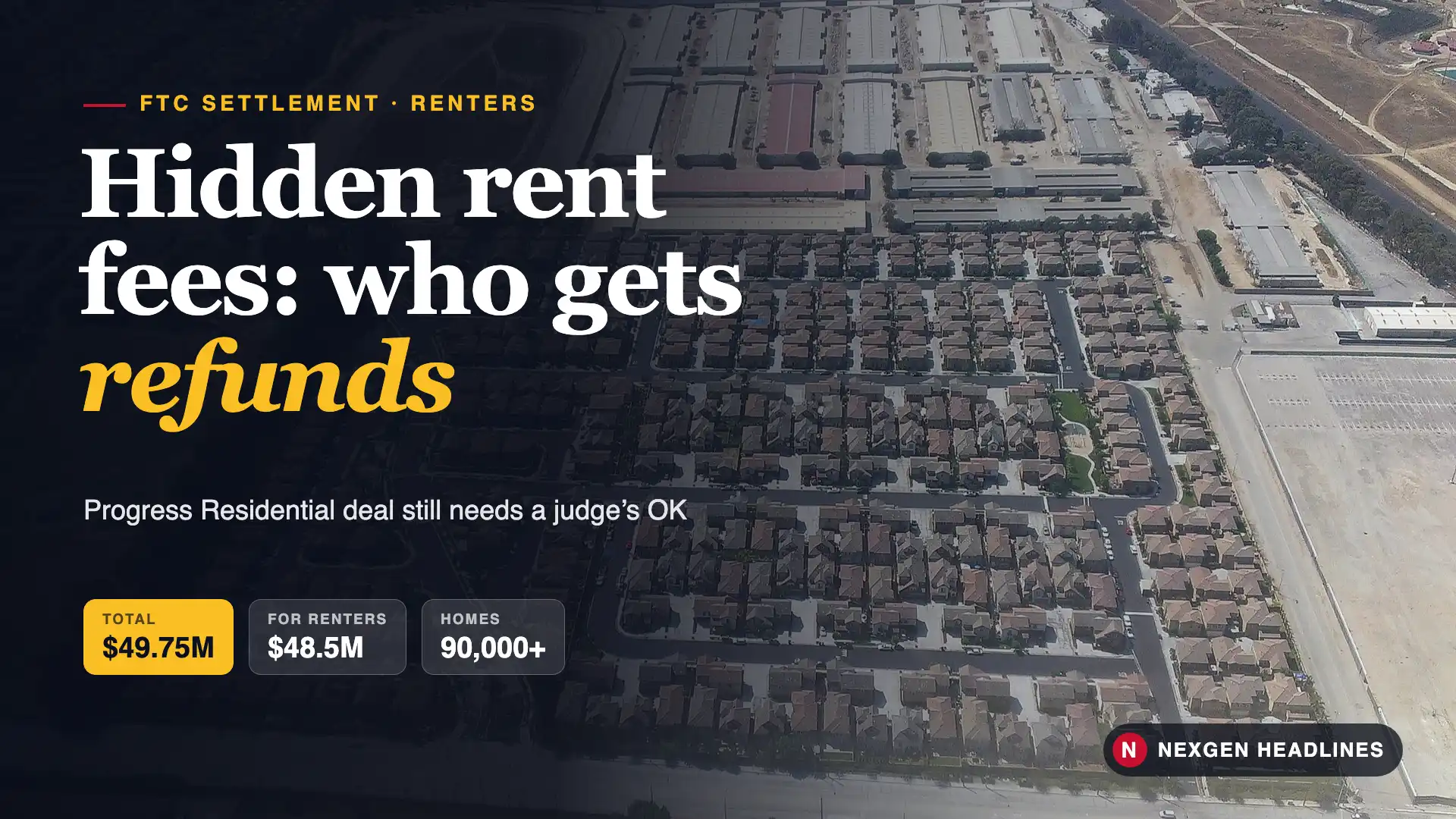
Featured image: Aerial view of tract homes in South Los Angeles near Darby Park, August 2014 (not a Progress Residential property). Photo: Alfred Twu / Wikimedia Commons, CC0; edited by Nexgen Headlines.