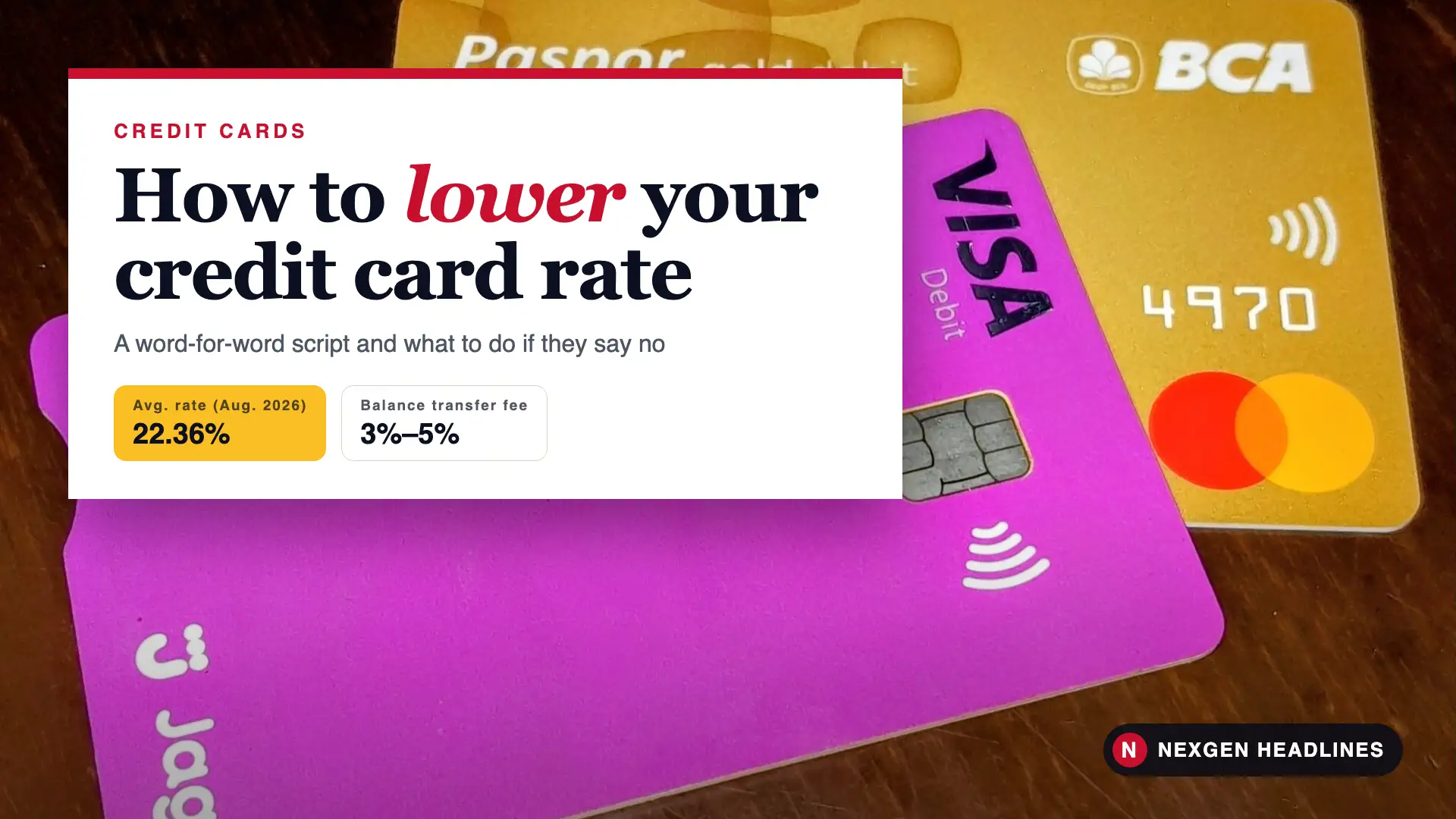

Quick answer: To lower your credit card interest rate, call the number on the back of your card and ask. Mention your on-time payments, your credit score and any lower offers you’ve received. If they say no, ask about a hardship program, move the balance to a 0% balance transfer card, or pay it down with a lower-rate personal loan. Federal Reserve data shows the average rate on card accounts charged interest was 22.36% in August 2026.
Credit card interest is one of the most expensive bills many Americans pay, and most people never ask for a better rate. A five-minute phone call can save hundreds of dollars a year. This guide gives you a word-for-word script, the best times to ask, and what to do if the answer is no.
Why your APR matters
| Balance | Yearly interest at 24% APR | Yearly interest at 18% APR | Savings |
|---|---|---|---|
| $3,000 | about $720 | about $540 | about $180 |
| $6,000 | about $1,440 | about $1,080 | about $360 |
| $10,000 | about $2,400 | about $1,800 | about $600 |
Simplified math assuming the balance stays the same for a year. Real interest depends on your daily balance and payments.
How to ask for a lower rate: 6 steps
- Check your credit score and recent payment history. Many card apps show your score for free.
- Look up competing offers, like balance transfer cards or credit union rates.
- Call the number on the back of your card during business hours.
- Ask directly for a lower APR, using the script below.
- If they say no, ask for a supervisor or the retention department.
- Get any new rate confirmed in writing or in your app.
Word-for-word phone script
“Hi, I’ve been a customer since [year], and I’ve paid on time every month. My current APR is [rate]%, which is higher than offers I’m getting from other cards. I’d like to keep using this card, but I’d need a lower rate. Can you lower my APR today?”
If they say no:
“I understand. Could you check whether I qualify for any promotional rate or hardship program? If not, could I speak with a supervisor or your retention team?”
Be polite, brief and specific. Write down the representative’s name, the date and any offer.
When you’re most likely to get a yes
- Your credit score has gone up since you opened the card.
- You’ve paid on time for at least 6 to 12 months.
- You’ve been a customer for years.
- You have a real offer from another lender to mention.
- You use the card regularly. Issuers want to keep active customers.
Even a 2–3 point cut matters on a large balance. If you’re turned down, try again in 3 to 6 months after more on-time payments.
Made-up example: one phone call
This is a made-up example to show how a request can go. It is not a real person, and results vary.
Andre carries $6,000 on a card at 26% APR. His credit score has risen since he opened the card, and he’s never missed a payment. He calls, uses the script and mentions a 0% balance transfer offer he got in the mail.
The first rep can’t help, so Andre asks for retention. The retention rep lowers his rate to 21%. On his balance, that’s roughly $300 a year less in interest, and he keeps his oldest card open.
If the answer is no: 5 other options
1. Balance transfer card
Many cards offer 0% intro APR on transferred balances for a set period. You typically pay a balance transfer fee, often 3% to 5% of the amount. It works best if you can pay off most of the balance before the intro period ends.
2. Hardship program
If you’ve lost income or had a medical emergency, ask about a hardship plan. Issuers may temporarily lower your rate, waive fees or reduce payments. Your card may be frozen while you’re on the plan.
3. Personal loan
A fixed-rate personal loan, especially from a credit union, may cost less than your card. It also gives you a set payoff date. Compare the APR, including any origination fee.
4. Nonprofit credit counseling
A nonprofit credit counselor can set up a debt management plan. Card issuers often agree to lower rates for people on these plans. Look for agencies connected with the National Foundation for Credit Counseling (NFCC).
5. Pay down the highest rate first
Use the avalanche method: pay minimums on every card and put extra money toward the highest-rate card first. It saves the most interest.
Also read: How Does a Balance Transfer Card Work?
Where to find lower-rate cards
- Credit unions: Federal credit unions are generally limited to an 18% interest rate cap set by their regulator, the NCUA, so their cards are often cheaper.
- Your own bank: Existing customers sometimes get better offers.
- Prequalification tools: Many issuers let you check offers with a soft credit check that doesn’t affect your score.
- Low-rate cards: Some cards skip rewards in exchange for a lower ongoing APR, which is better if you carry a balance.
If you carry a balance month to month, a low APR matters far more than rewards points.
How to stop paying interest entirely
The best interest rate is 0%, and you can get it on any card by paying the full statement balance by the due date each month. Most cards give you a grace period of at least 21 days on new purchases when you pay in full.
- Set up autopay for at least the minimum, so you’re never late.
- Pay the full statement balance when you can.
- Stop using cards with balances while you pay them off.
- Build an emergency fund so surprise bills don’t land on a card.
Made-up example: comparing two paths
These are made-up numbers to show the trade-offs. Real costs depend on your terms.
Lena owes $5,000 at 24% APR. Option A: her issuer lowers her rate to 19%. Option B: she moves the balance to a card with 0% for 15 months and a 3% transfer fee ($150). She can pay $350 a month.
With Option B, she pays off the full balance within the intro period and pays only the $150 fee. With Option A, she’d still pay several hundred dollars in interest over the same time. For Lena, the balance transfer wins, as long as she doesn’t add new charges.
Hardship script if money is tight
If you’ve lost a job, had medical bills or face another setback, be honest. Issuers often have programs they don’t advertise.
“I’ve had a financial hardship because of [job loss, medical bills, reduced hours]. I want to keep paying, but I can’t keep up at this rate. Do you have a hardship program that could lower my interest rate or payment for a while?”
Ask these questions before you agree:
- How long does the lower rate last?
- Will my card be frozen or closed?
- Will this be reported to the credit bureaus, and how?
- What happens if I miss a payment during the plan?
Get the terms in writing before your next payment.
Got a rate-increase notice? What to do
- Read the notice carefully. It should say when the new rate starts and whether you can reject it.
- Call and ask the issuer to keep your current rate, especially if you have a good payment history.
- Consider rejecting the increase if offered. You’d typically have to stop using the card but could pay off the balance under the old terms.
- Shop other options like a credit union card or balance transfer.
How credit card rates work
Most credit card APRs are variable. They’re usually set as the prime rate plus a margin. When the Federal Reserve raises or cuts rates, the prime rate usually moves, and your card APR follows within a billing cycle or two.
Asking for a lower rate changes the margin, the part your issuer controls. That’s why a lower rate from a call can save money no matter what the Fed does.
Your rights on rate changes
Under the federal Credit CARD Act, card issuers generally must:
- Give you 45 days’ notice before raising your rate on new purchases, in most cases
- Let you reject certain rate increases by closing the account and paying it off under the old terms
- Apply payments above the minimum to the highest-rate balance first
If you’re 60 days late, an issuer can apply a penalty APR to your existing balance. Paying on time protects your rate.
Common mistakes
- Never asking. Many issuers will lower rates for good customers who call.
- Opening several new cards at once to chase 0% offers, which can hurt your score.
- Ignoring the transfer fee when comparing balance transfer offers.
- Running the balance back up after moving or paying it down.
- Closing old cards, which can raise your credit utilization.
- Paying a “debt relief” company upfront; the FTC warns against advance fees.
Recommended products
Tools that help you pay down card balances.
Disclosure: As an Amazon Associate, Nexgen Headlines earns from qualifying purchases.
FAQ
Does asking for a lower APR hurt my credit score?
Usually no. Asking for a rate reduction on an existing card typically doesn’t involve a hard credit check. Ask to be sure.
How often can I ask for a lower rate?
There’s no set rule. If you’re turned down, wait 3 to 6 months and ask again after more on-time payments.
What is a good credit card APR?
Lower is better. The Federal Reserve’s average for accounts charged interest was 22.36% in August 2026. Credit union cards are often lower; federal credit unions generally can’t charge more than 18%.
Can I negotiate if I’ve missed payments?
It’s harder, but ask about a hardship program. Explain what happened and what you can afford.
Will my rate go down if the Fed cuts rates?
Usually, a little. Most card APRs are tied to the prime rate, so a Fed cut typically lowers your rate within a billing cycle or two. But the cut is often small compared with what you can save by negotiating or moving the balance.
Should I close a card after paying it off?
Usually not, especially if it has no annual fee. Keeping it open helps your credit utilization and the age of your credit history. Use it lightly and pay it in full.
Is a balance transfer better than asking for a lower rate?
It can be, if you’ll pay off the balance during the 0% period and the transfer fee is less than the interest you’d save.
Bottom line
A lower credit card APR is often just a phone call away. Use the script, mention your payment history and competing offers, and ask for retention if needed. If the answer is no, compare balance transfers, credit union loans and nonprofit counseling, and pay down your highest-rate card first.
Last reviewed: Nov. 9, 2026.
Sources: Federal Reserve: Consumer Credit G.19, FRED: Credit card rates on accounts assessed interest, CFPB: Credit cards, CFPB: Balance transfers, NFCC, FTC: How to get out of debt.
Featured image: Photo: VulcanSphere / Wikimedia Commons, CC BY 4.0; edited by Nexgen Headlines.