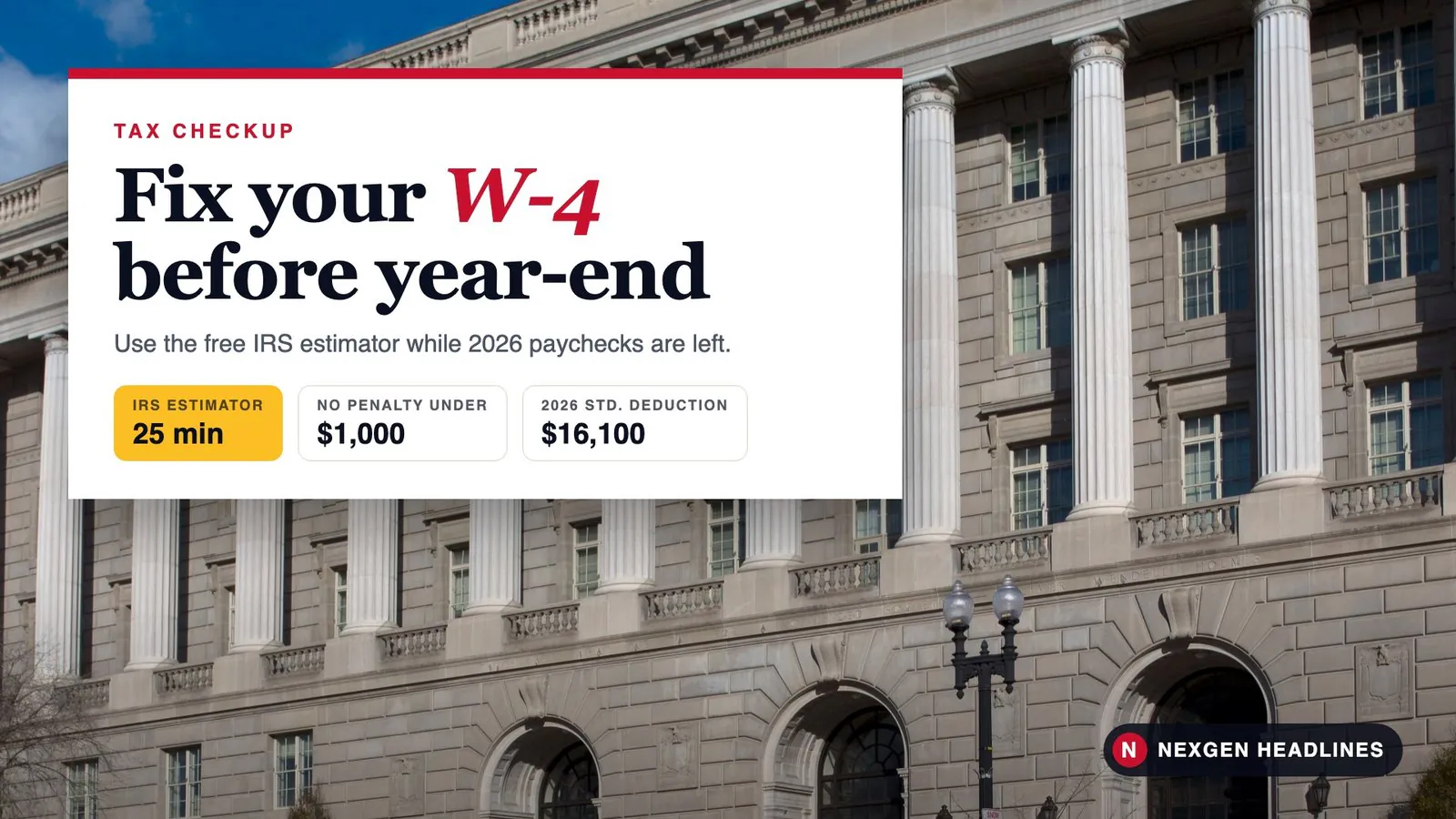

Quick answer: Use the free IRS Tax Withholding Estimator now, while paychecks are left in 2026. If it says you’re short, give your employer a new Form W-4 with extra withholding. The IRS Tax Withholding Estimator is free, takes about 25 minutes and does not ask for your name or Social Security number. You need your latest pay stub. If the result says you are off, it can fill in a new Form W-4 that you hand to your employer. Late October through December is a good time to do it, while there are still paychecks left this year.
Here is a common situation. Someone gets a raise in March, picks up a side gig in the summer, and then in February finds out they owe a few hundred dollars when they expected a refund. Nothing went wrong. Their paycheck withholding just never caught up with their life. This is a made-up example. Picture a nurse. Call her Priya. she changed jobs in June, her new employer used default withholding, and she never touched her W-4. That is exactly the kind of year that ends with a surprise.
What withholding actually is
Every paycheck, your employer sends part of your pay to the IRS on your behalf. How much depends on what you put on your Form W-4. At tax time, your real bill is compared with what was already sent in. Too little sent, you owe. Too much, you get a refund. A big refund is not a bonus; it is your own money, lent to the government interest-free.
Use the free IRS estimator
- Go to the IRS Tax Withholding Estimator.
- Grab your most recent pay stubs (and your spouse’s, if you file jointly). If you have other income or plan to itemize, have last year’s federal return handy too.
- Answer the questions. The IRS says it takes about 25 minutes, and it says your answers are not saved or shared with the IRS and are cleared when you close the browser.
- If the tool suggests a change, it can produce a pre-filled Form W-4 (or W-4P for pensions). Give it to your employer or upload it through their payroll or HR system.
The estimator is meant for people with an employer (W-2) or a pension or annuity with withholding. It is not for nonresident aliens, who should use IRS Notice 1392.
When to run a checkup
- Every January.
- After a major life change: new job, big raise or pay cut, marriage, divorce, a child, or buying a home.
- In late December, if you changed your withholding during the year, to see where you landed.
Refund or bigger paychecks: your call
Adjusting withholding can lower the chance of an underpayment penalty, or it can raise your take-home pay in exchange for a smaller refund, per the IRS. There is no right answer. If a refund works as forced savings for you, keep it. If you would rather have the money each month, aim closer to zero.
Back to Priya
When she ran the estimator in November, it showed she was on track to owe money because two employers in one year had left a gap. She submitted a new W-4 the same week. With about six paychecks left, the extra withholding was small per check, and the bill she was dreading shrank. Twenty-five minutes, no cost.
Why late-year withholding works better than you think
This is the key reason to act before December. The IRS treats withholding from your paycheck as if it were paid evenly all year, even if most of it came out in November and December. Estimated tax payments don’t work that way. They count on the date you pay them.
So a bigger withholding amount on your last few paychecks can help you avoid an underpayment penalty for the whole year, not just the end of it.
Do you owe an underpayment penalty?
You generally won’t owe a penalty if any of these is true:
- You owe less than $1,000 after subtracting withholding and credits.
- You paid at least 90% of this year’s tax through withholding or estimated payments.
- You paid at least 100% of last year’s tax (110% if your adjusted gross income was over $150,000, or $75,000 if married filing separately).
The estimator helps you see where you stand on these rules.
How to fill out the new W-4: step by step
| W-4 step | What it’s for | Who should use it |
|---|---|---|
| Step 1 | Name, address, filing status | Everyone |
| Step 2 | Multiple jobs, or both spouses work | Two-income homes, people with 2 jobs |
| Step 3 | Child and dependent credits | Parents and caregivers |
| Step 4(a) | Other income (interest, side gigs) | Anyone with untaxed income |
| Step 4(b) | Deductions beyond the standard deduction | Itemizers, and people claiming new tip, overtime or senior deductions |
| Step 4(c) | Extra tax per paycheck | Anyone who wants to close a gap fast |
| Step 5 | Sign and date | Everyone; an unsigned form isn’t valid |
Fastest fix: if the estimator says you’ll owe $600 and you have 6 paychecks left, enter $100 in Step 4(c). That’s a made-up example; use your own numbers.
Also read: 12 side hustles you can start with almost no money (and how taxes work). Side income is one of the most common reasons people come up short.
New 2026 tax breaks that can change your withholding
The One Big Beautiful Bill Act, signed in July 2025, added new deductions for tax years 2025 through 2028. If they apply to you, the estimator can account for them:
- Tips: deduct up to $25,000 of qualified tips.
- Overtime: deduct the extra “half” of overtime pay, up to $12,500 ($25,000 for joint filers).
- Age 65 and older: an extra deduction of up to $6,000 per person.
- Car loan interest: up to $10,000 a year on a new car assembled in the U.S.
Income limits apply to each one. The 2026 standard deduction is $16,100 for single filers and $32,200 for married couples filing jointly, per the IRS.
Two-income couples: the most common gap
Married couples who both work are the group most likely to come up short. Each employer withholds as if that paycheck is the household’s only income, so the combined pay can land in a higher bracket than either job alone.
The fix is to run the estimator once, together, with both pay stubs. Then put the extra withholding on the higher-paid spouse’s W-4 only. Doing it on both often leads to too much withheld.
The same problem hits anyone who held two jobs in 2026, even if not at the same time.
Mistakes to avoid
- Both spouses checking the Step 2 box and also using the worksheet. Use one method, not both.
- Forgetting a second job. Each employer withholds as if it’s your only job.
- Claiming “exempt” without qualifying. You must have owed no tax last year and expect none this year. An exempt W-4 also expires; you have to file a new one by Feb. 15 each year.
- Never changing it back. If you added extra withholding for the end of 2026, review it again in January.
- Sending the W-4 to the IRS. It goes to your employer only.
Self-employed or retired? What changes
Freelancers and gig workers don’t have withholding, so they pay quarterly estimated taxes. The last 2026 payment is due Jan. 15, 2027. If you also have a W-2 job, raising withholding there can cover your side income instead.
Retirees can ask for withholding on pensions with Form W-4P, and on Social Security with Form W-4V (7%, 10%, 12% or 22% of each payment).
FAQ
Is it too late to change withholding for this year?
Not if you still have paychecks coming. Changes only affect future pay, so earlier is better, but a late change still helps.
Do I give the IRS my new W-4?
No. You give it to your employer. The IRS only sees the result on your return.
Does the estimator replace a tax professional?
No. If you have complicated income such as a business or investments, consider a professional or the IRS’s own guidance.
When is the 2027 tax filing deadline?
For 2026 returns, the usual deadline is April 15, 2027.
Bottom line
Spend 25 minutes with the free IRS estimator before your last paychecks of 2026. If you’re short, add a dollar amount in Step 4(c) of a new W-4 and give it to your employer. It’s the easiest way to avoid a surprise bill in April.
Recommended products
- Tax document organizer – Keep W-2s, 1099s and receipts in one place.
- Portable document scanner – Save digital copies of pay stubs and tax forms.
- Desktop calculator – Big buttons for budget and tax math.
Disclosure: As an Amazon Associate, Nexgen Headlines earns from qualifying purchases. Prices and availability can change.
This is general information, not tax advice. Priya is an illustrative example.
Sources: IRS – Tax Withholding Estimator; IRS – Form W-4; IRS – Penalty for Underpayment of Estimated Tax; IRS – One Big Beautiful Bill provisions; SSA – Form W-4V.
Last reviewed: Oct. 23, 2026.