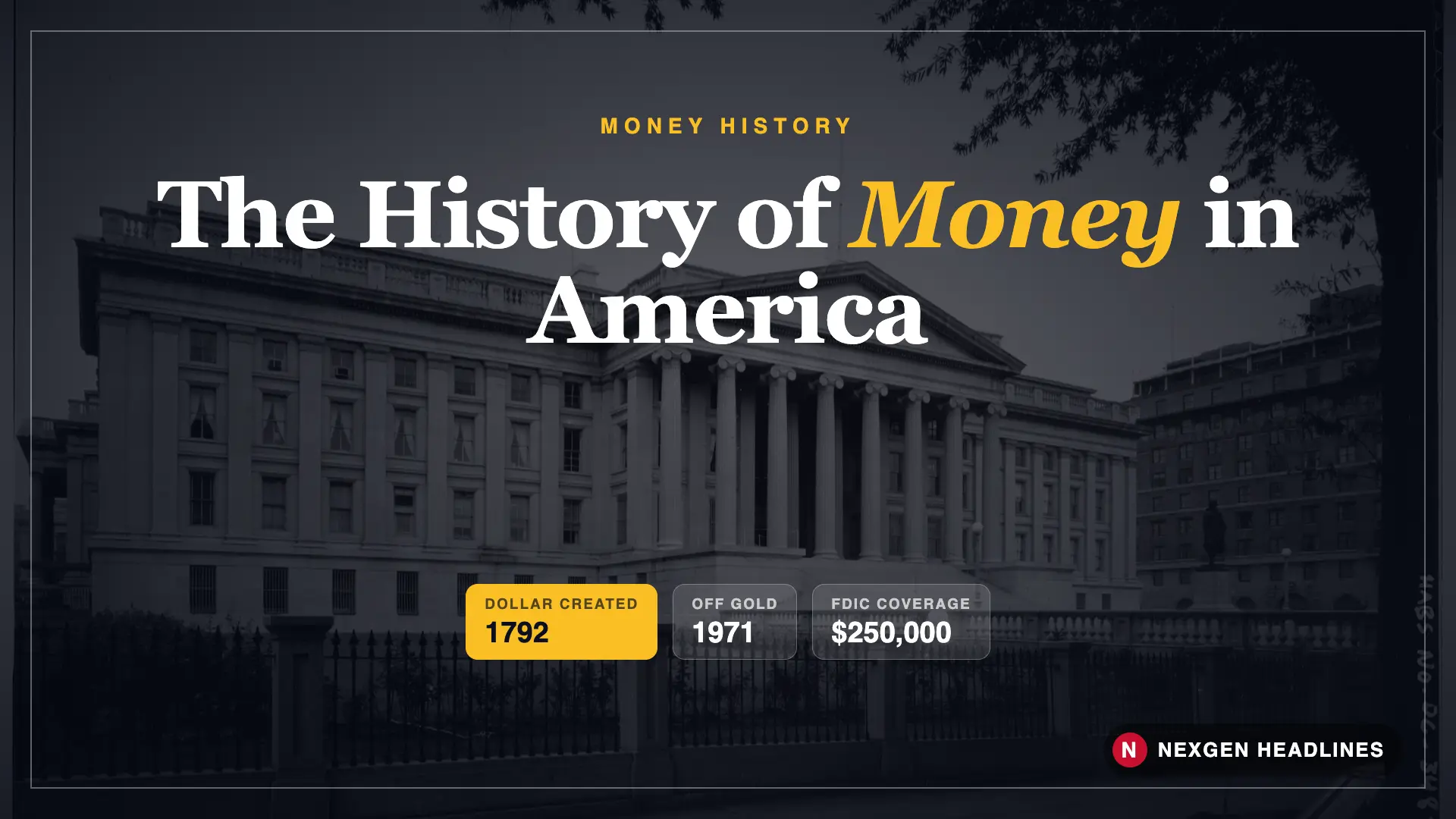

Quick answer: American money started as shell beads, tobacco and Spanish silver coins. The U.S. dollar was created in 1792, backed by silver and later gold. Since Aug. 15, 1971, the dollar has been backed only by trust in the U.S. government. A dollar from 1913 buys about 3 cents’ worth of goods today.
That is 400 years in four sentences. The full story has at least ten major financial panics. Three of the rules that came out of them still protect your savings.
Watch: the entire history of money in America (51 minutes)
Timeline: the history of money in America
| Year | What happened | Why it still matters |
|---|---|---|
| 1637 | Massachusetts makes wampum (shell beads) legal money for small debts | Money is whatever people agree to accept |
| 1690 | Massachusetts issues the first government paper money in the Western world | The start of paper money in America |
| 1775–1781 | Congress prints about $241 million in “Continentals,” which become nearly worthless | Printing too much money destroys its value |
| 1792 | The Coinage Act creates the U.S. Mint and the dollar | One national unit of money |
| 1835 | President Andrew Jackson pays off the national debt | The only time the debt has been zero |
| 1862 | The Union prints “greenbacks” to pay for the Civil War | Why U.S. paper money is green |
| 1913 | The Federal Reserve and the modern income tax begin | The Fed still sets interest rates |
| 1929–1933 | The stock market crashes and about 9,000 banks fail | Led directly to deposit insurance |
| 1933 | The FDIC is created; coverage starts in 1934 at $2,500 | Coverage today is $250,000 |
| 1944 | 44 nations tie their money to the dollar at Bretton Woods | The dollar becomes the world’s main currency |
| 1971 | President Nixon ends the dollar’s link to gold | The dollar now runs on trust alone |
| 2008 | Lehman Brothers fails; FDIC coverage rises to $250,000 | No insured depositor lost money |
| 2022 | Inflation hits 9.1% in June, the highest in about 40 years | Cash loses value when prices rise |
Before the dollar: shells, tobacco and Spanish silver
English colonists arrived in the 1600s with almost no coins. England kept its silver at home. So the colonies used what they had.
In New England, that was wampum, beads carved from shells by Native American nations. Massachusetts made it legal money for small debts in 1637. In Virginia, people paid taxes and wages in tobacco.
Both had the same problem. People made or grew more of them, and each bead or leaf bought less. That pattern repeats through the whole story.
The most trusted coin was Spanish. The Spanish silver dollar, or “piece of eight,” was often cut into eight slices called bits. Two bits made a quarter. Foreign coins stayed legal money in the United States until 1857.
The first money disaster: “not worth a Continental”
In 1775, the Continental Congress had an army to pay and no power to tax. It printed paper bills called Continentals. By the end, it had issued about $241 million.
Britain made things worse by spreading fake bills. By 1781, Continentals had stopped working as money. Americans started calling anything useless “not worth a Continental.”
The founders remembered. The Constitution bars states from issuing their own paper money.
Hamilton, the Mint and the first dollar
Alexander Hamilton, the first Treasury Secretary, insisted the new country pay all its debts. His reasoning was simple. A country that pays can borrow cheaply later.
The Coinage Act of April 1792 created the U.S. Mint in Philadelphia and defined the dollar by a set weight of silver. It also set a death penalty for Mint officers who cheated on the metal.
8,000 kinds of dollar bills
President Andrew Jackson vetoed the renewal of the national bank in 1832. In January 1835, he paid off the entire national debt. That has never happened again. Today the debt is about $40 trillion.
Without a national bank, state banks printed their own notes. One count found more than 8,000 different banknotes in circulation. Shopkeepers kept printed guides to tell real notes from worthless ones. In 1837, the bubble burst.
Why money is green
The Civil War cost the Union more than $1 million a day early on. In 1862, Congress approved paper money backed only by the government’s word. The backs were printed in green ink, so people called them greenbacks.
The war also brought the first federal income tax: 3% on income over $800. And by the war’s end, an estimated one-third to one-half of paper money in circulation was fake. On July 5, 1865, the government created the Secret Service to hunt counterfeiters. Protecting presidents came later.
Also read: Who Got the First Social Security Check? The $22.54 Story
1913: the Fed and the income tax
In the Panic of 1907, the banker J.P. Morgan organized the rescue of New York’s banks himself. Washington decided the country should not depend on one man.
President Woodrow Wilson signed the Federal Reserve Act on Dec. 23, 1913. The same year brought the modern income tax. The basic rate was 1% on income over $3,000. The top rate was 7%.
The crash, the bank holiday and the FDIC
In October 1929, the stock market fell about 13% on a Monday and about 12% the next day. By July 1932, stocks had lost almost 90% of their value. About 9,000 banks failed between 1930 and 1933. There was no deposit insurance, so savers lost their money.
In March 1933, President Franklin Roosevelt closed every bank for a week. In June, Congress created the Federal Deposit Insurance Corporation (FDIC). Coverage began on Jan. 1, 1934, at $2,500. The FDIC says no depositor has lost a penny of insured funds since.
The Dow Jones Industrial Average did not return to its 1929 peak until Nov. 23, 1954.
From gold to trust: 1944 to 1971
In July 1944, delegates from 44 nations met at Bretton Woods, New Hampshire. Other countries tied their currencies to the dollar. The dollar was tied to gold at $35 an ounce.
By 1971, there were far more dollars overseas than gold to back them. On Aug. 15, 1971, President Richard Nixon ended the exchange of dollars for gold. Inflation reached 14.8% in March 1980. The Fed pushed interest rates to about 20% to stop it, and the average 30-year mortgage rate passed 18% in October 1981.
2008 to today
Lehman Brothers filed the largest bankruptcy in U.S. history on Sept. 15, 2008. Congress approved a $700 billion rescue and raised FDIC coverage from $100,000 to $250,000.
In 2020 and 2021, Washington sent three rounds of pandemic checks: up to $1,200, $600 and $1,400. Inflation then hit 9.1% in June 2022. In March 2023, Silicon Valley Bank faced $42 billion in withdrawal requests in one day and was closed.
The three rules 400 years of panics teach
- Know what is insured. FDIC coverage is $250,000 per depositor, per insured bank, per ownership category. Federally insured credit unions have similar coverage through the NCUA. Stocks, crypto and many money apps are not covered.
- Inflation never sleeps. Cash you need soon belongs in an insured account. Money you won’t need for decades has to grow faster than prices.
- Panics pass. Debt doesn’t. In 1929 and 2008, the people hurt worst had borrowed heavily and were forced to sell at the bottom.
These are made-up examples to show how the rules work.
Maya has $6,000 saved and a $2,000 credit card balance at 24% interest. Rule three says the card comes first, because no safe investment pays 24%. Her emergency cash goes in an insured savings account.
Joe is retired with $300,000 in one savings account at one bank. Only $250,000 is insured. Moving $50,000 to a second insured bank covers all of it.
FAQ
When was the U.S. dollar created?
Congress created the dollar with the Coinage Act of April 1792. The same law set up the U.S. Mint in Philadelphia.
Is the U.S. dollar backed by gold?
No. The United States stopped exchanging dollars for gold on Aug. 15, 1971. The dollar is now “fiat” money, backed by trust in the government and the economy.
How much has the dollar lost in value?
Based on the government’s Consumer Price Index, $1 in 1913 has the buying power of roughly $34 today. Put another way, today’s dollar buys about 3% of what a 1913 dollar did.
Has anyone ever lost FDIC-insured money?
The FDIC says no depositor has lost a penny of insured funds since coverage began in 1934. Money above the $250,000 limit is not guaranteed.
Why is American money green?
The paper money printed during the Civil War had green ink on the back. People called the bills greenbacks, and the color stayed.
Bottom line
American money has been shells, tobacco, silver, gold and paper. Each change followed a crisis. The lessons are steady: check that your cash is insured, don’t let long-term savings sit still while prices rise, and avoid debt that forces you to sell in a panic.
This article is general education, not personal financial advice.
Last reviewed: Nov. 10, 2026
Sources: FDIC: Deposit Insurance; Federal Reserve History; BLS CPI Inflation Calculator; U.S. Mint: History; U.S. Secret Service: History; Treasury: Debt to the Penny; SSA History; Treasury: Economic Impact Payments; Bloomberg (Silicon Valley Bank filing, March 2023).