

North Korea Nuclear Tests May Have Changed the Earth Beneath Mount Mantap
North Korea Nuclear Tests may have produced effects that continued long after the explosions themselves ended.
A new study published in the journal Science has found that underground nuclear explosions at North Korea’s Punggye-ri testing site appear to have reactivated previously quiet geological faults beneath Mount Mantap.
Researchers analyzed 17 years of seismic data and found that earthquake activity around the site did not simply fade after North Korea’s final nuclear test in 2017. Instead, seismic activity increased and gradually became concentrated along fault structures.
The findings suggest that repeated underground explosions may have damaged the shallow crust and changed the stresses acting on nearby faults.
Six Nuclear Tests Were Conducted at Punggye-ri
North Korea conducted six underground nuclear tests at the Punggye-ri site between 2006 and 2017.
The tests were carried out beneath Mount Mantap in the country’s northeastern region.
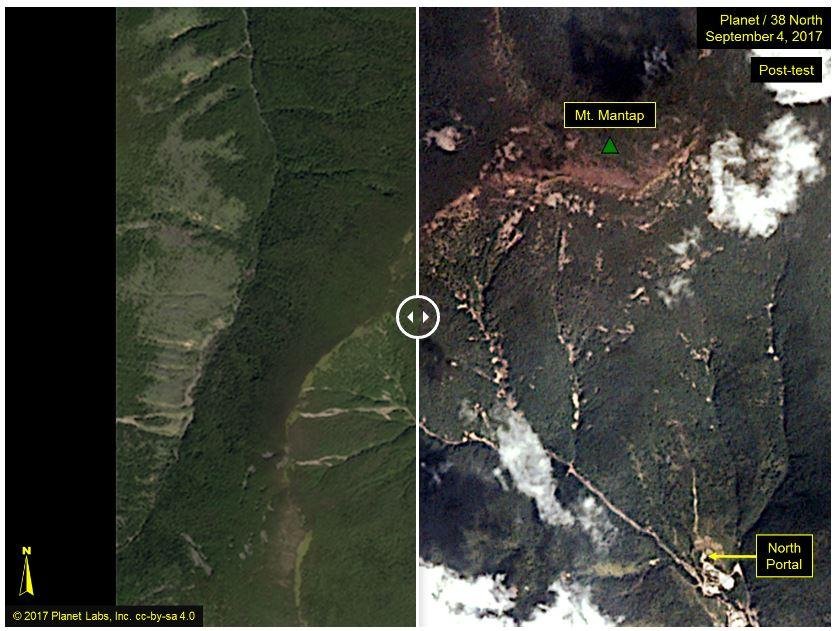
The final test, conducted in September 2017, was the largest of the six. Scientists estimate that the explosion produced a seismic event of approximately magnitude 6.3 and caused significant deformation of the mountain.
Normally, earthquakes generated around underground explosions are expected to decrease relatively quickly after the testing stops.
The seismic pattern at Mount Mantap was different.
Researchers found that earthquake activity continued and intensified for years following the 2017 explosion.
More Than 1,300 Earthquakes Detected
The research team examined seismic recordings collected in South Korea and northeastern China from 2008 through May 2025.
They identified 1,399 local earthquakes around Mount Mantap during the study period.
The most significant change occurred after the 2017 nuclear test.
According to the researchers, seismic activity increased about three weeks after the final explosion and continued growing over the following years.
By 2023 and 2024, some of the detected earthquakes had reached magnitudes above 3.0.
The strongest earthquake identified in the study reached approximately magnitude 3.4.
The researchers say the pattern was unusual because the earthquakes became increasingly organized along specific geological structures rather than remaining randomly distributed.
How Nuclear Explosions Can Affect Faults
The science behind the findings involves pressure and stress inside the Earth’s crust.
An underground nuclear explosion releases a tremendous amount of energy in a very small area.
That energy can fracture surrounding rock and create changes in the local stress field.
If nearby faults are already close to the point where they could slip, changes in stress may push portions of those faults toward movement.
Researchers believe that repeated nuclear testing at Mount Mantap gradually damaged the shallow crust.
The explosions may have created fractures and redistributed underground stress, eventually allowing previously quiet faults to become active.
The study describes this as delayed fault reactivation rather than simply a normal series of aftershocks.
The Earthquakes Were Unusually Shallow
North Korea Nuclear Tests
Another important finding concerns the depth of the earthquakes.
Many earthquakes in the Korean Peninsula occur at considerably greater depths.
The seismic events around Mount Mantap were unusually shallow, with most occurring within about one kilometer of the surface, according to reporting on the study.
That shallow location is consistent with the researchers’ conclusion that the nuclear explosions affected the upper portion of the Earth’s crust.
The earthquakes also became concentrated along two fault zones extending for roughly 24 kilometers.
Could a Larger Earthquake Happen?
North Korea Nuclear Tests
The research has raised concerns about what could happen if the identified faults were to become fully reactivated.
Professor Kwang-Hee Kim of Pusan National University estimated that the fault system could potentially produce an earthquake of around magnitude 6.4 if the relevant fault zones were activated together.
That is a scientific estimate of a possible scenario, not a prediction that such an earthquake will occur.
Researchers are not saying that a magnitude 6.4 earthquake is imminent.
Instead, the finding demonstrates that underground nuclear testing can alter geological conditions for years and potentially create seismic risks that continue long after testing has stopped.
Why the 2017 Test Was So Important
North Korea Nuclear Tests
North Korea’s sixth nuclear test was significantly larger than its earlier tests.
The explosion occurred beneath Mount Mantap on September 3, 2017.
The event generated a strong seismic signal that was detected internationally.
Satellite observations also showed substantial changes to the mountain.
The new research provides another piece of evidence about the long-term consequences of that explosion.
Instead of the geological effects disappearing shortly afterward, researchers found evidence that the surrounding crust continued adjusting for years.
That delayed response is one of the most important aspects of the new study.
A Different Kind of Seismic Activity
Scientists are particularly interested in the fact that the seismic activity became more organized over time.
Immediately following an explosion, earthquake activity can be expected to occur as the surrounding rock adjusts.
At Mount Mantap, however, the researchers observed a longer-term progression.
The earthquakes initially appeared more scattered but later became concentrated along identifiable fault-controlled structures.
That pattern supports the idea that the underground tests progressively altered the stress conditions in the area.
The findings therefore challenge the assumption that seismic effects from underground nuclear testing necessarily disappear soon after the explosions end.
The Findings Could Help Monitor Former Test Sites
The study could have implications beyond North Korea.
Countries around the world have conducted underground nuclear tests, leaving behind locations where the Earth’s crust may have been disturbed.
Understanding how those explosions affect faults could help scientists monitor former nuclear test sites.
It could also make seismic monitoring more complicated.
If nuclear explosions can trigger earthquakes years later, researchers may need to distinguish delayed human-induced seismic activity from naturally occurring earthquakes.
That could be especially important in regions where earthquake monitoring is also used to identify possible underground nuclear tests.
Why Long-Term Monitoring Matters
The research team emphasized the importance of continuing to monitor the Mount Mantap region.
The discovery shows that the geological consequences of underground explosions may not end when a country’s nuclear testing program stops.
Instead, the Earth’s crust can continue adjusting long afterward.
For scientists, Mount Mantap has effectively become a natural laboratory for studying how extreme underground explosions interact with existing geological structures.
Continued seismic monitoring could reveal whether the activity eventually declines or continues developing along the identified faults.
A Warning From the Earth’s Crust
The new study provides an unusual look at the long-term consequences of North Korea Nuclear Tests.
Six underground tests were conducted at Punggye-ri over more than a decade.
The final and largest explosion in 2017 was followed not by a simple decline in seismic activity, but by years of increasingly organized earthquakes around Mount Mantap.
Researchers believe repeated explosions damaged the shallow crust and redistributed stress, allowing faults that had previously been quiet to become active.
The findings do not mean that a major earthquake is certain to occur.
But they do show that underground nuclear testing can leave a geological footprint that lasts far beyond the moment of detonation.
For scientists, that makes Mount Mantap an important location for continued monitoring — and an example of how human activity can interact with deep geological processes in unexpected ways.
Important News Takeaway
The latest Science study found that seismic activity near North Korea’s Punggye-ri nuclear test site increased and became concentrated along fault structures after the country’s final nuclear test in 2017. Researchers identified 1,399 local earthquakes between 2008 and 2025 and concluded that repeated underground explosions likely altered stresses in the shallow crust and reactivated existing faults
THANKS FOR READING