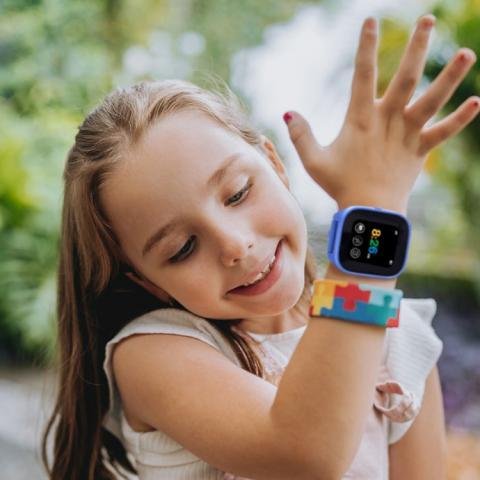
Kids Smartwatch technology may look simple from the outside, but designing one for children is far more complicated than shrinking an adult smartwatch.
Children drop things. They run through puddles. They forget where they left their belongings. They press buttons repeatedly, pull at straps, and sometimes treat expensive electronics like toys.
That means engineers designing a Kids Smartwatch have to think differently.
The device must be durable enough for playgrounds and school days, simple enough for a child to operate, powerful enough to communicate with parents, and safe enough to be worn for hours.
Behind the bright colors and playful interfaces is a surprisingly complex engineering challenge.
A Smartwatch Designed for Unpredictable Users
Adults generally understand how fragile electronics can be.
Children often do not.
A child may leave a smartwatch on a bathroom counter, throw it into a backpack, wear it during sports, or accidentally drop it on concrete.
Engineers therefore design children’s devices around real-world abuse rather than ideal conditions.
A successful Kids Smartwatch needs to survive repeated impacts without becoming uncomfortable or unreliable.
That requires stronger housings, protected screens, durable buttons and carefully designed wristbands.
Water Resistance Is Essential
Water is one of the biggest threats to children’s electronics.
Kids wash their hands, play outside in rain, jump into puddles and sometimes forget to remove wearable devices before getting wet.
For that reason, manufacturers typically build children’s smartwatches with water-resistant construction.
Seals around charging ports, buttons and display components help prevent moisture from reaching sensitive electronics.
The goal is not simply to protect the device from an accidental splash.
Engineers have to consider repeated exposure to water throughout the product’s lifetime.
The Screen Has to Survive Daily Abuse
The display is one of the most vulnerable parts of any smartwatch.
For children, the risk is even greater.
A smartwatch may hit a desk, playground equipment or the ground during a fall.
Manufacturers therefore use protective materials and reinforced designs to reduce the chance of cracks and scratches.
The display also needs to remain responsive to small fingers.
Buttons and touch controls must be large enough for children to use comfortably without requiring complicated gestures.
Simple Controls Matter
A smartwatch for adults can contain dozens of settings and complicated menus.
A Kids Smartwatch needs to be much simpler.
Children should be able to perform essential actions quickly.
Depending on the model, those may include:
- Calling approved contacts
- Sending messages
- Checking the time
- Using location features
- Activating an emergency function
- Viewing reminders
- Checking activity information
Too many options can confuse younger users.
The best children’s devices therefore prioritize simple menus, clear icons and predictable controls.
Safety Is Part of the Hardware
Parents often purchase children’s smartwatches because they want communication and safety features.
That means engineers must consider safety from the beginning of the design process.
Depending on the product, features can include GPS location tracking, approved-contact calling, emergency alerts and location sharing.
Some devices also provide geofencing, allowing parents to receive alerts when a child moves outside a predefined area.
These features turn the smartwatch into more than a timepiece.
It becomes a communication tool designed to help families stay connected.
Battery Life Creates Another Challenge
Children are not always responsible about charging electronics.
A child may remove a smartwatch at the end of the school day and forget to charge it overnight.
That creates a serious engineering problem.
A Kids Smartwatch needs enough battery capacity to support communication, location services and other features while remaining small and comfortable.
GPS can consume significant amounts of power, especially when location information is updated frequently.
Engineers therefore have to balance tracking accuracy with battery efficiency.
Location Tracking Requires Careful Engineering
GPS is one of the most important features for many parents.
But GPS performance can vary depending on buildings, weather, surroundings and satellite visibility.
A smartwatch may also combine GPS with other positioning technologies to improve location estimates.
The device must process location information efficiently while communicating with a smartphone application.
That requires both hardware and software working together.
Comfort Is Just as Important as Durability
A smartwatch can be extremely strong and still fail as a product if children refuse to wear it.
Children have smaller wrists than adults, so the watch must remain lightweight.
The strap needs to be flexible without becoming uncomfortable.
Materials must also be selected carefully because the device may remain against a child’s skin for long periods.
Designers therefore consider everything from strap texture to the shape of the watch case.
Privacy Becomes a Major Responsibility
A Kids Smartwatch can collect sensitive information, including a child’s location and communication data.
That creates significant privacy responsibilities for manufacturers.
Parents need clear information about what data the device collects, where that information is stored, who can access it, and how long it is retained.
Security measures are also important because unauthorized access to location information could create serious risks.
For children’s technology, cybersecurity is not simply a technical feature.
It is part of child safety.
Making the Watch Difficult to Misuse
Engineers also have to think about accidental misuse.
Children may press buttons repeatedly, change settings, or attempt to remove straps.
Software designers therefore build systems that limit access to important settings.
Parents may control approved contacts, location features and other functions through a companion smartphone application.
This creates a separation between child-friendly controls and parent-level controls.
Testing Goes Beyond the Laboratory
Before a Kids Smartwatch reaches consumers, manufacturers need to test it under conditions that resemble real childhood.
That can involve repeated drop tests, button testing, strap stress tests, water exposure and battery testing.
Engineers may simulate thousands of button presses or repeated impacts to identify weaknesses.
The objective is simple: find problems before children do.
Designing for School Life
A children’s smartwatch also needs to fit into everyday routines.
Schools may restrict device use during classes.
Parents may want communication features available while preventing unnecessary distractions.
Some smartwatches therefore include school-mode settings that limit certain functions during designated hours.
This allows the device to remain available for essential communication without turning into another source of distraction.
Parents and Children Want Different Things
One of the most interesting challenges is that the product has two audiences.
Children want something that looks fun and feels easy to use.
Parents want safety, reliability, privacy and control.
A successful Kids Smartwatch has to satisfy both.
Bright colors and playful interfaces can attract children, while GPS, secure communication and parental controls provide the functionality adults expect.
Getting that balance right is one of the hardest parts of the design process.
Why Testing for ‘Chaos’ Matters
The phrase “designed for chaos” captures the reality of children’s technology.
A child does not treat a smartwatch like a fragile piece of electronics.
It becomes part of their everyday life.
It travels to school, parks, sports activities, vacations and family outings.
It gets exposed to dirt, water, bumps and constant movement.
That means durability is not an optional extra.
It is fundamental to the product.
The Future of Kids Smartwatches
Future children’s smartwatches could become even more capable.
Manufacturers are exploring improvements in battery technology, location accuracy, artificial intelligence, health-related features and communication.
However, additional capabilities also create additional privacy and safety questions.
The industry will need to ensure that new features improve children’s lives without collecting unnecessary personal information.
Why This Technology Matters
A Kids Smartwatch represents a unique combination of consumer technology and family safety.
Unlike adult wearables, its success cannot be measured simply by processor speed or the number of applications available.
It has to work in the real world of childhood.
That means surviving accidents, remaining comfortable, providing reliable communication and protecting sensitive information.
Summary
A Kids Smartwatch may look like a small piece of wearable technology, but creating one requires extensive engineering. Manufacturers have to design for drops, water, dirt, small wrists, limited attention spans, battery limitations and unpredictable daily use. At the same time, GPS tracking, communication tools, parental controls and privacy protections must work reliably. The result is a product that has to satisfy two very different users: children who want something simple and fun, and parents who want something safe, durable and dependable. As technology continues advancing, the challenge will be adding smarter features while keeping children’s safety and privacy at the center of the design.
THANKS FOR READING