
A Major Decision Sparks Debate Over Technology and Learning
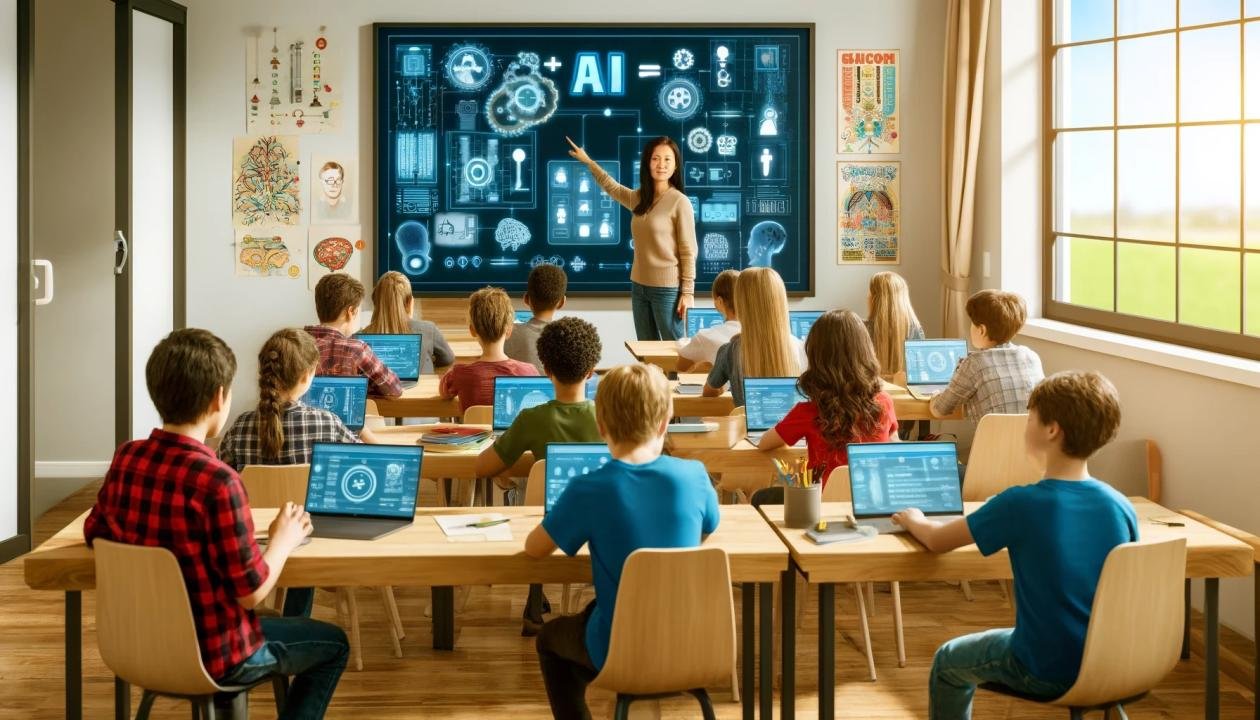
AI in the Classroom is at the center of a major education debate after the nation’s largest school district moved to restrict artificial intelligence tools for students through eighth grade.
The policy reflects a growing concern among educators and parents that students may become too dependent on AI before developing essential skills such as writing, reading, critical thinking and independent problem-solving.
At the same time, the decision raises a difficult question: Should schools keep young students away from artificial intelligence, or should they teach children how to use the technology responsibly?
The answer could shape how an entire generation learns.
Why Schools Are Worried About AI
The rapid growth of generative AI has transformed education in a remarkably short period.
Tools can now produce essays, answer questions, summarize books, solve mathematical problems and generate study materials within seconds. For students, that convenience can be extremely attractive.
But educators worry that convenience can come at a cost.
If students allow AI to complete assignments instead of struggling through the learning process themselves, they may miss opportunities to develop skills that are difficult to replace later. Writing, for example, is not simply about producing a finished paragraph. It teaches students how to organize ideas, communicate clearly and build an argument.
That is one reason AI in the Classroom has become such a controversial issue.
Why the Ban Focuses on Younger Students
The restriction through eighth grade reflects the idea that younger students need to establish fundamental academic skills before relying heavily on advanced technology.
Elementary and middle school are important years for developing basic literacy, numeracy and reasoning abilities. Teachers want students to experience the process of making mistakes, revising their work and finding solutions without immediately turning to an automated tool.
Supporters of the policy argue that once those foundations are stronger, students can learn to use AI more effectively and responsibly.
The goal is not necessarily to eliminate technology from education forever. Instead, it is to delay certain forms of AI assistance until students have developed stronger independent-learning habits.
Teachers Face a New Challenge
The debate also places teachers in a difficult position.
Educators are expected to prepare students for a world where AI will almost certainly play an important role in the workplace. Completely ignoring the technology would therefore be unrealistic.
At the same time, teachers need to know whether a student’s work actually represents the student’s own thinking.
That makes AI in the Classroom different from previous technology debates. Computers, calculators and search engines changed education, but generative AI can create original-looking work that makes it much harder to distinguish between assistance and authorship.
Teachers must now balance innovation with academic integrity.
Parents Have Questions Too
For parents, the new restrictions may offer reassurance.
Some families are concerned that children are spending too much time using technology and too little time reading, writing and interacting directly with teachers and classmates.
A policy limiting AI use during the early school years can give parents greater confidence that their children are developing essential skills without allowing software to do the work for them.
However, other parents may worry that students could fall behind their peers in learning how to use a technology that is rapidly becoming part of everyday life.
AI Can Also Be a Powerful Educational Tool
Despite concerns, artificial intelligence is not entirely negative for education.
When used appropriately, AI can help teachers create lesson materials, explain difficult concepts in different ways and provide additional practice. Students can also use carefully supervised tools for brainstorming, feedback and learning support.
That is why many educators favor teaching responsible AI use rather than treating the technology as inherently harmful.
The central issue is how AI is used.
There is a major difference between asking an AI system to explain a difficult concept and asking it to write an entire assignment that a student submits as their own.
A Bigger Question About the Future
The debate surrounding AI in the Classroom is ultimately about more than one school district.
Schools across the United States are trying to determine what education should look like in an era when powerful AI systems are widely available.
Some districts are developing AI guidelines. Others are experimenting with classroom tools, teacher training and AI literacy programs. The approaches vary, but the underlying challenge is similar: educators must prepare students for the future without sacrificing the fundamental skills they need to succeed.
That balance will not be easy.
Students Still Need to Learn How to Think
One of the strongest arguments for limiting AI among younger students is simple: children need opportunities to think for themselves.
Learning is often uncomfortable. A student may struggle to write the first sentence of an essay or spend twenty minutes trying to solve a difficult problem.
Those moments are valuable.
They teach persistence, patience and problem-solving. If AI removes every difficult step, students may finish assignments faster without actually becoming better learners.
The best educational technology should support learning—not replace it.
What Comes Next
The future of AI in the Classroom will likely involve more nuanced rules rather than a simple choice between banning and embracing the technology.
Schools may gradually introduce AI literacy as students become older, teaching them how to verify information, recognize mistakes, protect privacy and use AI ethically.
For younger students, traditional learning methods may remain the priority.
For older students, AI could become a tool for research, creativity and preparation for the modern workplace.
The challenge will be creating rules that protect students while still preparing them for the world they will enter.
Conclusion
The debate over AI in the Classroom represents one of the biggest education questions of the modern era. Restricting AI for younger students can help protect foundational skills, independent thinking and academic integrity, while critics may argue that children also need early exposure to technology that will shape their future.
There may be no perfect answer.
What matters most is ensuring that technology remains a tool for education rather than a substitute for learning. As schools continue experimenting with new policies, the most successful approach will likely be one that combines strong academic foundations with responsible, age-appropriate AI education.
THANKS FOR READING