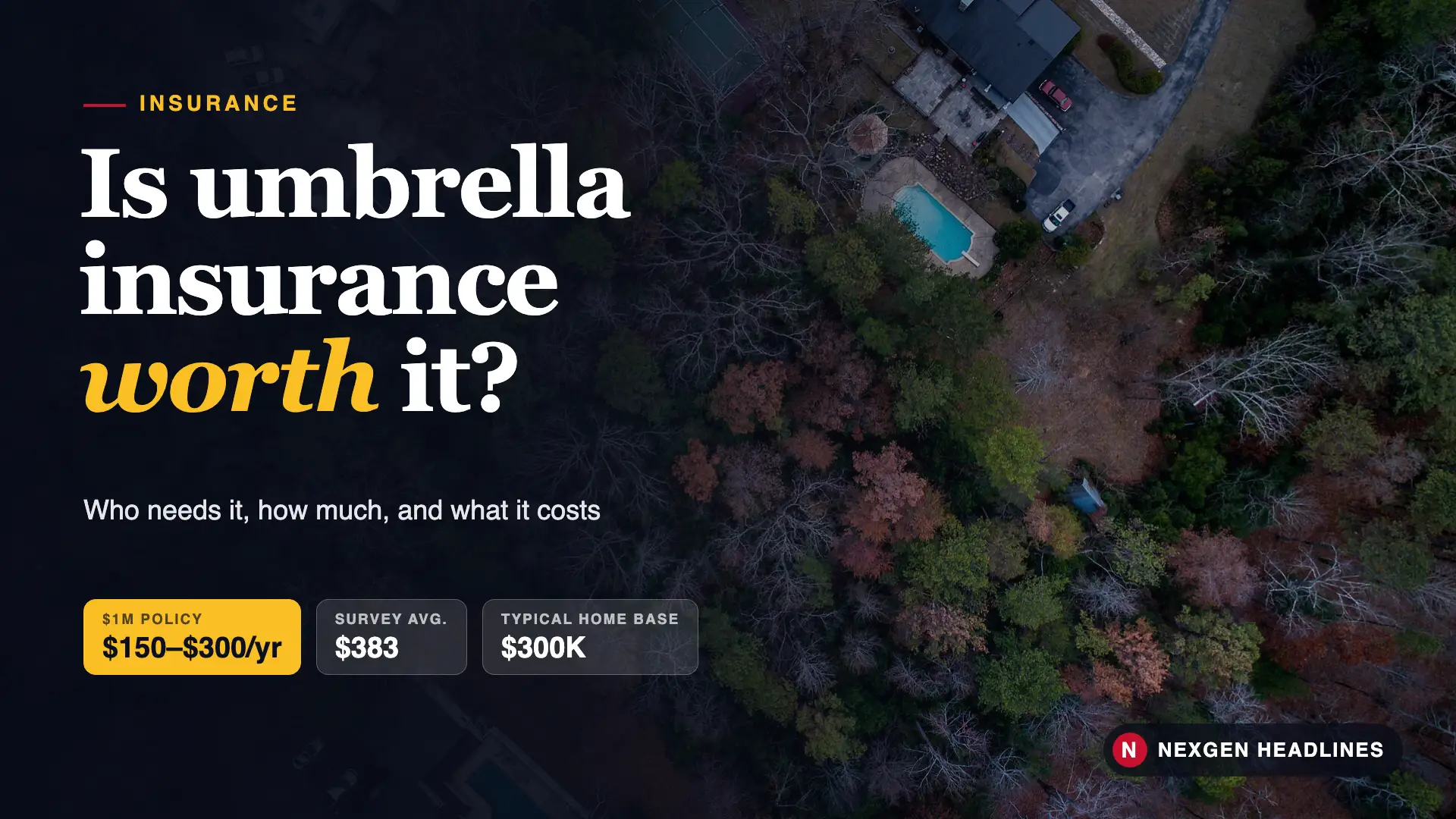

Quick answer: Umbrella insurance is worth it if you have more to lose than your auto and home policies cover: savings, home equity, future wages, a pool, a teen driver or a dog. A $1 million policy typically costs about $150 to $300 a year, according to the Insurance Information Institute, and some insurers’ averages run higher. It pays after your auto or home liability limit runs out, and it can cover lawsuits those policies don’t.
Most people never think about liability until a lawsuit lands. One bad car crash with serious injuries can top a typical $100,000 or $300,000 auto liability limit fast. Here’s how to decide if you need an umbrella, how much to buy, and how to keep the price low.
Umbrella insurance at a glance
| Question | Short answer |
|---|---|
| What it covers | Liability above your auto, home or renters limits, plus some claims they exclude (like libel or slander) |
| Typical coverage sold | $1 million and up, in $1 million steps |
| Typical cost for $1 million | About $150–$300 a year (III); one insurer survey cited by Progressive put the average at $383 |
| Extra $1 million | Often about $50–$100 more a year (varies by insurer) |
| What you usually need first | Higher auto and home liability limits, set by the insurer |
| What it doesn’t cover | Your own injuries or property, business activity, intentional harm |
How an umbrella policy works
Think of it as a second layer of liability coverage. Your auto or home policy pays first, up to its limit. Once that limit is used up, the umbrella pays the rest, up to its own limit.
Umbrella policies usually also pay for legal defense costs. Lawyers can cost tens of thousands of dollars even when you win a case. Many policies pay defense costs on top of the coverage limit.
They can also cover claims your other policies skip. Common ones include false arrest, libel, slander and some liability when you’re traveling abroad. Read your policy for the exact list.
Who should seriously consider umbrella insurance
- Homeowners with real equity or savings. In a lawsuit, a court can go after assets beyond your insurance.
- Families with teen drivers. Young drivers have higher crash rates, and parents can be sued.
- Owners of pools, trampolines or dogs. These are common sources of injury claims at home.
- Landlords with one or two rentals (check how your insurer handles rental properties).
- Higher earners. Even with few assets today, future wages can be garnished to pay a judgment, within state limits.
- Volunteers and board members of local groups, who may be named in lawsuits.
- People who post a lot online. Defamation claims are rare, but an umbrella can help.
Who can probably skip it
- Renters with little savings, no car and no dog.
- People whose assets are mostly in retirement accounts. Many 401(k) and IRA balances have strong protection from creditors under federal and state law, though rules vary.
- Anyone who can’t yet afford adequate auto and home coverage. Fix those first.
How much umbrella coverage do you need?
A simple rule: buy enough to cover your net worth, then round up to the next million. Add more if you have a lot of future earnings to protect.
- Add up what a court could take: home equity, savings, brokerage accounts, cars and other property.
- Subtract what’s protected in your state (homestead exemptions and retirement accounts vary).
- Consider your risk: teen drivers, a pool or lots of guests push you higher.
- Round up to the nearest $1 million. Each extra million is usually cheap.
Made-up example (for illustration):
Dan and Erica own a home with $280,000 in equity and have $120,000 in savings. They have a 17-year-old son who just got his license. Their auto policy covers $250,000 per person and $500,000 per crash.
Their son causes a crash that badly injures two people. A jury awards $1.2 million. Their auto policy pays $500,000. Without an umbrella, they could owe the other $700,000, and their home equity and savings are at risk. With a $1 million umbrella, which might cost them a few hundred dollars a year, the umbrella pays the $700,000 gap.
These are made-up numbers. Real awards, limits and prices vary widely.
What umbrella insurance costs and why
Prices depend on how many homes, cars and drivers you have, your claims history, and your state. The Insurance Information Institute puts a typical $1 million policy at about $150 to $300 a year. Progressive cites an ACE Private Risk Services figure of $383 a year for a household with one home, two cars and two drivers.
Things that raise your price:
- Teen or young drivers, and more vehicles
- Rental properties, boats or recreational vehicles
- A pool, trampoline or certain dog breeds (depending on the insurer)
- Past claims or driving violations
The fine print: underlying limits
Insurers won’t let an umbrella start at a low base. They require you to carry certain underlying limits first. A common requirement is auto liability of $250,000 per person and $500,000 per accident, and home liability of $300,000. Requirements differ by company.
Raising those limits costs money too, so get a quote for the whole package. Buying the umbrella from the same insurer as your auto and home often brings a bundle discount.
Also read: Does homeowners insurance cover water damage?
What umbrella insurance does NOT cover
- Your own injuries or your family’s medical bills
- Damage to your own home or car
- Business activities (you need commercial coverage for those)
- Intentional or criminal acts
- Contract disputes
- Many policies exclude professional liability, like malpractice
How to buy an umbrella policy: step by step
- Check your current limits on your auto and home declarations pages.
- Ask your current insurer for an umbrella quote, including the cost to raise underlying limits.
- Get at least two other quotes from an independent agent or another insurer.
- List every driver, car, home, boat and rental honestly. Leaving one out can void coverage.
- Compare defense-cost coverage and exclusions, not just price.
- Review it yearly, especially when you add a driver or buy property.
Common mistakes to avoid
- Buying an umbrella but leaving a gap below it. If your auto limit is below what the umbrella requires, you may pay the gap yourself.
- Forgetting a household driver. Teens away at college may still count.
- Assuming it covers your side business. It usually doesn’t.
- Buying too little. An extra million is often cheap compared with the first.
Umbrella insurance vs. just raising your auto limits
Some people ask why they shouldn’t simply buy higher auto liability limits. You can, but most insurers cap personal auto liability at a few hundred thousand dollars. An umbrella is the usual way to reach $1 million or more.
An umbrella also stretches across every policy you have. One $1 million umbrella can sit on top of your auto, home and boat coverage at once. Raising each policy’s limit separately would cost more and still leave gaps for things like slander claims.
What happens when you file an umbrella claim
- Tell both insurers right away when you’re sued or someone is badly hurt. Late notice can cause coverage problems.
- Your auto or home insurer usually takes the lead and defends you first.
- The umbrella insurer steps in when a settlement or judgment goes above the underlying limit, or for claims the other policy excludes.
- Don’t admit fault or sign anything without talking to your insurer.
Keep copies of your declarations pages together, so you can show both policies quickly if something happens.
Does umbrella insurance cover rental cars and Uber driving?
It usually follows your personal auto coverage, so rental cars you drive for personal trips are often included. Driving for a rideshare or delivery app is a different story. Most personal umbrella policies exclude business use of a car. If you drive for Uber, Lyft or DoorDash, ask your insurer in writing how it treats that time.
Recommended products
Simple tools that help you prevent claims and stay organized.
Disclosure: As an Amazon Associate, Nexgen Headlines earns from qualifying purchases.
FAQ
How much does a $1 million umbrella policy cost?
Typically about $150 to $300 a year, according to the Insurance Information Institute. Your price depends on your cars, drivers, homes and claims history.
Does umbrella insurance cover car accidents?
Yes. It pays injury and property damage claims against you after your auto liability limit is used up.
Do renters need umbrella insurance?
Some do. Renters with savings, a dog or a car can buy an umbrella on top of renters and auto policies.
Is umbrella insurance tax-deductible?
Not for personal use. If part of it covers a rental property, ask a tax pro whether that share is deductible.
Can I buy umbrella insurance from a different company?
Yes, but you must still meet its underlying limit rules, and you may miss a bundle discount.
Bottom line
If a lawsuit could reach your home equity, savings or future wages, an umbrella policy is one of the cheapest ways to protect them. Start with $1 million, raise your auto and home limits to what the insurer requires, and get two or three quotes.
Last reviewed: Nov. 13, 2026. Prices are estimates from industry sources; your quote will differ.
Sources: Insurance Information Institute: umbrella insurance, Progressive: umbrella insurance cost, NAIC consumer insurance guides, Mercury Insurance.
Featured image: Suburban houses near a forest. Photo: Nathan Anderson (Unsplash) / Wikimedia Commons, CC0; edited by Nexgen Headlines.