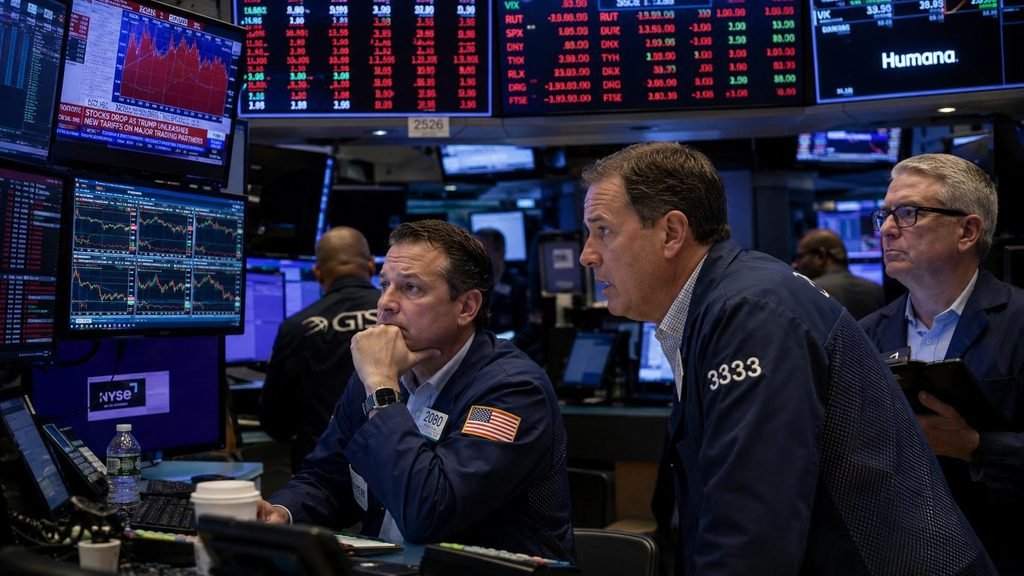
Stock Market Correction
Stock Market Correction fears are growing among Americans even as U.S. stocks remain close to record levels. A new survey found that nearly three-quarters of Americans believe recent market highs may not be sustainable and that the economy could be heading toward a correction.
The finding highlights an unusual situation: financial markets have remained strong, but many people watching from the sidelines are becoming increasingly nervous about what could happen next.
74% of Americans Are Concerned
The latest Q3 2026 Quarterly Market Perceptions Study from Allianz Life found that 74% of Americans are concerned that recent market highs are unsustainable and that the economy may be due for a correction.
The survey was conducted in August among 1,005 adults age 18 and older in the contiguous United States.
Concern was widespread across generations. Millennials were the most concerned at 77%, followed by Baby Boomers at 73%, Gen X at 72% and Gen Z at 71%.
That consistency suggests that worries about the market are not limited to one age group.
Why Are Investors Nervous?
Several factors are contributing to the caution.
U.S. stocks have enjoyed strong gains, with the S&P 500 up about 13% in 2026 and trading near record levels, according to recent reporting. Enthusiasm surrounding artificial intelligence and solid corporate sales and earnings have helped support the market.
At the same time, investors are questioning whether some technology stocks have moved too far, too quickly.
Talk of a potential AI bubble has become another source of uncertainty. The concern is that expectations surrounding artificial intelligence could be pushing some companies’ valuations beyond what future earnings can reasonably support.
What Does a Market Correction Actually Mean?
A stock market correction sounds alarming, but it does not automatically mean a financial crisis.
A correction is generally defined as a decline of at least 10% from a recent market high. A bear market is typically associated with a decline of 20% or more.
That distinction is important.
Markets can experience corrections without entering a prolonged economic downturn. In some cases, prices fall, investors reassess valuations and the market eventually stabilizes.
For long-term investors, a correction can therefore be very different from a financial collapse.
Americans Are Holding Back
The survey suggests that market anxiety is already affecting financial decisions.
About 63% of Americans said they are waiting to make financial decisions because economic conditions feel too unpredictable. Only 27% said they were comfortable with current market conditions and ready to invest.
That creates an interesting contradiction.
People are worried that stocks could fall, but some are also delaying investments because they are waiting for greater certainty.
The problem is that financial markets rarely provide perfect certainty before a major move.
Could Fear Become a Problem?
Some market observers argue that widespread caution can itself influence market behavior.
If large numbers of investors decide to sell or avoid buying because they expect prices to fall, that behavior can put additional pressure on stock prices.
USA TODAY reported that some analysts believe widespread fear could potentially become a self-fulfilling cycle if investors withdraw money because they expect a correction.
However, that does not mean a correction is guaranteed.
Investor expectations are not the same thing as a market forecast.
The Market Still Has Positive Signals
Despite the concerns, there are reasons for investors to remain constructive.
Recent reporting shows that corporate earnings remain an important source of support for U.S. stocks. Reuters reported that S&P 500 earnings are expected to rise strongly in 2026, although investors are becoming more cautious about whether AI-related spending and profit growth can continue at the same pace.
That creates a complicated market picture.
Stocks have strong earnings support, but valuations, interest rates, bond yields and expectations for future growth remain important risks.
Rising Bond Yields Add Pressure
Another major factor is the bond market.
Higher Treasury yields can make stocks less attractive compared with bonds and can increase borrowing costs for businesses and consumers. Recent market reports have highlighted rising long-term Treasury yields as one of the factors creating pressure across parts of the stock market.
Small-cap stocks can be particularly sensitive to higher borrowing costs because smaller companies may rely more heavily on financing.
What Should Investors Watch?
Investors watching for signs of a Stock Market Correction may want to pay attention to several major indicators.
These include corporate earnings, inflation, Treasury yields, Federal Reserve policy, oil prices and the performance of major technology companies.
Market breadth is another important factor. Recent analysis has pointed to weakness beneath the headline S&P 500 performance, with many stocks struggling even while large technology companies have helped keep major indexes elevated.
Important News Takeaway
The latest survey does not prove that a Stock Market Correction is coming.
What it does show is that Americans have become increasingly cautious about the sustainability of recent market gains. With 74% expressing concern and 63% delaying financial decisions because of uncertainty, investor confidence is clearly under pressure.
At the same time, strong corporate earnings and continued enthusiasm around artificial intelligence are providing support for stocks.
For investors, the key issue may not be predicting the exact day of a correction. Instead, understanding risk, maintaining an appropriate long-term strategy and avoiding decisions based purely on fear may be more important.
THANKS FOR READING