
Update, Oct. 23, 2026: This guide was first published May 23, 2026, when rates hit a 9-month high. We’ve rewritten it with Freddie Mac’s latest weekly numbers.
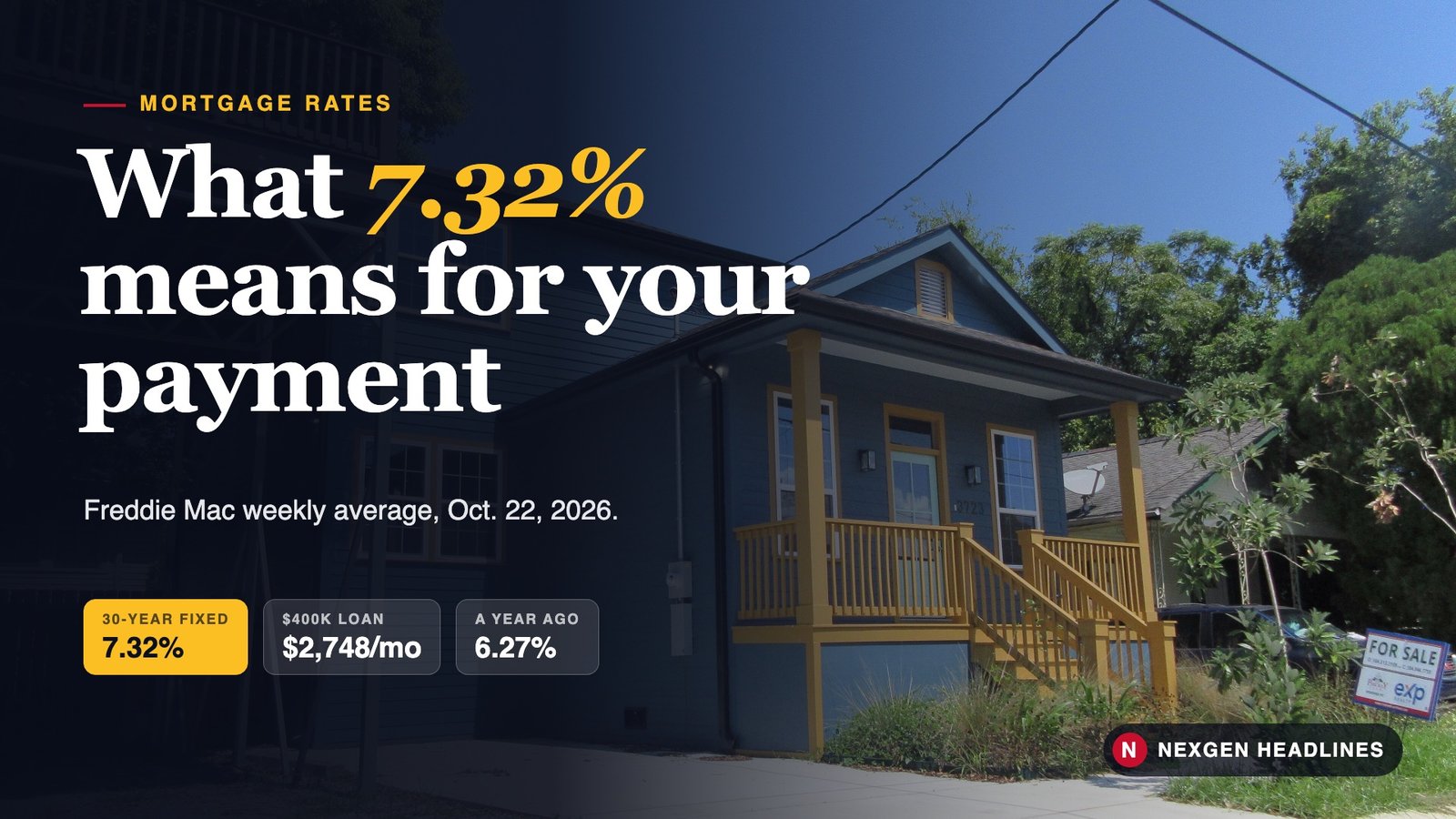
Quick answer: The average 30-year fixed mortgage rate was 7.32% for the week ending Oct. 22, 2026, according to Freddie Mac. That’s down from 7.40% the week before, but about a full point higher than a year ago. On a $400,000 loan, that’s roughly $280 more per month than at last year’s rate.

Mortgage rates at a glance
| Loan type | Latest average | Week before | Source |
|---|---|---|---|
| 30-year fixed | 7.32% (Oct. 22) | 7.40% (Oct. 15) | Freddie Mac |
| 15-year fixed | 6.71% (week of Oct. 15) | Freddie Mac | |
| 30-year fixed, a year earlier | About 6.27% (October 2025) | Freddie Mac | |
Freddie Mac’s weekly survey is an average of rates offered to borrowers with strong credit and a 20% down payment. Your own quote can be higher or lower. Daily lender sites often show slightly different numbers because they track live quotes, not the weekly survey.
What 7.32% means for your monthly payment
These figures cover principal and interest only on a 30-year loan. Taxes, insurance and HOA dues come on top. These are our own calculations, rounded to the nearest dollar.
| Loan amount | At 6.27% | At 6.50% | At 7.32% |
|---|---|---|---|
| $300,000 | $1,851 | $1,896 | $2,061 |
| $400,000 | $2,468 | $2,528 | $2,748 |
On a $400,000 loan, the gap between 6.27% and 7.32% is about $280 a month, or more than $3,300 a year.
Why mortgage rates are high right now
Mortgage rates don’t follow the Federal Reserve’s rate directly. They track the 10-year Treasury yield more closely, plus a gap that lenders add for risk.
- Inflation worries push investors to demand higher yields on long-term bonds.
- Strong economic data lowers the odds of quick Fed rate cuts.
- Bond market swings can move mortgage rates within days, even without Fed action.
Freddie Mac’s survey showed several straight weekly increases before the Oct. 22 dip. One week of decline is not a trend yet.
7 ways to get a lower rate than the average
- Raise your credit score. Borrowers in the top score ranges usually get the best pricing. Even a 20-point gain can help.
- Get 3 to 5 quotes on the same day. Rates differ between lenders. Compare the Loan Estimate forms side by side.
- Put more down. 20% down avoids private mortgage insurance on a conventional loan.
- Look at a 15-year loan if you can afford the higher payment. Rates are usually lower.
- Ask about points. Paying a fee up front can buy a lower rate. It pays off only if you keep the loan for years.
- Check FHA, VA or USDA loans. These government-backed loans can help buyers with smaller down payments.
- Lock your rate once you’re under contract, so a sudden jump doesn’t hurt you.
Also read: How to raise your credit score: a step-by-step guide. It’s one of the fastest ways to qualify for a better rate.
Should you buy now or wait?
No one can predict rates. Here’s a simple way to decide:
- Buy now if you plan to stay 5+ years, the payment fits your budget today, and you’ve found the right home.
- Wait if the payment would leave you with no emergency savings, or your credit score is about to improve.
- Remember: if rates fall later, you may be able to refinance. But refinancing costs money, often 2% to 5% of the loan, so don’t count on it.
Made-up example: a first-time buyer’s choices
This is a made-up example. Jordan in Georgia is buying a $375,000 home with $75,000 down, so the loan is $300,000. At 7.32%, principal and interest is about $2,061 a month. By raising a credit score before applying and getting quotes from four lenders, Jordan finds a rate closer to 6.5%. That brings the payment down to about $1,896, a savings of roughly $165 a month.
How much house can you afford at today’s rates?
Many lenders use the 28/36 guideline. Your housing payment (including taxes and insurance) should stay under about 28% of gross monthly income, and all debt payments under about 36%. Some loan programs allow more, but a lower number leaves room for real life.
Made-up example: a household earning $8,000 a month before taxes would aim for a housing payment around $2,240. At 7.32%, that points to a loan of roughly $250,000 to $275,000 once taxes and insurance are added.
Low down payment options
| Loan type | Minimum down | Good to know |
|---|---|---|
| Conventional (first-time buyer programs) | 3% | Mortgage insurance until you reach 20% equity |
| FHA | 3.5% (with a 580+ credit score) | Easier credit rules, but mortgage insurance often lasts longer |
| VA | 0% | For eligible veterans, service members and some spouses |
| USDA | 0% | For eligible rural and some suburban areas, with income limits |
Your state housing finance agency may also offer down payment help, grants or lower-rate loans for first-time buyers. HUD lists local programs by state.
Don’t forget closing costs
Closing costs often run about 2% to 5% of the loan amount. On a $300,000 loan, that can mean $6,000 to $15,000. They include lender fees, the appraisal, title insurance and prepaid taxes and insurance.
You can ask the seller to pay some of these costs, compare title companies, and check if your state offers closing cost assistance. Your lender must give you a Closing Disclosure at least 3 business days before closing. Compare it to your Loan Estimate.
Is buying “points” worth it?
One discount point costs 1% of the loan amount and lowers your rate. How much it lowers the rate depends on the lender, so ask for exact numbers on your Loan Estimate.
Made-up example: on a $300,000 loan, one point costs $3,000. If it drops the rate from 7.32% to 7.07%, the monthly payment falls from about $2,061 to about $2,010, a savings of about $51. You’d need roughly 59 months, or about 5 years, to break even. If you might sell or refinance sooner, skip the points.
What if you already have a mortgage?
- Locked in below today’s rate? Keep it. Don’t refinance into a higher rate.
- Have an ARM about to reset? Ask your lender now what your new payment will be, and compare refinance quotes early.
- Struggling with payments? Call your servicer before you miss one. A HUD-approved housing counselor can help for free or at low cost.
Common mistakes
- Taking the first offer. One quote is not enough.
- Looking only at the rate. Compare APR, fees and points on the Loan Estimate.
- Opening new credit before closing. A new car loan or card can hurt your approval.
- Draining all savings for the down payment. Keep a cushion for repairs and moving costs.
- Forgetting taxes and insurance. They can add hundreds a month.
Key dates to watch
- Every Thursday: Freddie Mac releases its weekly rate survey.
- Monthly: the Consumer Price Index inflation report and the jobs report can move rates.
- Federal Reserve meetings: the Fed’s next decision and comments can shift bond yields.
FAQ
What is the average 30-year mortgage rate today?
Freddie Mac’s latest weekly average was 7.32% for the week ending Oct. 22, 2026.
Do Fed rate cuts lower mortgage rates?
Not directly. Mortgage rates follow long-term bond yields, which react to inflation and economic news. Fed cuts can help, but rates sometimes rise after a cut.
How often do mortgage rates change?
Lenders can change their rates every day, sometimes more than once. Freddie Mac’s survey is published weekly, usually on Thursdays, so it shows the trend rather than the exact rate you’ll be offered.
How long does a rate lock last?
Common locks run 30 to 60 days. Longer locks may cost extra. Ask what happens if your closing gets delayed.
Is an adjustable-rate mortgage a good idea now?
An ARM can start lower, but the rate can rise later. It fits best if you plan to sell or refinance before the first adjustment.
How much does my credit score affect my rate?
A lot. Lower scores usually mean higher rates and fees. Check your free credit reports before you apply.
Bottom line
At 7.32%, mortgages cost far more than a year ago. You can’t control the average, but you can control your credit score, your down payment and how many lenders you compare. Those steps can save you hundreds a month.
Recommended products
- First-time home buyer guide – Plain-English books on the buying process.
- Financial calculator – Run mortgage and payment math yourself.
- Home document binder – Keep loan papers, deeds and warranties in one place.
Disclosure: As an Amazon Associate, Nexgen Headlines earns from qualifying purchases. Prices and availability can change.
This is general information, not financial advice. Rates change weekly; check Freddie Mac for the latest survey.
Sources: Freddie Mac – Primary Mortgage Market Survey; Freddie Mac release, Oct. 22, 2026; CFPB – Buying a House; CFPB – Loan Estimate explainer; HUD – Buying a Home.
Last reviewed: Oct. 23, 2026.