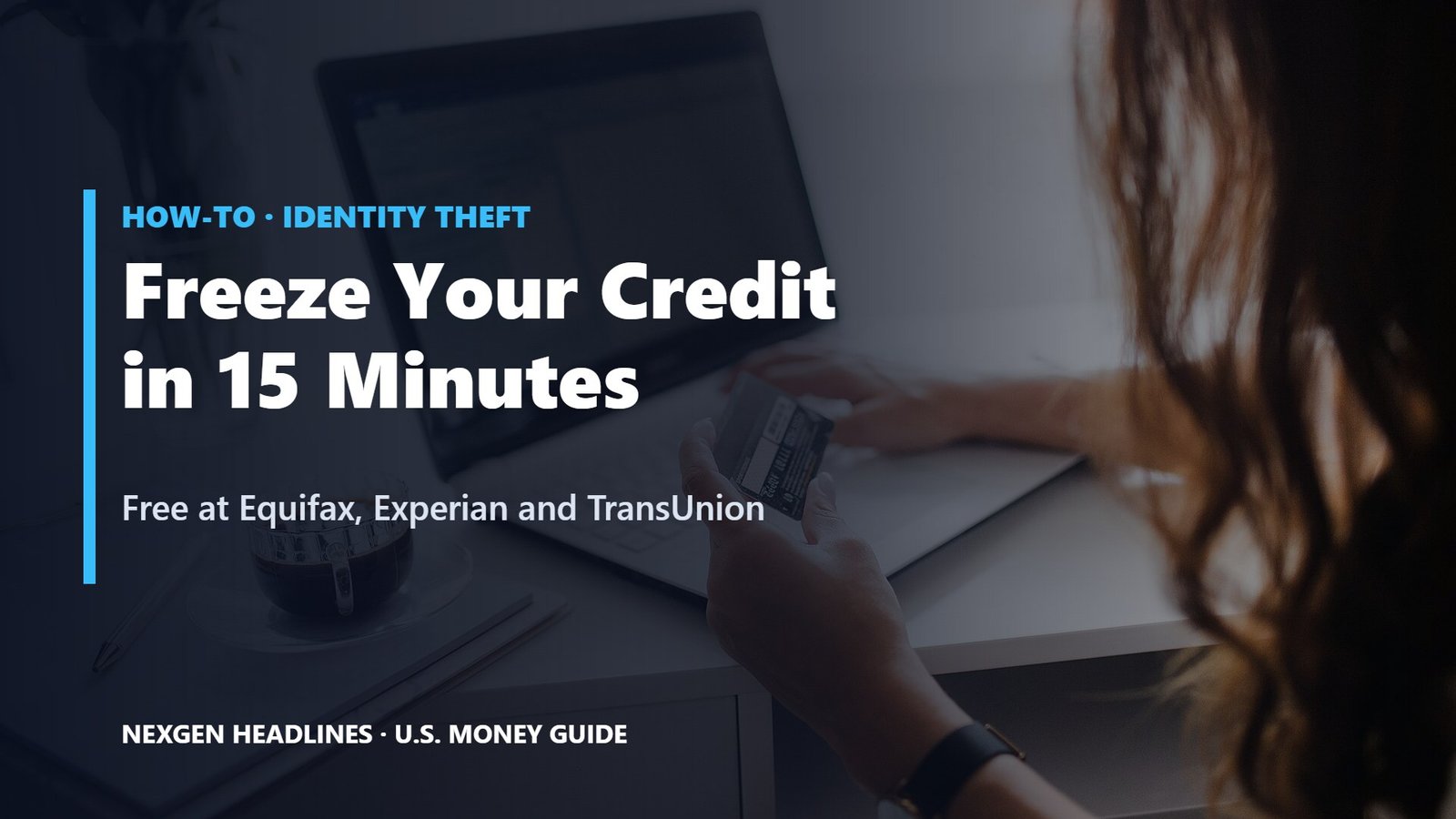
Quick answer: Freeze your credit at all three bureaus, Equifax, Experian and TransUnion, because a freeze at one does not cover the others. It is free, does not hurt your score, and you can lift it anytime you apply for credit.
A credit freeze is the single best free step you can take against identity theft in the U.S. It stops criminals from opening new credit cards or loans in your name, even if they have your Social Security number. It costs nothing, doesn’t hurt your credit score and takes about 15 minutes. Here is exactly how to do it at all three credit bureaus.
Do this today
- Freeze your credit at all three bureaus: Equifax, Experian and TransUnion. A freeze at one does not cover the others.
- It is free by federal law, both to freeze and to unfreeze.
- Save the PIN or login for each bureau. You need it to lift the freeze later.
- Lift the freeze (online, in minutes) before you apply for a loan, card or apartment.
📱 Short on time? Swipe through the 1-minute Web Story version.
What a credit freeze does (and doesn’t do)
| A credit freeze… | Yes / No |
|---|---|
| Blocks new accounts opened in your name | Yes |
| Is free to place and lift | Yes |
| Lowers your credit score | No |
| Stops you using your existing cards | No |
| Stops your current lenders from seeing your report | No |
| Protects against charges on cards you already have | No (watch your statements) |
How to freeze your credit: step by step
- Go to each bureau’s official freeze page (type the address yourself, don’t click links in emails): equifax.com, experian.com/freeze and transunion.com/credit-freeze.
- Create an account. Have your name, address, date of birth and Social Security number ready.
- Verify your identity. You may get a text code or questions about past addresses and loans.
- Place the freeze. Online and phone requests must be processed within one business day.
- Save your PIN or login details somewhere safe, such as a password manager.
- Repeat for the other two bureaus. Then do it for any children in your care: kids’ identities are a common target.

How to unfreeze (“thaw”) when you need credit
Log in to the bureau your lender uses and choose a temporary lift (for example, for 7 days) or a permanent removal. Online and phone lifts must happen within one hour. If you don’t know which bureau a lender checks, ask them, or lift all three for a few days.
Credit freeze vs. fraud alert vs. credit lock
| Option | Cost | What it does |
|---|---|---|
| Credit freeze | Free | Blocks new credit until you lift it; protected by federal law |
| Fraud alert | Free | Asks lenders to verify your identity; lasts 1 year (7 years for identity theft victims); one request covers all three bureaus |
| Credit lock | Often paid | Bureau product similar to a freeze, but governed by the bureau’s contract, not the same federal rules |
⚠️ No real bureau will call or text you asking for your freeze PIN. If someone does, hang up. If you think your identity was stolen, report it at IdentityTheft.gov, the FTC’s official site, which gives you a recovery plan.
How fast a freeze starts and stops
Federal law sets the clock. These deadlines come from the CFPB and USA.gov:
| Request | Online or by phone | By mail |
|---|---|---|
| Place a freeze | Within 1 business day | Within 3 business days of receipt |
| Lift or remove a freeze | Within 1 hour | Within 3 business days of receipt |
| Written confirmation | Within 5 business days after the freeze is placed | |
The one-hour lift is why online is best. If a lender needs your report today, you can thaw it from your phone at the dealership.
Official freeze pages for each bureau
Type these addresses yourself. USA.gov links to these same bureau help pages.
| Bureau | Where to freeze |
|---|---|
| Equifax | equifax.com/personal/credit-report-services |
| Experian | experian.com/help |
| TransUnion | transunion.com/credit-help |
Watch for upsells. Bureaus may offer a paid “lock” or monitoring plan. You don’t need it to freeze. The free freeze is protected by federal law.
No internet? Freeze by phone or mail
USA.gov says each bureau accepts freeze requests online, by phone or by mail. Phone requests follow the same fast deadlines as online ones.
Mail is slowest, at up to three business days after the bureau receives your letter. Include your full name, address, date of birth and Social Security number, plus copies of your ID and a recent bill.
Need help from a person? USAGov answers questions at 1-844-872-4681 (1-844-USAGOV1).
When you’ll need to lift the freeze
Lift it a day or two before anything that may check your credit, such as:
- Applying for a new credit card or store card
- Getting a car loan, mortgage or refinance
- Renting an apartment
- Opening a new cell phone or utility account
- Applying for a personal or student loan
Tip: ask the lender which bureau it uses. Then lift only that one, for a set number of days. It refreezes on its own when the time ends.
Freezing credit for a child or a family member you care for
Federal law gives extra protection to “protected consumers.” That means children under 16 and adults who are incapacitated, per the CFPB.
- A parent, guardian or person with legal authority can request the freeze.
- It is free at all three bureaus.
- If the child has no credit file, the bureau creates one just to freeze it. That record can’t be used for credit.
- Expect to send proof, such as a birth certificate and your own ID.
Each bureau has its own process for minors. Start on the bureau’s help page above.
Also read: What to do if your identity is stolen.
The three kinds of fraud alerts
A fraud alert is a lighter tool. Lenders can still pull your report, but they should verify it’s you first. The FTC lists three types:
| Type | How long it lasts | Who it’s for |
|---|---|---|
| Initial fraud alert | 1 year, renewable | Anyone worried about identity theft |
| Extended fraud alert | 7 years | Identity theft victims with an FTC identity theft report or police report |
| Active duty alert | 1 year, renewable for the deployment | Service members on active duty |
You can have a fraud alert and a freeze at the same time. For most people, the freeze gives stronger protection.
Other freezes worth knowing about
- ChexSystems: many banks check this report when you open a checking account. ChexSystems offers a security freeze online through its consumer portal, by phone at 800-887-7652, or by mail.
- Your phone carrier: ask about a number lock or port-out PIN. It makes it harder for a thief to move your number to a new SIM.
- Your Social Security account: create your own my Social Security login so no one else can open it first.
Which tool fits you?
| Your situation | Best first step |
|---|---|
| Not planning to borrow for a while | Freeze all three bureaus and leave them frozen |
| Shopping for a car or home in the next month | Freeze now, then lift the one bureau your lender uses |
| Your data was in a breach, but you need credit soon | Initial fraud alert now; freeze after you borrow |
| Someone already opened an account in your name | Freeze, plus an extended fraud alert and an IdentityTheft.gov report |
| Parent of a child under 16 | Free child freeze at each bureau |
Found an account you didn’t open? Do this
- Report it at IdentityTheft.gov. The FTC gives you a personal recovery plan and an identity theft report.
- Call the company where the fake account was opened. Ask it to close the account and send you a letter.
- Freeze all three bureaus if you haven’t yet.
- Ask for an extended fraud alert. Your FTC report qualifies you for the 7-year alert.
- Check your reports at AnnualCreditReport.com, the official free site. Dispute anything that isn’t yours.
Mistakes to avoid
- Freezing only one bureau. Lenders may check any of the three.
- Losing your PIN or login. Recovery takes time when you need credit fast.
- Paying for a “lock.” The freeze is free and has legal deadlines.
- Clicking a freeze link in an email or text. Scammers copy bureau websites.
- Forgetting the kids. A child’s clean Social Security number is a prime target.
- Thinking a freeze stops all fraud. It doesn’t block charges on cards you already have. Keep checking statements.
Recommended products to protect your identity
- Cross-cut paper shredder — destroy old statements and pre-approved offers
- Locking fireproof file box — store Social Security cards and freeze PINs
- Identity-protection roller stamp — black out addresses on mail
- Locking mailbox — keep thieves out of your mail
Disclosure: As an Amazon Associate, Nexgen Headlines earns from qualifying purchases.
Frequently asked questions
Does freezing my credit hurt my score?
No. A freeze has no effect on your credit score.
Is a credit freeze really free?
Yes. Since 2018, federal law requires all three bureaus to freeze and unfreeze for free.
Can I still use my credit cards?
Yes. A freeze only blocks new accounts. Your existing cards and loans work normally.
How long does a freeze last?
Until you lift it. There is no expiration.
Do I need to freeze my child’s credit?
You can, and it is free. Each bureau has its own process for minors, usually requiring proof that you are the parent or guardian.
The bottom line
Freeze your credit at Equifax, Experian and TransUnion today. It’s free, it doesn’t touch your score, and online lifts take under an hour. Do the same for kids under 16, and save every PIN in a safe place.
Last reviewed: Oct. 23, 2026. Rules and websites can change; always use the official links in this guide.
Sources: CFPB, What is a credit freeze; USA.gov, Credit freeze; FTC, Credit freezes and fraud alerts; ChexSystems, Security freeze.