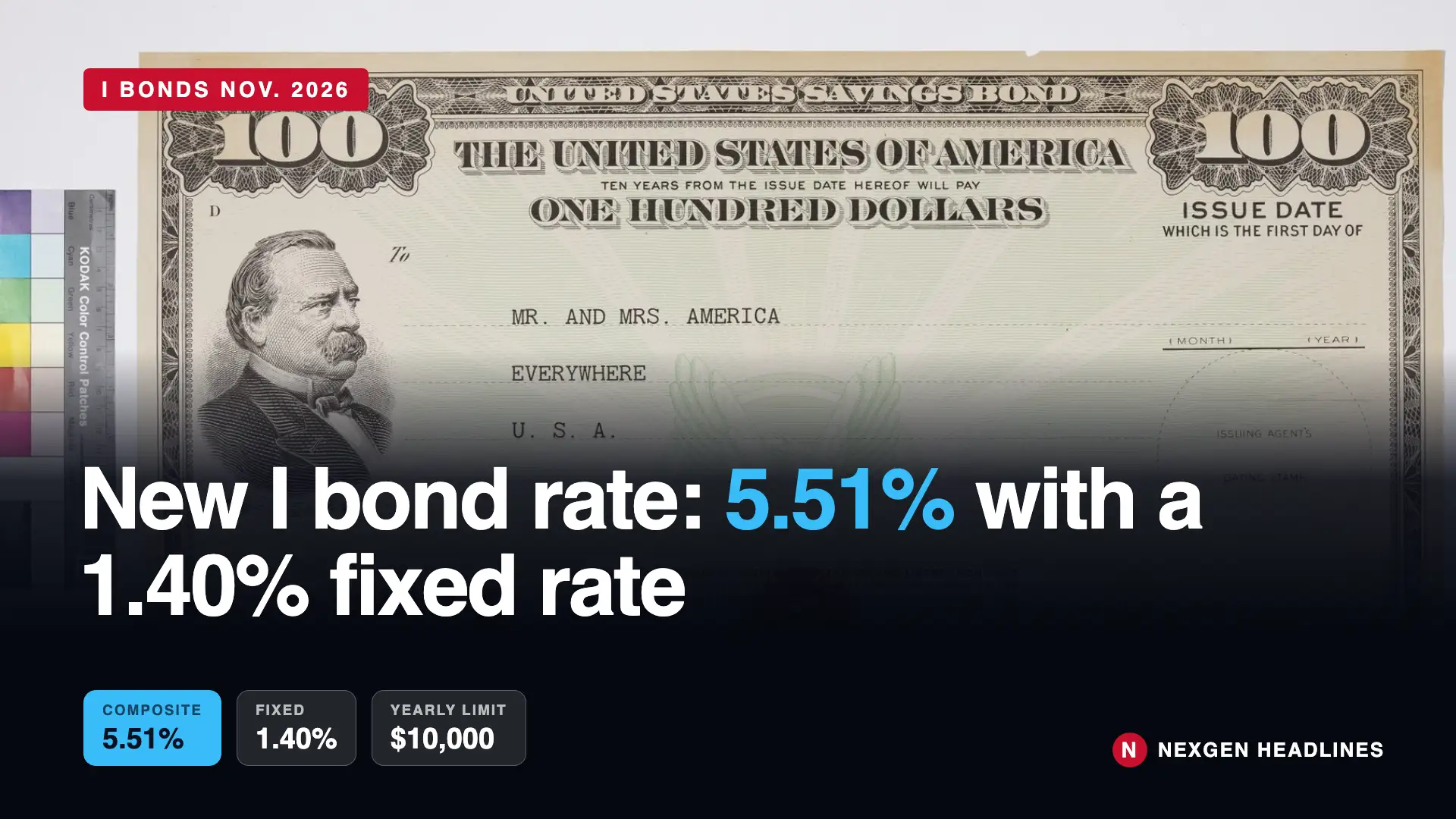

Quick answer: I bonds bought from Nov. 1, 2026, through April 30, 2027, earn a 5.51% annual rate for their first six months. That’s a 1.40% fixed rate, which you keep for the life of the bond, plus an inflation rate of 4.08% (annualized). You can buy up to $10,000 a year per person at TreasuryDirect.gov. You must hold an I bond for at least 12 months, and you lose the last 3 months of interest if you cash out before 5 years.
After two years of low fixed rates, the November reset made I bonds interesting again. A 1.40% fixed rate is the highest in a while, and it’s locked in on top of inflation for up to 30 years. Here’s how the rate works, who should buy, and how to do it step by step.
I bond rates at a glance
| Rate piece | For bonds bought Nov. 2026–April 2027 |
|---|---|
| Fixed rate (never changes) | 1.40% |
| Inflation rate (semiannual) | 2.04% (4.08% annualized) |
| Composite rate, first 6 months | 5.51% |
| Yearly purchase limit (electronic) | $10,000 per person |
| Minimum purchase | $25 |
| Minimum holding time | 12 months |
| Early cash-out penalty | Last 3 months of interest if held under 5 years |
Sources: TreasuryDirect rate formula; rate reported by Tipswatch and other outlets on Oct. 30, 2026. Confirm on TreasuryDirect before buying.
How the 5.51% is calculated
An I bond’s rate has two parts. The fixed rate is set when you buy and stays the same for the bond’s 30-year life. The inflation rate changes every six months, based on the Consumer Price Index (CPI-U).
Treasury combines them with this formula:
Composite = fixed + (2 × semiannual inflation) + (fixed × semiannual inflation)
For November 2026: 0.0140 + (2 × 0.0204) + (0.0140 × 0.0204) = 0.0551, or 5.51%.
Every six months after you buy, your bond’s inflation part resets. Your 1.40% fixed rate never changes. If inflation falls to zero, your bond still earns about 1.40%. The composite rate can’t go below zero.
How to buy I bonds: step by step
- Go to TreasuryDirect.gov and open an individual account. You’ll need your Social Security number, a U.S. address, a bank account and an email address.
- Verify your identity. TreasuryDirect now uses ID.me for many new accounts. Follow the prompts.
- Link your bank account (checking or savings) to pay for bonds.
- Choose BuyDirect, then Series I. Enter an amount from $25 up to $10,000 (to the penny).
- Pick an issue date. Buying any day in a month gives you interest for the whole month, so late-month purchases are smart.
- Confirm the purchase and save the confirmation.
Gift and business accounts have their own $10,000 limits. Gift bonds count toward the recipient’s limit in the year they’re delivered.
Made-up example (for illustration):
Rachel buys a $10,000 I bond on Nov. 25, 2026. She gets credit for all of November. For the first six months, it earns at a 5.51% annual rate, about $275 in that half-year (estimate).
In May 2027, the inflation part resets. If inflation cools and the new semiannual rate is 1.20%, her new composite would be about 3.82% (1.40% fixed + 2.40% + a small extra), not the 2.40% a new buyer with a 0% fixed rate would get. That 1.40% fixed rate is her edge for as long as she holds the bond.
Future rates are projections only. Actual rates depend on inflation.
Also read: How to build an emergency fund from scratch
Who should buy I bonds now?
- Savers with money they won’t need for at least a year. You can’t touch it for 12 months.
- People who want inflation protection backed by the U.S. government. I bonds can’t lose value.
- Anyone in a high-tax state. I bond interest is free from state and local income tax.
- Parents saving for college. Interest may be tax-free if used for qualified education costs and you meet income limits.
I bonds are not great for your only emergency fund, because of the 12-month lock. Keep a few months of expenses in a high-yield savings account first.
Taxes on I bonds
- Interest is subject to federal income tax, but not state or local income tax.
- You can defer federal tax until you cash the bond or it matures after 30 years. Most people do this.
- When you cash out, TreasuryDirect issues a Form 1099-INT.
- The education exclusion can make interest federally tax-free when spent on qualified higher education costs. Income limits apply, and the bond must be in a parent’s name (age 24 or older when bought).
I bonds vs. other safe options
| Option | Rate type | Access | State tax |
|---|---|---|---|
| I bonds | Fixed + inflation, resets every 6 months | Locked 12 months; 3-month penalty before 5 years | Exempt |
| High-yield savings | Variable, can drop any time | Anytime | Taxed |
| CDs | Fixed for the term | Penalty if early | Taxed |
| TIPS | Real yield + inflation | Can sell any time (price varies) | Exempt |
| Treasury bills | Fixed for short term | Matures in weeks/months | Exempt |
Should you cash in older I bonds?
Many people bought I bonds in 2022 when rates hit 9.62%. Most of those have a 0% fixed rate. Now that new bonds come with a 1.40% fixed rate, some savers cash old bonds and buy new ones. Before you do:
- Check the bond is over 12 months old.
- If it’s under 5 years, you’ll lose 3 months of interest. Cash out right after a high-rate month falls off, not before.
- Remember you can only buy $10,000 of new bonds a year, so swap in steps.
- Cashing out makes the deferred interest taxable this year.
Mistakes to avoid
- Buying on the last day of April or October without checking the next rate. If the next six-month rate is announced as higher, it may be worth waiting.
- Forgetting TreasuryDirect login details. Account recovery can take weeks. Save your login info safely and add a beneficiary.
- Expecting paper bonds with your tax refund. Treasury stopped issuing paper I bonds through tax refunds starting Jan. 1, 2025.
- Using I bonds as your only savings. The 12-month lock can hurt in an emergency.
How to cash out an I bond
Log in to TreasuryDirect, go to Current Holdings, pick the bond and choose Redeem. You can cash part of a bond, as long as at least $25 remains. The money usually reaches your linked bank account in about one to two business days. Interest is credited on the first day of each month, so cash out early in a month rather than late to avoid losing a month’s interest.
Can you buy I bonds for kids or as gifts?
Yes. A parent can open a minor linked account under their own TreasuryDirect account and buy up to $10,000 a year in the child’s name. You can also buy I bonds as gifts held in your account until you deliver them. Gifts count toward the recipient’s $10,000 limit in the year they’re delivered, not the year you bought them.
Where your I bond rate stands in history
Fixed rates on I bonds were 0% for much of 2020 through 2022, even when the composite rate hit 9.62% in 2022 because of high inflation. Fixed rates rose after that. The new 1.40% fixed rate matters most for long-term holders, because it keeps paying above inflation for as long as you own the bond, up to 30 years.
Recommended products
Helpful books and tools for safe saving.
Disclosure: As an Amazon Associate, Nexgen Headlines earns from qualifying purchases.
FAQ
What is the I bond rate for November 2026?
5.51% for bonds bought from Nov. 1, 2026, through April 30, 2027. That includes a 1.40% fixed rate.
How much can I invest in I bonds?
Up to $10,000 per person per calendar year in electronic I bonds, plus separate limits for gifts and business accounts.
Can I lose money on I bonds?
No. The rate can’t go below zero, and the bonds are backed by the U.S. government. You can lose 3 months of interest if you cash out before 5 years.
When is the next I bond rate change?
Treasury announces new rates on or around May 1 and Nov. 1 each year.
Are I bonds better than a high-yield savings account?
For money you won’t need for a year or more, often yes, because of the fixed rate and state tax break. For emergency cash you may need soon, a savings account is easier.
Bottom line
New I bonds pay 5.51% for their first six months, with a 1.40% fixed rate locked in for life. If you have savings you won’t touch for at least a year, buying up to $10,000 before April 30, 2027, is a safe way to stay ahead of inflation.
Last reviewed: Nov. 12, 2026. Future I bond rates are not known; examples are estimates.
Sources: TreasuryDirect: I bond interest rates, TreasuryDirect: I bonds, Tipswatch, IRS Publication 550, IRS Form 8815 (education exclusion).
Featured image: Vintage U.S. Savings Bond poster. Public domain, via Digital Public Library of America / Wikimedia Commons; edited by Nexgen Headlines.