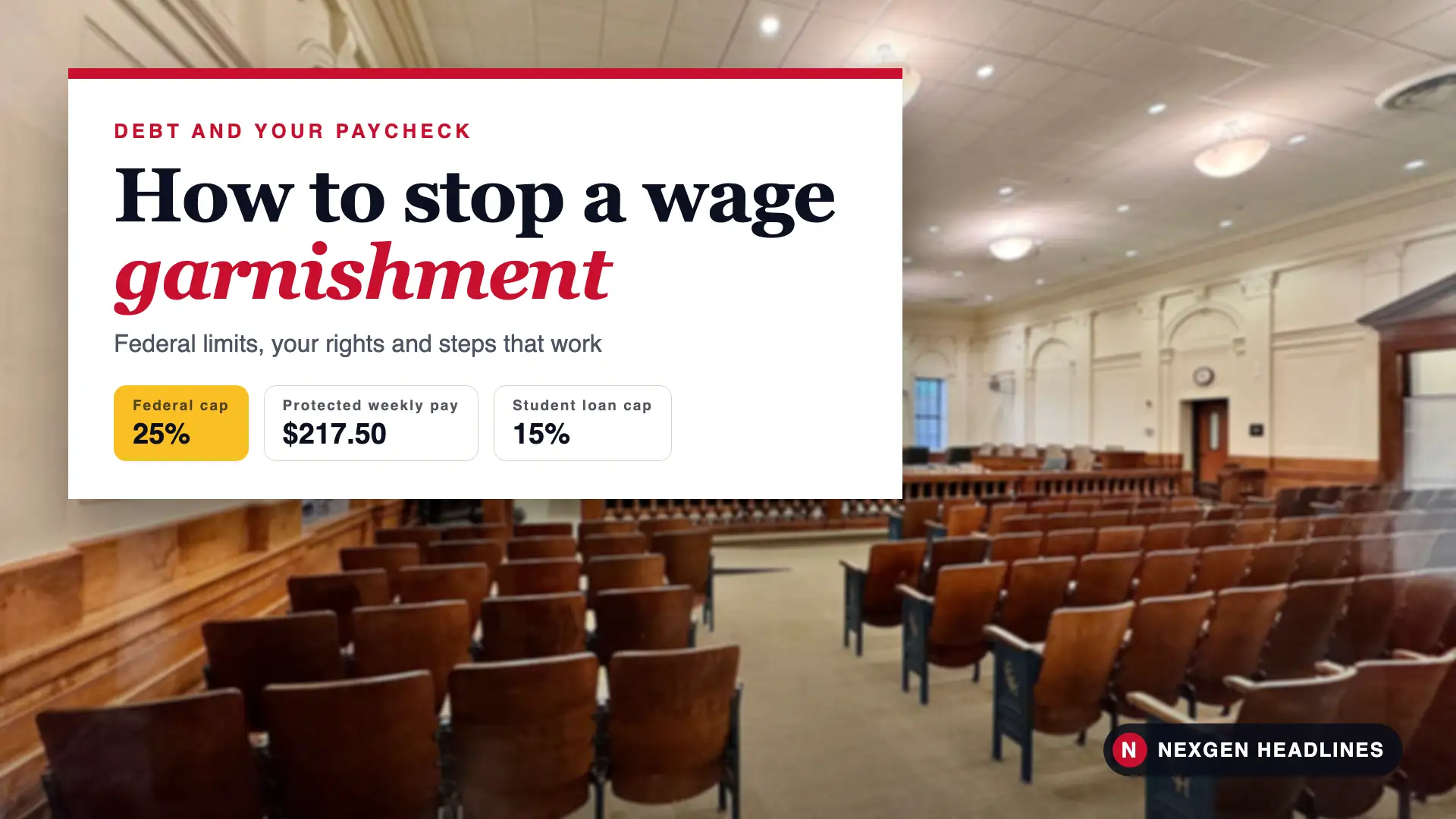

Quick answer: For most consumer debts, a creditor needs a court judgment before it can garnish your wages. Federal law then caps it at 25% of your disposable earnings, or the amount above $217.50 a week (30 times the $7.25 federal minimum wage), whichever is less. To stop or lower it, respond to the court papers, claim exemptions, negotiate or, in some cases, file bankruptcy.
Seeing less money in your paycheck because of a garnishment is scary. But you have more rights than most people realize. This guide explains the federal limits, which debts can skip the court step, and how to stop or reduce a garnishment.
Wage garnishment limits at a glance
| Type of debt | Federal limit | Court order first? |
|---|---|---|
| Credit cards, medical bills, personal loans | Lesser of 25% of disposable earnings or amount over $217.50/week | Yes, a judgment is needed |
| Child support and alimony | Up to 50% if you support another spouse or child; up to 60% if not; plus 5% more if over 12 weeks behind | Usually a support order |
| Federal student loans in default | Up to 15% of disposable pay (administrative garnishment) | No court needed, but you get notice and a chance for a hearing |
| Federal taxes (IRS levy) | Different rules; part of pay is exempt based on deductions and dependents | No court needed, but notices come first |
Many states set lower limits than federal law. When state and federal rules differ, the one that protects you more usually applies.
What “disposable earnings” means
Disposable earnings are what’s left of your pay after legally required deductions, according to the U.S. Department of Labor. These include:
- Federal, state and local income taxes
- Social Security and Medicare taxes
- State unemployment and disability taxes
- Required state employee retirement contributions
Voluntary deductions, like health insurance, union dues or 401(k) contributions, usually don’t reduce disposable earnings for this math.
Made-up example: how the 25% cap works
These are made-up numbers to show the federal math. Your state may protect more.
| Weekly item | Amount |
|---|---|
| Gross pay | $900 |
| Required taxes withheld | −$180 |
| Disposable earnings | $720 |
| Option 1: 25% of $720 | $180 |
| Option 2: $720 minus $217.50 | $502.50 |
| Max federal garnishment (the lesser) | $180 a week |
For low earners, the $217.50 rule protects more. If disposable pay is $217.50 a week or less, ordinary creditors can’t garnish anything under federal law.
How to stop or reduce a wage garnishment: 7 steps
- Read every court paper. Note the court, case number and deadlines.
- Respond to the lawsuit before the deadline. If you ignore it, the creditor can win by default.
- Check if the debt is really yours and the amount is right. Ask the collector to validate it.
- File an exemption claim. Most states let you protect some or all wages based on need. The form usually comes with the garnishment notice.
- Request a hearing if you have a defense or can’t afford basic needs.
- Negotiate a payment plan or settlement. Many creditors will release a garnishment for a reasonable deal.
- Talk to a lawyer or legal aid. Free help is often available.
Can my employer fire me over a garnishment?
Federal law says your employer can’t fire you because your wages are garnished for any one debt, according to the Department of Labor. That protection doesn’t cover garnishments for two or more separate debts. Some states protect you further.
Your employer must follow the court order. It can’t ignore the garnishment, but it also must stay within the legal limits.
What creditors usually need before garnishing
For most private debts, the steps look like this:
- You fall behind on a credit card, medical bill or loan.
- The debt goes to collections.
- The creditor or collector sues you in court.
- The court enters a judgment, often a default judgment if you don’t respond.
- The creditor asks the court for a garnishment order, which goes to your employer.
- You get notice and a chance to claim exemptions.
That’s why answering a lawsuit matters so much. Many garnishments start from default judgments people never saw coming.
Also read: How Many Times Can a Debt Collector Call You?
States with extra protection
A few states, such as Texas, Pennsylvania, North Carolina and South Carolina, generally don’t allow wage garnishment for most ordinary consumer debts. Exceptions usually still apply for child support, taxes and federal student loans.
Other states set a lower percentage than 25% or protect more of your pay. Check your state court website or your state attorney general for the exact rules.
Is my Social Security or bank account safe?
Federal benefits: Social Security, SSI, VA benefits and federal retirement are generally protected from private creditors. Exceptions include federal taxes, federal student loans and child support.
Bank accounts: Under a Treasury rule, banks must protect up to two months of federal benefits that were directly deposited when they receive a garnishment order for a bank account.
Keep benefit money in a separate account if you can, and save your bank statements. Mixing it with other money can make it harder to prove what’s protected.
Federal student loans: different rules
If you default on federal student loans, the government can use administrative wage garnishment without going to court. It can take up to 15% of your disposable pay. Before it starts, you get written notice and a chance to request a hearing.
Ways to stop it:
- Loan rehabilitation: make a series of agreed monthly payments
- Loan consolidation into a new Direct Loan
- Request a hearing if you have a defense, like financial hardship
Contact the Default Resolution Group through StudentAid.gov for your options.
IRS wage levies
The IRS can levy wages for unpaid federal taxes after sending notices. A levy is different from ordinary garnishment: an exempt amount is set by IRS tables based on your filing status and dependents.
To release a levy, contact the IRS right away. Options include an installment agreement, an offer in compromise, or “currently not collectible” status if you can’t pay basic living expenses.
Made-up example: stopping a garnishment with a payment plan
This is a made-up example to show how negotiation can work. It is not a real case.
Angela, a home health aide, finds $140 a week missing from her paycheck. A credit card company won a default judgment she never knew about because the papers went to an old address.
She calls legal aid. A lawyer helps her file an exemption claim and contact the creditor’s attorney. The creditor agrees to release the garnishment for $75 a month. Angela gets the deal in writing and the garnishment stops.
Got sued over a debt? How to respond
Responding to the lawsuit is the best way to prevent a garnishment. Here’s what usually works:
- Find the deadline. The summons tells you how many days you have to answer, often 20 to 30 days, depending on the state and court.
- File a written answer with the court. Many courts have free fill-in forms and self-help centers.
- List your defenses. Examples: it’s not your debt, the amount is wrong, it was already paid, or it’s past the statute of limitations.
- Send a copy to the creditor’s lawyer, as the court rules require.
- Show up to every hearing, or ask the court how to appear remotely.
Many debt buyers can’t produce full records, and courts expect them to prove the debt. When people respond, cases are sometimes dismissed or settled for less.
What to do the first week of a garnishment
| Day | Action |
|---|---|
| Day 1 | Get a copy of the garnishment order from HR or the court |
| Day 1–2 | Find the exemption form and its deadline |
| Day 2–3 | Call legal aid or a consumer attorney |
| Day 3–5 | File your exemption claim with proof of income and expenses |
| Day 5–7 | Contact the creditor’s attorney to offer a payment plan |
Keep a log of every call, letter and payment. It helps if the amount withheld is ever wrong. Also check each pay stub, since the garnishment line should match the order exactly.
Gig workers and self-employed people
If you’re paid as an independent contractor on a 1099, there may be no employer to send a wage order to. Creditors with a judgment may try other tools instead, like a bank account levy or an order to a company that pays you. State rules vary a lot. The same exemption process usually applies, so read every notice and respond on time. Keep records of your business expenses too, since they can help show how much income you really need to cover basic living costs for your household.
Can bankruptcy stop a garnishment?
Yes. Filing bankruptcy triggers an automatic stay, which generally stops most garnishments right away. Chapter 7 can wipe out many consumer debts. Chapter 13 sets up a repayment plan.
Bankruptcy has serious long-term effects on your credit, so talk to a bankruptcy attorney first. Many offer free consultations.
Common mistakes to avoid
- Ignoring a lawsuit. This is how most garnishments start.
- Missing the exemption deadline. The window can be short.
- Assuming the amount is right. Check interest, fees and credits.
- Quitting your job. The judgment doesn’t go away, and it can follow you.
- Paying a “debt relief” company up front. The FTC warns against advance fees.
- Not updating your address with the court. You can miss important notices.
Where to get free help
- Legal aid: find local free help at LawHelp.org
- U.S. Department of Labor: questions about federal garnishment limits and firing protection
- CFPB: complaints about debt collectors at consumerfinance.gov/complaint
- State attorney general: state garnishment rules and complaints
- Nonprofit credit counselors: help building a budget or debt plan
Recommended products
Tools that make it easier to track bills and paperwork.
Disclosure: As an Amazon Associate, Nexgen Headlines earns from qualifying purchases.
FAQ
How much of my paycheck can be garnished?
For ordinary debts, federal law caps it at the lesser of 25% of disposable earnings or the amount above $217.50 a week. Your state may allow less.
Can a debt collector garnish my wages without going to court?
Not for most private debts. They need a court judgment first. Federal student loans, taxes and child support follow different rules.
Can I be fired for a wage garnishment?
Not for a garnishment on any one debt, under federal law. Two or more separate debts aren’t covered by that federal protection.
Can they garnish my Social Security?
Private creditors generally can’t. Federal debts like taxes and student loans, and child support, are exceptions.
How do I stop a garnishment fast?
File an exemption claim, negotiate a payment plan with the creditor, or talk to a lawyer about bankruptcy, which triggers an automatic stay.
How long does a wage garnishment last?
Usually until the judgment, plus allowed interest and costs, is paid in full, or until the creditor releases it. Judgments can last many years and sometimes be renewed, depending on the state. That’s why a negotiated payoff or settlement is often worth pursuing early.
What if my employer takes too much?
Ask HR for the calculation in writing and compare it with the order and the federal limits. If it’s wrong, contact the court that issued the order and the U.S. Department of Labor’s Wage and Hour Division, which enforces the federal limits.
Bottom line
Wage garnishment has firm federal limits, and many states protect even more. Never ignore a debt lawsuit. If garnishment starts, claim your exemptions quickly, check the amount, negotiate and get free legal help.
Last reviewed: Nov. 6, 2026.
Sources: U.S. Department of Labor: Fact Sheet #30, Wage Garnishment, DOL: Wage garnishment, FTC: Garnishment of federal benefits, StudentAid.gov: Default, IRS: Wage levies, CFPB.
Featured image: Photo: Harrison Keely / Wikimedia Commons, CC BY 4.0; edited by Nexgen Headlines.