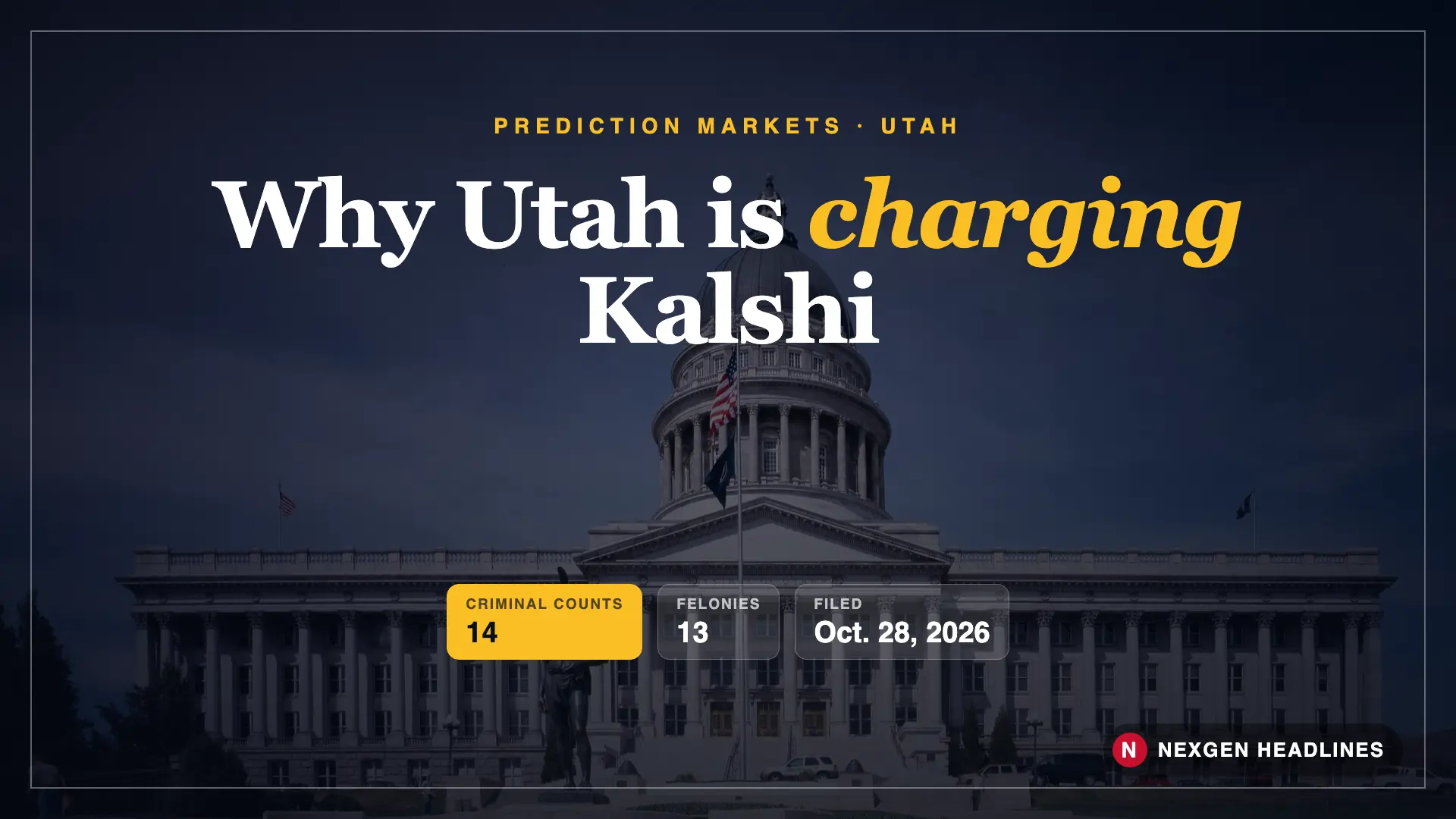

Quick answer: As of Nov. 4, 2026, Utah is prosecuting Kalshi because state officials say its sports “event contracts” are illegal gambling. On Oct. 28, 2026, Utah Attorney General Derek Brown filed 14 criminal counts against the company and its two co-founders. Kalshi says only federal regulators can police it. No court has ruled on the charges yet.
This is a fight over one big question: who gets to regulate prediction markets, the states or Washington? Utah is the second state to bring criminal charges. Here is what happened, what it means for users, and what to watch next.
Utah vs. Kalshi at a glance
| Question | Short answer |
|---|---|
| Who was charged? | Kalshi, CEO Tarek Mansour and COO Luana Lopes Lara |
| When? | Oct. 28, 2026, in state court in Salt Lake City |
| How many counts? | 14 total: 13 felonies and 1 misdemeanor |
| Who filed? | Utah Attorney General Derek Brown |
| What does Utah say? | Kalshi kept taking sports bets from Utahns after an Aug. 4 federal ruling went against it |
| What does Kalshi say? | It is a federally regulated exchange, and the case is “a crazy overreach” |
| Is there a separate civil case? | Yes. Utah sued Kalshi in state court on Oct. 20, 2026 |
| Is the federal government involved? | Yes. The CFTC sued Utah days before the charges |
| Has anyone been convicted? | No. These are charges, not findings of guilt |
What exactly are the charges?
Utah’s charging papers list three kinds of crimes. The Deseret News and KUER reported the breakdown this way:
| Count | Number | Level |
|---|---|---|
| Pattern of unlawful activity | 1 | Second-degree felony |
| Online gambling promotion | 12 | Third-degree felony |
| Gambling promotion | 1 | Class A misdemeanor |
| Total | 14 | 13 felonies, 1 misdemeanor |
The Associated Press described the same case a little differently. It said the filing has 13 gambling counts plus one count of profiting off illegal activity. Both descriptions add up to 14 counts.
KUER reported that Mansour and Lopes Lara could face prison time if convicted. No sentence has been asked for in public reporting so far.
How Utah built the case: the undercover account
The charges grew out of a test run by a state investigator. According to the Deseret News, investigator Scott Eggerman opened a Kalshi account on Sept. 13, 2026.
He used an undercover identity, a debit card, a Utah phone number and a Utah bank account. Over 11 days, he placed about a dozen trades.
The trades covered NFL and MLB games, a Real Salt Lake soccer match and the Utah–Utah State football game. Each of those 12 trades became one of the online gambling counts.
One example in the court papers is small but telling. Eggerman put $5.00 on Utah beating Utah State by more than 27.5 points. Kalshi showed a 53% chance of payout. Utah won by 36 points on Sept. 19, and he collected $4.13.
Utah also says Kalshi charged fees of 3 to 78 cents per trade. In the state’s view, that is a house taking a cut. In Kalshi’s view, it is an exchange fee, like a stock trade.
Timeline: how the Utah fight got here
| Date | What happened |
|---|---|
| Feb. 2026 | Kalshi sues Utah in federal court to stop the state from enforcing its gambling laws against sports contracts. |
| March 17, 2026 | Arizona files the first criminal case ever against a CFTC-registered prediction market. The target is Kalshi. |
| April 10, 2026 | A federal judge in Phoenix pauses Arizona’s case at the request of the CFTC and the Justice Department. |
| May 2026 | Utah Gov. Spencer Cox publicly praises Arizona for charging Kalshi, KUER reported. |
| Aug. 4, 2026 | U.S. District Judge Robert J. Shelby rules Utah’s gambling laws apply to Kalshi’s sports contracts. He finds federal law does not override them. |
| Sept. 2026 | The 10th U.S. Circuit Court of Appeals declines to block Utah’s enforcement while Kalshi appeals. |
| Sept. 13, 2026 | A Utah investigator opens an account. Over 11 days, he places about a dozen sports trades. |
| Oct. 20, 2026 | Utah files a 63-page civil lawsuit against Kalshi in state court. |
| Week of Oct. 26, 2026 | The CFTC and the United States sue Utah, saying federal law gives the CFTC “exclusive jurisdiction.” |
| Oct. 28, 2026 | Utah files 14 criminal counts against Kalshi and its co-founders. |
| Nov. 4, 2026 | No first court date has been reported yet. The case remains at the charging stage. |
What is Kalshi, in plain English?
Kalshi is a website and app where people trade “event contracts.” Each contract asks a yes-or-no question. Will a team win? Will a candidate win? Will a rate go up?
A contract pays $1 if the answer is yes and nothing if it is no. The price moves between those two numbers. A price of 53 cents roughly means traders see a 53% chance.
Kalshi is registered with the Commodity Futures Trading Commission (CFTC) as a designated contract market. That is the same federal agency that oversees futures on corn, oil and interest rates.
Kalshi’s argument is simple. If it is a federally regulated exchange, then state gambling laws should not apply. Utah’s answer is also simple. A bet on a football game is a bet on a football game, whatever you call it.
Also read: Kalshi’s prediction-market apps with Native American tribes are dividing Indian Country
What each side says
Brown framed the case in blunt terms. “Gambling is illegal in Utah, whether you place the bet, run the game, or promote it,” he said, according to the AP.
He also said a federal court had already ruled that Utah’s laws apply to Kalshi. KUER quoted him saying, “Kalshi kept taking bets from Utahns anyway.”
Kalshi pushed back hard. A spokesperson called the charges “a crazy overreach” and said Utah is “clearly playing politics.” The company said it looks forward to stopping the case in court, “just like we did in Arizona.”
Brown’s office told KUER that the timing, two days after the CFTC sued Utah, was a coincidence. It said the charges followed a months-long investigation.
Who decides how this ends?
| Player | Role | Where it stands |
|---|---|---|
| Utah Attorney General’s Office | Prosecutes the criminal case and the civil suit | Charges filed Oct. 28; civil suit filed Oct. 20 |
| Utah state court (Salt Lake City) | Hears the criminal and civil cases | No hearing date reported as of Nov. 4 |
| CFTC and U.S. Justice Department | Federal regulator; sued Utah to block state enforcement | 33-page complaint filed late October |
| Federal district court in Utah | Ruled on Kalshi’s own suit | Sided with Utah on Aug. 4 |
| 10th U.S. Circuit Court of Appeals | Hears Kalshi’s appeal | Refused to pause Utah’s enforcement in September |
| U.S. Supreme Court | Could settle the state-vs.-federal question | Analysts expect it to take up the issue eventually (a projection, not a scheduled case) |
Why Arizona matters to the Utah case
Arizona went first. Attorney General Kris Mayes filed criminal charges against Kalshi on March 17, 2026. Her office said Kalshi ran an illegal gambling business and let people bet on elections.
That case stalled fast. On April 10, 2026, U.S. District Judge Michael Liburdi issued a temporary restraining order that halted it. The CFTC and the Justice Department had asked for the pause.
That is the Arizona “win” Kalshi mentioned in its Utah statement. But the picture has shifted since then. The AP reported that a 9th Circuit ruling in a Nevada case could help Arizona revive its charges.
Utah’s case also starts from a different spot. In Arizona, a federal judge sided with Kalshi’s regulator. In Utah, a federal judge has already sided with the state. That is why Utah’s charges are getting so much attention.
The bigger fight: roughly 20 states and counting
Utah is not alone. The AP reported that litigation over prediction markets now spans roughly 20 states. The CFTC has sued at least 10 states to stop them from regulating these platforms.
Legal analyst Daniel Wallach told the AP he expects more states to bring criminal cases. He said those cases could shape how states treat both Kalshi and rival platform Polymarket.
The timing is notable. Interest in election contracts peaks around elections, and the midterms were held Nov. 3. Arizona’s case specifically covered election markets, while Utah’s counts focus on sports trades.
There is a political layer too. KUER noted that Donald Trump Jr. is a strategic adviser to Kalshi. Kalshi has not been accused of wrongdoing tied to that role.
Utah’s civil lawsuit: the money question
The criminal case gets the headlines. The civil case may matter more for the company’s bottom line.
Utah’s 63-page complaint, filed Oct. 20, estimates Kalshi made between $30.5 million and $61.1 million from Utah accounts. That covers February 2026 through Oct. 19, 2026, according to the Deseret News.
The state asks the court to do three things:
- Stop Kalshi from offering sports, election, politics and culture contracts in Utah.
- Make Kalshi give up profits earned from Utah users.
- Require a court-approved geolocation provider to keep Utah users out.
Kalshi spokesperson Jacki McGavick responded that Kalshi is a federally regulated exchange. She said no single state should have a veto over it.
What this means if you use Kalshi
The charges target the company and its founders, not ordinary users. We found no reports of Utah charging any customer as of Nov. 4, 2026.
Still, note Brown’s words. He said gambling is illegal in Utah “whether you place the bet” or run it. Utah residents should take that seriously.
Here are practical steps for anyone using a prediction market. This is general information, not legal advice.
- Check your state’s rules. Your state attorney general or gaming agency website is the best source.
- Read emails from the platform. If a court orders geoblocking, the app may restrict your account.
- Know your balance and withdrawal options. Download your account statement now, before anything changes.
- Keep tax records. The IRS says gambling winnings are taxable income. How event-contract profits are taxed is still debated, so keep every statement and ask a tax pro.
- Watch for scams. Fake “prediction market” sites and copycat apps often spike when a brand is in the news.
Made-up examples to make this concrete. These are made-up examples, not real people.
Example 1: Dana lives in Ogden and has $80 sitting in a prediction-market account. She has no open trades. Her simplest move is to download her statement, withdraw the balance and wait for the courts to settle the law.
Example 2: Marcus lives in Phoenix and traded a few election contracts before Nov. 3. Arizona’s criminal case is paused, and it targets the company. He should save his records for tax time and watch for account notices.
Example 3: Priya lives in New York and trades interest-rate contracts. Those are not what Utah’s charges are about. Her bigger risk is a scam app posing as a real exchange.
What happens next: key dates to watch
| What to watch | When | Why it matters |
|---|---|---|
| First court appearance in Salt Lake City | Not yet scheduled publicly | Kalshi will likely ask to dismiss or pause the case |
| Federal response to the CFTC’s suit against Utah | Coming weeks | A federal order could freeze Utah’s case, as happened in Arizona |
| 10th Circuit decision on Kalshi’s appeal | No date set | Decides whether Judge Shelby’s Aug. 4 ruling stands |
| Arizona’s bid to revive its case | Ongoing | A revived case would add pressure on Kalshi |
| New state charges | Any time | Analysts expect more states to follow Utah |
| Supreme Court | No timeline set | The only court that can settle it nationwide |
We will update this explainer when a court date is set or a judge rules.
How to follow the case yourself
- Utah Attorney General’s Office (attorneygeneral.utah.gov) posts major filings and statements.
- CFTC press releases (cftc.gov) cover the federal side.
- Local reporting from KUER and the Deseret News has been the most detailed on the Utah filings.
- Be careful with social media posts claiming a quick win for either side. Check for a named court and date first.
FAQ
Is Kalshi legal in Utah right now?
Utah says no. A federal judge ruled on Aug. 4, 2026, that Utah’s gambling laws apply to Kalshi’s sports contracts. Kalshi is appealing and says federal law protects it. Until higher courts rule, the legal status is disputed.
Are Kalshi’s founders going to jail?
Not at this point. They have been charged, not convicted. KUER reported they could face prison time if convicted, but the case is at its earliest stage.
Can Kalshi users in Utah be charged?
We found no reports of Utah charging users as of Nov. 4, 2026. The attorney general has said placing a bet is illegal in Utah. Users should check official state guidance and consider a lawyer for personal advice.
Why does the CFTC side with Kalshi?
The CFTC says it has exclusive jurisdiction over contracts traded on federally registered exchanges. It argues state gambling laws cannot override that. It has sued at least 10 states on this point, the AP reported.
Does this affect Polymarket too?
Not directly. Utah’s charges name Kalshi and its founders only. But analysts told the AP that state criminal cases could shape how states treat other platforms, including Polymarket.
Bottom line
Utah has turned a regulatory dispute into a criminal case. It has 14 counts, a favorable federal ruling and an undercover investigation behind it. Kalshi has the CFTC in its corner and a pause in Arizona to point to.
Nothing is decided yet. The real answer will likely come from federal appeals courts, and maybe the Supreme Court. If you use a prediction market, keep your records, know your state’s rules and watch your account notices.
Last reviewed: Nov. 4, 2026. This explainer will be updated when a court date is set or a judge rules.
Sources: KUER (Oct. 28, 2026); Deseret News (Oct. 28, 2026); Associated Press via NBC News (Oct. 29, 2026); AZFamily (April 10, 2026); AZFamily (March 17, 2026); IRS Topic 419, Gambling Income and Losses; CFTC.gov.
Featured image: Utah State Capitol, Salt Lake City. Photo: Carol M. Highsmith / Library of Congress, via Wikimedia Commons, public domain; edited by Nexgen Headlines.