
Canada-EU Alliance
Canada-EU Alliance Takes Center Stage in Europe
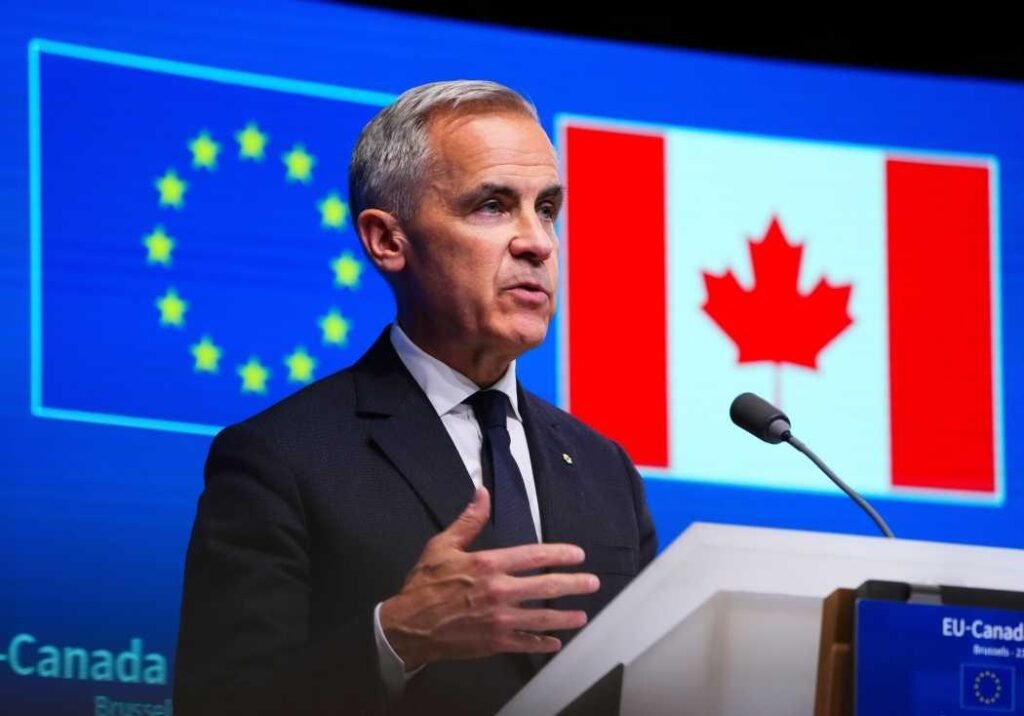
Canada-EU Alliance plans took a significant step forward Thursday as Canadian Prime Minister Mark Carney addressed the European Parliament in Strasbourg and welcomed the possibility of much deeper ties between Canada and the European Union.
- Canada-EU Alliance
- Canada-EU Alliance Takes Center Stage in Europe
- Carney Rejects the Idea of a New Rival Bloc
- What Is the Proposed Associate Membership?
- Why Canada Wants Closer European Ties
- Areas Where Canada and Europe Could Work Together
- Critical Minerals Could Become a Major Focus
- Digital Trade and Youth Exchanges
- Trump’s Strong Reaction
- Canada Says It Can Remain a U.S. Partner
- Europe Also Sees Strategic Value
- A Relationship Built on Existing Agreements
- The Proposal Still Faces Questions
- What Happens Next?
Carney made clear that Canada does not want to create another geopolitical bloc designed to compete directly with the United States or China. Instead, he described the proposed Canada-EU Alliance as a way for Canada and Europe to increase their economic and strategic resilience while protecting sovereignty, democratic institutions and open markets.
His comments came just one day after European Commission President Ursula von der Leyen proposed taking the relationship between Canada and the EU to a new level, including the possibility of making Canada the bloc’s first associate member.
The proposal is still at an early stage and would require further discussions and approval by EU member states.
Carney Rejects the Idea of a New Rival Bloc
During his European Parliament speech, Carney directly addressed the possibility that a closer Canada-EU relationship could become an alternative power center.
He said he was not proposing a third bloc to become a great-power rival “only with better manners.” Instead, Carney argued that the purpose of closer cooperation would be to make Canada and Europe more resilient and less vulnerable to pressure from larger powers.
The statement was widely interpreted as an indirect response to concerns from Washington.
Carney emphasized that Canada does not want to dominate other countries. Instead, he said the country wants partnerships that help protect its open markets, sovereignty, territorial integrity, freedoms, democracy and rule of law.
That distinction is at the heart of Canada’s current approach to Europe.
What Is the Proposed Associate Membership?
The idea of associate membership is new for the European Union.
Von der Leyen raised the possibility as part of a broader effort to deepen cooperation with Canada beyond the existing Canada-EU Comprehensive Economic and Trade Agreement, commonly known as CETA.
The exact structure of such an arrangement has not yet been finalized.
Canadian officials have described the potential relationship as a deeper economic and security partnership rather than traditional EU membership.
Carney said Canada welcomes the ambition behind the proposal, but he also indicated that the final structure would be subject to Canada’s democratic process.
That means the idea is still a developing diplomatic project rather than an established agreement.
Why Canada Wants Closer European Ties
The Canada-EU Alliance proposal comes at a time when Ottawa is looking to diversify its economic and strategic relationships.
Canada has historically relied heavily on the United States for trade, investment and continental security.
But recent disputes over tariffs and trade policy have encouraged the Canadian government to look more closely at other major markets.
Carney has repeatedly said Canada needs greater strategic autonomy while maintaining its long-standing relationship with the United States.
Earlier this week, he said Canada would remain a neighbor and important partner of the United States, while arguing that stronger relationships with other countries could make Canada more resilient.
The European Union is a natural candidate for deeper cooperation because Canada and European countries already have extensive political, economic and security relationships.
Areas Where Canada and Europe Could Work Together
Carney outlined a wide range of areas where the Canada-EU Alliance could become more integrated.
Among them are:
- Critical minerals
- Defense industrial capacity
- Artificial intelligence
- Computing
- Energy security
- Space technology
- Financial services
- Payments
- Digital trade
- Research and education
Canada has significant reserves of critical minerals and large energy resources, while Europe has substantial manufacturing capacity, research institutions and market power.
Carney argued that these different strengths can complement each other.
Canada can provide resources and specialized capabilities, while European countries can offer investment, manufacturing expertise, research and access to a large consumer market.
Critical Minerals Could Become a Major Focus
One particularly important area for the Canada-EU Alliance is critical minerals.
These minerals are essential for industries ranging from electric vehicles and batteries to advanced electronics, renewable energy and defense technologies.
Canada has significant mineral resources, while European countries are seeking to reduce vulnerabilities in strategic supply chains.
Closer cooperation could therefore give both sides additional options when sourcing important materials.
Carney also pointed to Canada’s capabilities in artificial intelligence, quantum technology and space as potential areas for expanded cooperation.
The goal would not necessarily be to replace existing partnerships, but to create additional supply chains and technological relationships.
Digital Trade and Youth Exchanges
The proposed partnership could also reach beyond traditional trade and defense.
Carney called for more seamless digital trade in non-agricultural goods and services.
He also proposed greater opportunities for young Canadians and Europeans to work and study across the Atlantic.
Canada has discussed participation in European education programs, including Erasmus+, which could create additional opportunities for students and young professionals.
Such initiatives would give the relationship a more people-to-people dimension rather than keeping it focused only on governments and businesses.
Trump’s Strong Reaction
The proposed Canada-EU Alliance has already drawn criticism from President Donald Trump.
Trump reacted strongly to the EU’s associate-membership proposal for Canada, calling the idea “laughable” and warning that the United States could impose significant tariffs or restrict trade with Europe if he considered the move hostile.
His comments add another layer of uncertainty to the developing partnership.
The European Commission, however, said the proposed strengthening of ties with Canada was not directed against another country.
Commission spokesperson Olof Gill said the partnership was intended to strengthen common interests rather than isolate or target the United States.
Canada Says It Can Remain a U.S. Partner
Despite the tensions, Carney has repeatedly emphasized that closer European ties do not mean Canada is abandoning the United States.
In remarks earlier this week, he described Canada and the U.S. as neighbors with deep economic and historical connections.
He also said stronger partnerships elsewhere could ultimately make Canada a stronger and more reliable U.S. partner.
That message is important because the United States remains central to Canada’s economy and continental relationship.
The Canada-EU Alliance is therefore being presented by Ottawa as diversification rather than a complete geopolitical realignment.
Europe Also Sees Strategic Value
European officials have their own reasons for deepening ties with Canada.
The EU faces challenges involving energy security, defense capacity, critical minerals, technology and global competition.
Canada can potentially help address several of these needs.
Canada is also geographically important because of its Arctic territory and access to both the Atlantic and Pacific oceans.
Carney highlighted Canada’s Arctic geography as another strategic asset during his speech.
The partnership could therefore extend beyond traditional economic cooperation into security and strategic planning.
A Relationship Built on Existing Agreements
The proposed Canada-EU Alliance is not starting from zero.
Canada and the European Union already have CETA, the Comprehensive Economic and Trade Agreement, which has been provisionally applied for years.
The two sides also signed a Strategic Partnership Agreement in June 2026, according to the Canadian government.
Canada is additionally the first non-European participant in the EU’s SAFE defense procurement initiative.
The new proposal would build on these existing relationships rather than replacing them overnight.
That could make the transition more practical, although significant political and legal questions remain.
The Proposal Still Faces Questions
Despite the enthusiasm from Carney and von der Leyen, the Canada-EU Alliance is far from finalized.
The meaning of associate membership has not yet been fully defined.
EU member states would need to consider and approve any formal arrangement, while Canada’s own political institutions would also have a role in determining the final structure.
There are also practical questions about trade, regulation, mobility, defense cooperation and the exact rights and responsibilities of an associate member.
Some Canadian political opponents have already raised concerns about sovereignty and the potential implications of closer European integration.
These debates are likely to become more detailed if negotiations move forward.
What Happens Next?
The next stage will involve Canada and European officials defining what a deeper relationship would actually look like.
Carney has said the objective is not self-sufficiency but collective resilience.
That means Canada would continue trading with the United States and other major economies while building stronger relationships with Europe and other partners.
For Europe, the proposed partnership could provide additional access to Canadian energy, minerals, technology and investment.
For Canada, it could provide greater access to European markets and strategic capabilities.
The details will determine how significant the partnership ultimately becomes.
Final Thoughts
The Canada-EU Alliance is emerging at a sensitive moment in transatlantic politics.
Mark Carney’s message in Strasbourg was clear: Canada wants stronger ties with Europe, but he says the goal is not to create an anti-American bloc or compete with the world’s major powers.
Instead, he presented the partnership as an effort to protect economic resilience, democratic values, sovereignty and open markets.
The proposal to potentially make Canada the European Union’s first associate member adds an entirely new dimension to the relationship, but the idea remains in its early stages.
At the same time, Trump’s warning that Washington could respond with tariffs shows how closely Canada-EU relations are now connected to broader U.S.-European trade and geopolitical tensions.
For now, Canada and Europe are exploring how much closer they can become while keeping existing relationships intact.
Whether that develops into a formal associate-membership arrangement, a broader economic and security alliance, or another model will depend on negotiations in the months ahead.
What is already clear is that Canada is looking beyond its traditional partnerships—and Europe is increasingly open to building a much stronger relationship with Ottawa.
THANKS FOR READING
