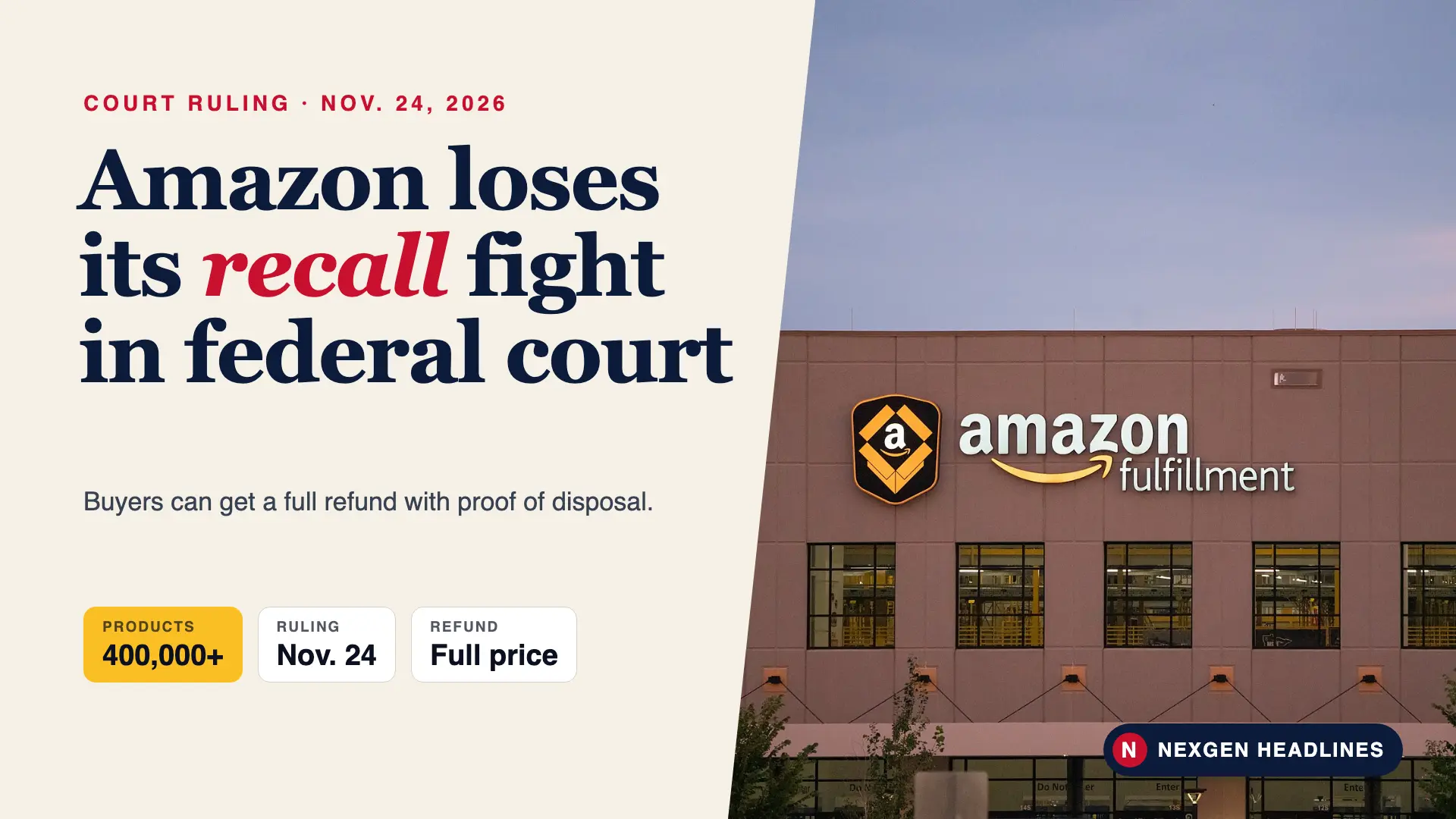

Quick answer: As of Nov. 27, 2026, Amazon has lost its court fight over a federal order to help recall more than 400,000 hazardous products. A federal judge in Maryland ruled for the U.S. Consumer Product Safety Commission (CPSC) on Nov. 24, 2026. The products are faulty carbon monoxide detectors, hair dryers without shock protection and children’s sleepwear that failed flammability rules.
Bought one through Amazon? The CPSC’s order says you can get a full refund of the purchase price. You just send proof you destroyed or threw away the product. Amazon can still appeal. Here is what the ruling means, who qualifies and what to watch next.
At a glance: the Amazon recall ruling
| Detail | What we know |
|---|---|
| Case | Amazon.com, Inc. v. Consumer Product Safety Commission |
| Court | U.S. District Court for the District of Maryland |
| Ruling date | Monday, Nov. 24, 2026 |
| Who won | The CPSC; Amazon’s complaint was dismissed |
| Products covered | More than 400,000 units sold by third-party sellers through Fulfilled by Amazon |
| Product types | Carbon monoxide detectors, hair dryers, children’s sleepwear |
| Main legal question | Is Amazon a “distributor” under the Consumer Product Safety Act? |
| Court’s answer | It upheld the CPSC, which says yes for these products |
| Your remedy | Full refund of the purchase price with proof of destruction or disposal |
| Can Amazon appeal? | Yes, to the 4th U.S. Circuit Court of Appeals |
What the judge decided, in plain English
The fight was never really about whether these products were dangerous. During the agency case, Amazon did not contest that the items posed a substantial hazard, CBS News reported. The real question was who has to recall them.
Third-party sellers listed the products. But they were stored, packed and shipped by Amazon through its Fulfilled by Amazon (FBA) program. Amazon argued that makes it a logistics provider, like a warehouse or a trucking company. Federal law exempts those businesses from recall orders.
The CPSC disagreed. In July 2024, the commission ruled unanimously that Amazon acted as a “distributor” of these products. Distributors can be ordered to carry out recalls.
On Nov. 24, 2026, U.S. District Judge Lydia Kay Griggsby sided with the agency. According to the CPSC, the court denied Amazon’s motion for summary judgment and granted the government’s. It then entered judgment for the CPSC and dismissed Amazon’s complaint. Because the case was decided on summary judgment, there was no trial.
“This is an important victory for American consumers,” CPSC Acting Chairman Peter A. Feldman said in the agency’s Nov. 25 statement. He added that families “deserve the same consumer safety protections under federal law whether they shop online or in a brick-and-mortar store.”
Which products are covered?
The order covers three groups of products. The CPSC first described them in its July 2021 complaint against Amazon, NPR reported at the time.
| Product type | The hazard | What CPSC said |
|---|---|---|
| Carbon monoxide (CO) detectors | May not sound an alarm when CO is present | About 24,000 units failed to alarm in CPSC testing (2021 complaint) |
| Hair dryers | No immersion protection device, so risk of electrocution if dropped in water | Sold without the required shock protection |
| Children’s sleepwear | Burn risk; fabric failed federal flammability rules | Items such as flannel and fleece bathrobes |
The CPSC has not named every brand in the coverage we found. Many listings came from small third-party sellers that may no longer be on Amazon. The safest step is to check your own order history (steps below).
Am I owed a refund? What the CPSC order requires
The remedy comes from the CPSC’s final Decision and Order issued Jan. 17, 2025. The Consumer Federation of America summarized its key terms. Amazon must:
- Post the recalls on its “Recalls and Product Safety Alerts” page on Amazon.com, the same day the CPSC publishes them.
- Email buyers directly with one round of “Dear Valued Customer” notices.
- Show the recall on each buyer’s “Your Orders” page in a way that stands out.
- Notify the FBA sellers that sold the affected products.
- Keep the recall notices up for at least five years.
- Pay a full refund of the purchase price to anyone who submits proof of destruction or disposal.
- File monthly progress reports with the CPSC for five years.
The refund part matters. Back in 2021, Amazon said it had already warned buyers and given refunds. But NPR reported that the CPSC’s complaint said those refunds came as credits to Amazon accounts. The agency called Amazon’s own steps “insufficient.” The new order calls for a refund of the purchase price instead.
One honest caveat: the ruling is three days old. We have not seen reports that Amazon has started sending new notices under the order. Amazon could also ask a higher court to pause the order during an appeal.
Also read: How to Dispute a Credit Card Charge and Win: The 60-Day Rule Every American Should Know
How to check if you bought a covered product
You don’t need to wait for an email. These steps take about 10 minutes:
- Open “Your Orders” on Amazon and search for “carbon monoxide,” “CO detector,” “hair dryer,” “robe” and “pajamas.”
- Look for a recall banner on each order. The order requires Amazon to flag recalled items there.
- Check Amazon’s Recalls and Product Safety Alerts page. Search for your product name or seller.
- Search CPSC.gov recalls by product type. Match the brand, model and photo.
- Check your email for messages from Amazon about a “product safety” issue. Search your spam folder too.
- Stop using anything that matches. Replace a suspect CO detector right away with one from a known brand.
- Follow the disposal steps in the notice, then keep a dated photo as your proof.
Beware of fake “Amazon recall refund” texts and emails. Amazon will not ask for your password or card number to send a refund. Go to the Amazon website or app yourself instead of clicking links.
Made-up examples: who gets what
These are made-up examples to show how the order could work. They are not real people.
Maria in Ohio bought a $19 plug-in CO detector from a third-party seller in 2020. It shipped from an Amazon warehouse. If her item is on the recall list, she photographs it cut apart, uploads the proof and should get $19 back.
Dave in Arizona bought a hair dryer, but the seller shipped it directly, not through FBA. The order covers products distributed through Fulfilled by Amazon, so his item may not qualify. He should still check CPSC.gov for a separate recall.
Keisha in Georgia got a $25 Amazon credit in 2021 for a kids’ robe. Whether she gets more depends on how Amazon carries out the order. She should keep her order record and watch for a notice.
Timeline: Amazon vs. the CPSC
| Date | What happened |
|---|---|
| July 14, 2021 | CPSC votes 3-1 to file an administrative complaint to force Amazon to recall the products |
| 2021–2022 | Amazon warns some buyers and issues refunds, largely as account credits, per the complaint and later court filings |
| 2023 | Amazon launches its product recall page, CBS News reported |
| July 29, 2024 | CPSC unanimously rules Amazon is a “distributor” of the FBA products |
| Jan. 17, 2025 | CPSC issues final order: notices, refunds with proof of destruction, five years of reports |
| March 14, 2025 | Amazon sues the CPSC in federal court in Maryland |
| Nov. 24, 2026 | Judge Lydia Kay Griggsby grants summary judgment to the CPSC and dismisses Amazon’s suit |
| Nov. 25, 2026 | CPSC announces the win; Acting Chairman Feldman calls it “an important victory” |
What Amazon argued, and why it lost (so far)
Amazon made three main arguments in its March 2025 lawsuit, based on CBS News and other reports:
- It isn’t a distributor. Amazon said the law lets the CPSC order recalls from “manufacturers, distributors and retailers,” but not from “third-party logistics providers.”
- It already acted. Amazon said it had notified buyers, refunded them and removed listings, so a new order was not needed.
- The agency’s setup is unconstitutional. Amazon said commissioners act as “judge, jury and prosecutor in the same proceeding.”
The CPSC argued that FBA goes far beyond storage and shipping. According to UNILAD Tech, citing The Verge, the agency pointed to Amazon’s control over customer messages, payments, pricing rules and returns. The agency also said Amazon’s 2021 warnings talked about “potential” safety issues without using the word “recall.”
The judge’s full written reasoning was not widely reported by Nov. 27. We will add it when it becomes available.
Who decides what happens next
| Who | Role | What to watch |
|---|---|---|
| Amazon | Can appeal the ruling | Whether it files a notice of appeal |
| 4th U.S. Circuit Court of Appeals | Would hear any appeal | Whether it pauses the order while it reviews the case |
| CPSC | Enforces the order | Recall releases naming the products and Amazon’s progress reports |
| U.S. Department of Justice | Defended the CPSC in court | Briefs in any appeal |
| You, the buyer | Claims the refund | Email notices and the “Your Orders” page |
What happens next: key dates to watch
- Now through January 2027: Amazon decides whether to appeal. When a federal agency is a party, federal rules generally allow 60 days to file a notice of appeal. By our count, that points to about Jan. 23, 2027. This is our estimate, not a court-set date.
- Any time: Amazon could ask for a stay. That would pause the order during an appeal if a court agrees.
- After the order takes hold: Watch for CPSC recall releases and matching Amazon emails to buyers.
- Next five years: Amazon must keep recall notices up and report monthly to the CPSC.
Why this matters beyond these 400,000 products
This case is a test of how far U.S. safety law reaches into online shopping. Many products on Amazon come from third-party sellers. Some are overseas companies that are hard for regulators to reach.
If the ruling holds, the CPSC has a court decision backing its view that Amazon can be on the hook for FBA products. That could make future recalls of marketplace items faster and clearer for shoppers.
If an appeals court reverses it, recalls of some marketplace products could fall back on sellers. Those sellers may be small, foreign or out of business. In that case, refunds could be harder to get.
Consumer groups have backed the CPSC throughout. In 2025, Consumer Reports said it was “absurd” to suggest a company should be exempt from recall rules because it hosts an online marketplace.
Meanwhile, a few safety basics apply no matter how the appeal goes. Test CO detectors monthly. Replace them on the schedule printed on the unit. Buy kids’ sleepwear labeled as meeting federal flammability rules.
Replacing a recalled item? Start here
- UL-listed carbon monoxide detectors – Pick a known brand with a UL 2034 listing on the box.
- Hair dryers with an ALCI safety plug – Look for the bulky plug with a test/reset button.
- Flame-resistant kids’ pajamas – Check the label for federal flammability compliance.
Disclosure: As an Amazon Associate, Nexgen Headlines earns from qualifying purchases. Check the seller and safety listing before you buy.
FAQ
Do I have to return the product to Amazon to get my money back?
No. Under the CPSC’s order, you get a full refund when you submit proof that you destroyed or threw away the product. A clear, dated photo is the usual kind of proof. Follow the exact steps in the recall notice.
Will I get cash or Amazon credit?
The order calls for a full refund of the purchase price. Earlier, in 2021, the CPSC complained that Amazon’s refunds came as account credits. How Amazon pays under the new order has not been reported yet.
Is the order in effect if Amazon appeals?
Generally yes, unless a court pauses it. Amazon would have to ask for a stay. Until a higher court acts, the district court’s ruling for the CPSC stands.
Does this mean Amazon is responsible for every product on its site?
No. This ruling deals with specific products shipped through Fulfilled by Amazon. The CPSC did not make Amazon responsible for testing every product before sale. Items shipped directly by sellers are a separate question.
I can’t find the product anymore. What should I do?
Check your “Your Orders” history for the listing. If it matches a recall, follow the notice. If you already threw the item away without a photo, contact Amazon customer service and explain. Keep your order number handy.
Bottom line
A federal judge has backed the CPSC. Amazon must help recall more than 400,000 dangerous CO detectors, hair dryers and kids’ sleepwear items sold through FBA. The order promises buyers a full refund with proof of disposal.
Amazon can still appeal, likely by late January 2027. For now, check your order history, stop using anything that matches and watch for an email from Amazon. We will update this explainer when Amazon decides on an appeal or recall notices go out.
Last reviewed: Nov. 27, 2026.
Sources: CPSC statement via PR Newswire, Nov. 25, 2026; UNILAD Tech (citing The Verge), Nov. 26, 2026; Consumer Federation of America, Jan. 17, 2025; CBS News, March 18, 2025; NPR, July 15, 2021; CPSC, July 2024 decision; CPSC.gov recalls search.
Featured image: “Amazon Fulfillment Center MSP1” by Tony Webster, CC BY 2.0, via Wikimedia Commons; edited by Nexgen Headlines.