
Quick answer: Cyber Monday 2026 is Monday, Nov. 30. To avoid scams, shop only on sites you type in yourself, pay with a credit card (not a debit card, gift card, Zelle or crypto), ignore “delivery problem” texts, and check that a deal exists on the store’s own site before you click. If you get scammed, call your card issuer right away and report it at ReportFraud.ftc.gov.
Cyber Monday is one of the biggest online shopping days of the year. Adobe says Americans spent $14.25 billion online on Cyber Monday 2025. Scammers know that, and they time fake stores, fake ads and fake delivery texts for the same week. Here’s how the common scams work and the simple habits that stop them.
Cyber Monday scam checklist
| Scam | Red flag | What to do |
|---|---|---|
| Fake store or copycat site | Price 60–90% off, new web address, odd spelling | Type the store’s address yourself; look up reviews |
| Social media ad scam | Ad for a “closing sale” or hot toy at a tiny price | Buy only from stores you know; search the store name + “scam” |
| Fake delivery text | “Your package is on hold, update your address” | Don’t tap the link; check tracking on the carrier’s own site |
| Phishing email | “Problem with your order,” urgent tone, login link | Open the app or site yourself to check your orders |
| Gift card or odd payment request | Seller wants gift cards, Zelle, wire or crypto | Walk away; pay only by credit card or a trusted checkout |
| Fake “price glitch” or coupon | Coupon code site asks for login or card details | Use codes from the retailer’s own site or email list |
When is Cyber Monday 2026?
Cyber Monday is always the Monday after Thanksgiving. In 2026, Thanksgiving is Thursday, Nov. 26, Black Friday is Nov. 27, and Cyber Monday is Nov. 30. Adobe noted the date shift: last year Cyber Monday fell on Dec. 1.
Adobe projects about $15.1 billion in U.S. online spending on Cyber Monday 2026. That’s a forecast, not a result. Either way, it’s a lot of money moving in one day, and that’s exactly why scammers show up.
Why scams spike around Cyber Monday
Three things line up this week. People expect huge discounts, so a fake 80%-off deal doesn’t look strange. People expect lots of packages, so a “delivery problem” text feels normal. And people are rushed, because deals “end at midnight.”
The money at stake is real. The Federal Trade Commission says Americans reported losing a record $15.9 billion to fraud in 2025. The FTC also says online shopping scams were the most-reported scam that started on social media.
The 6 most common Cyber Monday scams
1. Fake stores and copycat websites
Scammers build sites that look like real retailers or brand outlets. The web address may be close, like an extra word or a different ending. Prices are far below everyone else’s. You pay, and nothing arrives, or you get a cheap knockoff.
How to check: type the store’s address into your browser yourself. If you’ve never heard of a store, search its name with the words “scam” or “reviews.” Look for a real phone number and a physical address. A site that only takes wire transfers, Zelle or crypto is a big warning sign.
2. Social media ads that lead to nowhere
An ad on Facebook, Instagram or TikTok shows a popular gadget or a “warehouse clearance” for a fraction of the price. The FTC’s data shows this is where many shopping scams begin. Some ads even use stolen photos or fake celebrity endorsements.
How to check: leave the ad and look for the same deal on the brand’s own website. If the deal only exists inside the ad, skip it.
3. Fake package delivery texts
You get a text that says your package can’t be delivered and you need to “confirm your address” or pay a small redelivery fee. The link goes to a fake page that steals your card number.
How to check: don’t tap. Open your order in the store’s app or go to the carrier’s real site (USPS.com, UPS.com, FedEx.com) and type in the tracking number from your order email. USPS says it doesn’t send texts or emails with links unless you signed up for them with a tracking number.
4. Phishing emails about your order
These look like messages from Amazon, Walmart, Best Buy or your bank. They say there’s a problem with a payment or an order you didn’t place, and they push you to log in or call a number.
How to check: never use the link or phone number in the message. Open the app or type the site address yourself. Real problems will show up in your account.
5. Gift card and odd-payment demands
A seller on a marketplace or a fake “customer service” agent asks you to pay with gift cards, a payment app, a wire or cryptocurrency. The FTC is clear: anyone who demands payment by gift card is a scammer.
6. Fake coupon and “price glitch” sites
Sites promise secret codes or a pricing error. Some ask you to log in with your store password or enter your card “to unlock” the deal. That’s how they steal accounts.
Made-up example (for illustration):
Tanya sees an Instagram ad on Cyber Monday: a $399 robot vacuum for $59, “today only.” The web address is a long string she’s never seen. She searches the vacuum on the brand’s own site, and it’s $329 on sale there. She buys it from the brand directly with her credit card.
Two days later, she gets a text: “USPS: your parcel is on hold, update address.” She doesn’t tap it. Her order page shows the package is out for delivery. It arrives that afternoon.
How to shop safely on Cyber Monday: 8 steps
- Make a list before Monday. Know the items and normal prices. It’s easier to spot a fake deal when you know the real one.
- Go to sites directly. Use the store’s app or type the web address. Don’t shop from texts, pop-ups or ads.
- Pay with a credit card. It gives you the strongest legal protection (more on that below). A virtual card number from your bank adds another layer.
- Turn on two-step login for your shopping accounts and email.
- Check the seller on marketplaces. On Amazon, Walmart and eBay, see who actually sells and ships the item, and read recent reviews.
- Watch your card alerts. Turn on text or app alerts for every charge this week.
- Save everything. Keep order emails, screenshots of the deal and the seller’s name until the item arrives.
- Use public Wi-Fi with care. Shop on your phone’s data or a home network rather than open coffee-shop Wi-Fi.
Also read: How to tell if a Black Friday deal is real
Why a credit card beats a debit card
Federal law limits your losses, but the rules differ by how you pay.
| Payment | Your max loss for unauthorized use | Notes |
|---|---|---|
| Credit card | $50 (most issuers offer $0) | Fair Credit Billing Act; you can also dispute items never delivered |
| Debit card | $50 if reported within 2 business days; up to $500 within 60 days; more after that | Money leaves your checking account while the bank investigates |
| Gift card, wire, Zelle, crypto | Often no protection | Very hard to get back |
With a credit card, you’re disputing the bank’s money, not yours. With a debit card, your rent money may be tied up for days.
What to do if you got scammed
- Call your card issuer or bank right away. Ask them to dispute the charge and replace your card.
- Change passwords on any account you logged into from a fake site. Start with email.
- Report it to the FTC at ReportFraud.ftc.gov. You’ll get next steps.
- Report internet fraud to the FBI at IC3.gov, especially if you lost money.
- If you paid with a gift card, call the gift card company right away. Keep the card and receipt.
- If you shared your Social Security number, go to IdentityTheft.gov and consider a credit freeze at Equifax, Experian and TransUnion. It’s free.
Common mistakes to avoid
- Trusting the lock icon. A padlock means the connection is encrypted, not that the site is honest. Fake stores have padlocks too.
- Paying a “small fee” to release a package. Real carriers don’t text you for redelivery fees.
- Buying from a seller who moves the chat off the platform. You lose the marketplace’s buyer protection.
- Using the same password everywhere. One leak can open your email and every store account.
- Waiting to report. The faster you call your bank, the better your odds.
Recommended products
Disclosure: As an Amazon Associate, Nexgen Headlines earns from qualifying purchases.
FAQ
What date is Cyber Monday 2026?
Monday, Nov. 30, 2026. It’s the Monday after Thanksgiving, which falls on Nov. 26 this year.
How can I tell if a shopping website is fake?
Look for prices far below other stores, a web address that’s slightly off, no real contact details, and payment only by wire, Zelle, gift card or crypto. Search the store name plus “scam” before you buy.
Is it safe to click a delivery text?
No. Check tracking in the store’s app or on the carrier’s own website. Delete texts that ask you to pay a fee or update your address through a link.
Will my bank refund me if I’m scammed?
If a thief used your card, federal law limits your loss and most banks refund fast. If you paid a scammer yourself, refunds are harder but still possible with a credit card dispute. Call right away.
Where do I report an online shopping scam?
Report it to the FTC at ReportFraud.ftc.gov and to the FBI’s Internet Crime Complaint Center at IC3.gov. Also tell the platform where you saw the ad or seller.
Bottom line
Cyber Monday deals are real, but so are the scams. Type store addresses yourself, pay with a credit card, ignore delivery texts with links, and verify any deal on the store’s own site. If something goes wrong, call your card issuer first, then report it to the FTC. A few seconds of checking beats weeks of chasing a refund.
Last reviewed: Nov. 22, 2026. Spending figures for 2026 are Adobe projections; check back for actual results.
Sources: Adobe 2026 holiday forecast, Adobe 2025 holiday results, Spokesman-Review (AP) on FTC 2025 fraud data, FTC: Gift card scams, CFPB: Disputing a credit card charge, U.S. Postal Inspection Service: Smishing, FBI IC3.
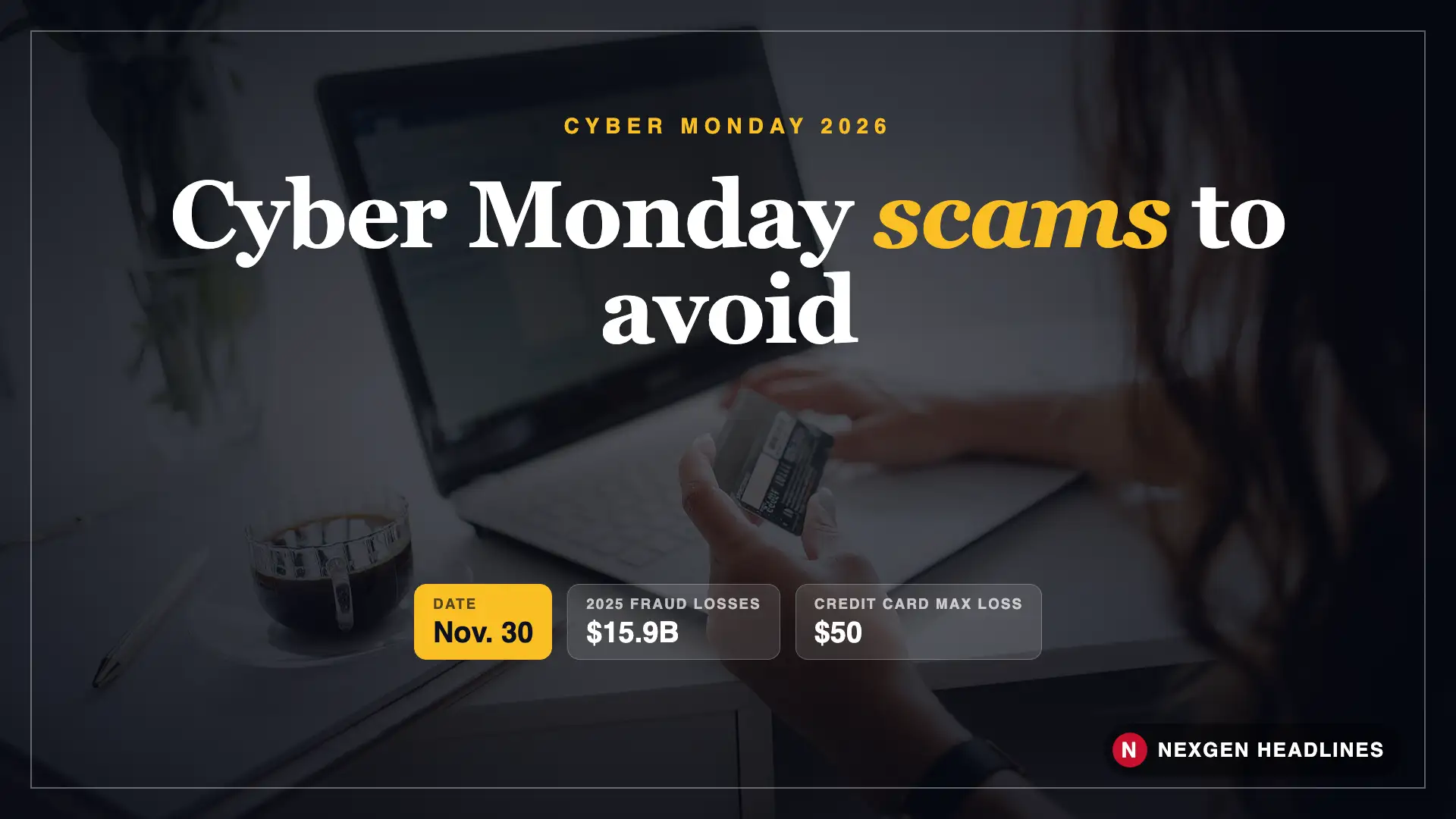
Featured image: Online shopping with a credit card. Photo: Shixart1985 / Wikimedia Commons, CC BY 2.0; edited by Nexgen Headlines.