
Quick answer: You can cancel car insurance at any time, not just at renewal. Buy your new policy first, then call or log in to your current insurer, pick a cancellation date that matches the new policy’s start date, and get a written confirmation. Most insurers refund unused premium on a prorated basis, but some keep a short-rate fee. If you’re dropping coverage on a car you’re keeping, check your state DMV rules first, because a lapse can lead to a registration suspension and fines.
Canceling sounds simple, and it usually is. The costly mistakes happen in the gaps: a day without coverage, plates you forgot to return, or a refund you never asked about. This guide walks you through it.
How to cancel car insurance: the short version
| Step | What to do |
|---|---|
| 1 | Get your new policy (if you still drive) and note its start date |
| 2 | Check your state’s DMV rules if you’re dropping coverage completely |
| 3 | Contact your current insurer by phone, app, agent or in writing |
| 4 | Set the cancellation date to the day the new policy starts |
| 5 | Ask how the refund is figured (prorated or short-rate) |
| 6 | Stop autopay only after cancellation is confirmed |
| 7 | Get written confirmation and save it |
| 8 | Update your lender or lessor if the car is financed |
When people cancel car insurance
- Switching to a cheaper insurer. The most common reason.
- Selling or trading in a car. Cancel coverage on that car once the title is transferred.
- Moving to another state. You’ll need a policy that meets your new state’s rules.
- Joining someone else’s policy, such as a spouse’s or partner’s.
- Giving up driving or storing a car long term.
- Car totaled or stolen after the claim is settled.
Step by step: how to cancel without a gap
- Line up the new coverage first. Buy the new policy and get its declarations page. Note the exact start date and time (many policies start at 12:01 a.m.).
- Find your policy number. It’s on your ID card, app and billing statements.
- Contact your insurer. Most companies let you cancel by phone or through an agent. Some allow it in the app. A few ask for a signed cancellation form.
- Pick the right date. Make the cancellation date the same day the new policy starts. Don’t cancel “today” if the new policy starts next week.
- Ask about the refund. Ask: “Is the refund prorated or short-rate? How much, and when will I get it?”
- Ask about fees. Some insurers charge a flat cancellation fee. Ask before you confirm.
- Get it in writing. Ask for an email or letter confirming the cancellation date. Screenshot app confirmations.
- Turn off autopay last. Stopping payments without canceling can cause a cancellation for nonpayment, which looks worse on your insurance history.
Also read: What is gap insurance, and do you need it?
Will you get a refund?
If you paid for six or 12 months up front, you usually get money back for the unused part. How much depends on the method.
| Refund method | How it works | What it means for you |
|---|---|---|
| Prorated | You get back every unused day of premium | The full fair share of your money |
| Short-rate | The insurer keeps a penalty from the unused premium | A smaller refund; ask for the exact amount |
| Flat fee | Prorated refund minus a set fee | Check the fee in your policy |
| Monthly payer | You’ve paid only for the current month | Small or no refund |
Refund rules vary by insurer and by state, and some states limit what insurers can keep. Your policy’s “cancellation” section explains your terms.
Made-up examples (for illustration):
Tanya paid $900 for a six-month policy and switches insurers after two months. With a prorated refund, she gets back about two-thirds of her premium, around $600. If her insurer used a short-rate method with a 10% penalty on the unused premium, she’d get about $540.
Ray pays monthly and cancels mid-month. He gets back only a few days of premium. He also forgets to stop autopay, so he watches his bank account to make sure no new charge goes through.
The DMV step most people forget
If you’re keeping a registered car but dropping all insurance, your state DMV may need to hear from you first. Every state handles this differently.
- California: the DMV says to notify it before you cancel to avoid a registration suspension. A car you’re not driving can be put on “planned non-operation” status.
- New York: if your liability coverage will lapse and you won’t replace it, surrender your plates to the DMV before the lapse. Otherwise your registration and even your license can be suspended.
- Pennsylvania: a coverage lapse can mean a three-month registration suspension, with a civil-penalty option of $500 in some cases.
Insurers in many states report cancellations to the DMV electronically. So the state usually knows within days. Check your own state DMV website before you cancel.
If you simply switch insurers with no gap, you usually don’t need to do anything with the DMV.
If your car has a loan or lease
Your lender or leasing company requires full coverage, usually liability plus comprehensive and collision. If you cancel without a new policy, the lender can buy force-placed insurance and add the cost to your loan. It’s often much more expensive and may protect only the lender.
When you switch, send the lender your new declarations page and list it as the lienholder or loss payee.
What a lapse in coverage costs you
- Higher premiums later. Insurers often charge more to drivers with gaps in coverage.
- State penalties. Fines, registration suspension, and reinstatement fees.
- Risk of paying a crash out of pocket. If you drive uninsured and cause an accident, you could owe for damage and injuries yourself.
- SR-22 filing. Some states require proof of future coverage after a lapse or an uninsured violation.
Canceling after selling, moving or a total loss
You sold the car
Wait until the title has been transferred and the buyer has driven away. Then cancel coverage on that car. Return or transfer plates as your state requires.
You moved to a new state
Buy a policy that meets your new state’s minimums, register the car there, then cancel the old policy. Some insurers can just move your policy if they sell in both states.
Your car was totaled
Don’t cancel until your claim is fully settled. Then ask the insurer to end coverage on that car and refund the unused premium.
What to say when you call
A short script keeps the call quick and avoids sales pressure. Try this: “I’d like to cancel policy number [number], effective [date]. Please tell me the refund amount, how it’s calculated, and send written confirmation to my email.”
The rep may offer a discount to keep you. That’s fine to hear out. If the new price beats your new quote, you can stay. If not, politely repeat your request.
Common mistakes
- Canceling before the new policy starts. Even one day without coverage counts as a lapse.
- Stopping payments instead of canceling. A nonpayment cancellation can follow you.
- Not asking about short-rate fees. Know the refund before you confirm.
- Forgetting plates or DMV notice in states that require it.
- Not telling your lender about the switch.
- No written proof. Keep the confirmation in case of a billing dispute.
Recommended products
Handy items for every driver’s glove box.
Disclosure: As an Amazon Associate, Nexgen Headlines earns from qualifying purchases.
FAQ
Can I cancel car insurance in the middle of my policy?
Yes. You can cancel any time. You may get a prorated refund, or a smaller one if your insurer uses short-rate cancellation or charges a fee.
Can I cancel car insurance online?
Some insurers allow it in the app or online account. Many still require a phone call, an agent or a signed form.
Does canceling car insurance hurt my credit?
Canceling itself doesn’t appear on your credit report. Unpaid premiums sent to collections can, so settle any balance.
What happens if I just stop paying?
The insurer will cancel for nonpayment after notice. That can raise future rates and may be reported to your state DMV.
Do I need to return my license plates?
Only in some states, such as New York, when coverage will lapse. Check your state DMV’s rules.
Bottom line
To cancel car insurance safely, start the new policy first, cancel the old one on the same day, ask how your refund is figured, and get it in writing. If you’re dropping coverage on a car you still own, check your state DMV rules before you cancel. A few minutes of planning avoids fines, a suspended registration and higher rates later.
Last reviewed: Nov. 23, 2026. State rules and insurer policies vary; confirm with your insurer and state DMV.
Sources: California DMV: Insurance requirements for registration, New York DMV: Cancel insurance, PennDOT: Penalties for canceling insurance, NAIC consumer resources, Experian.
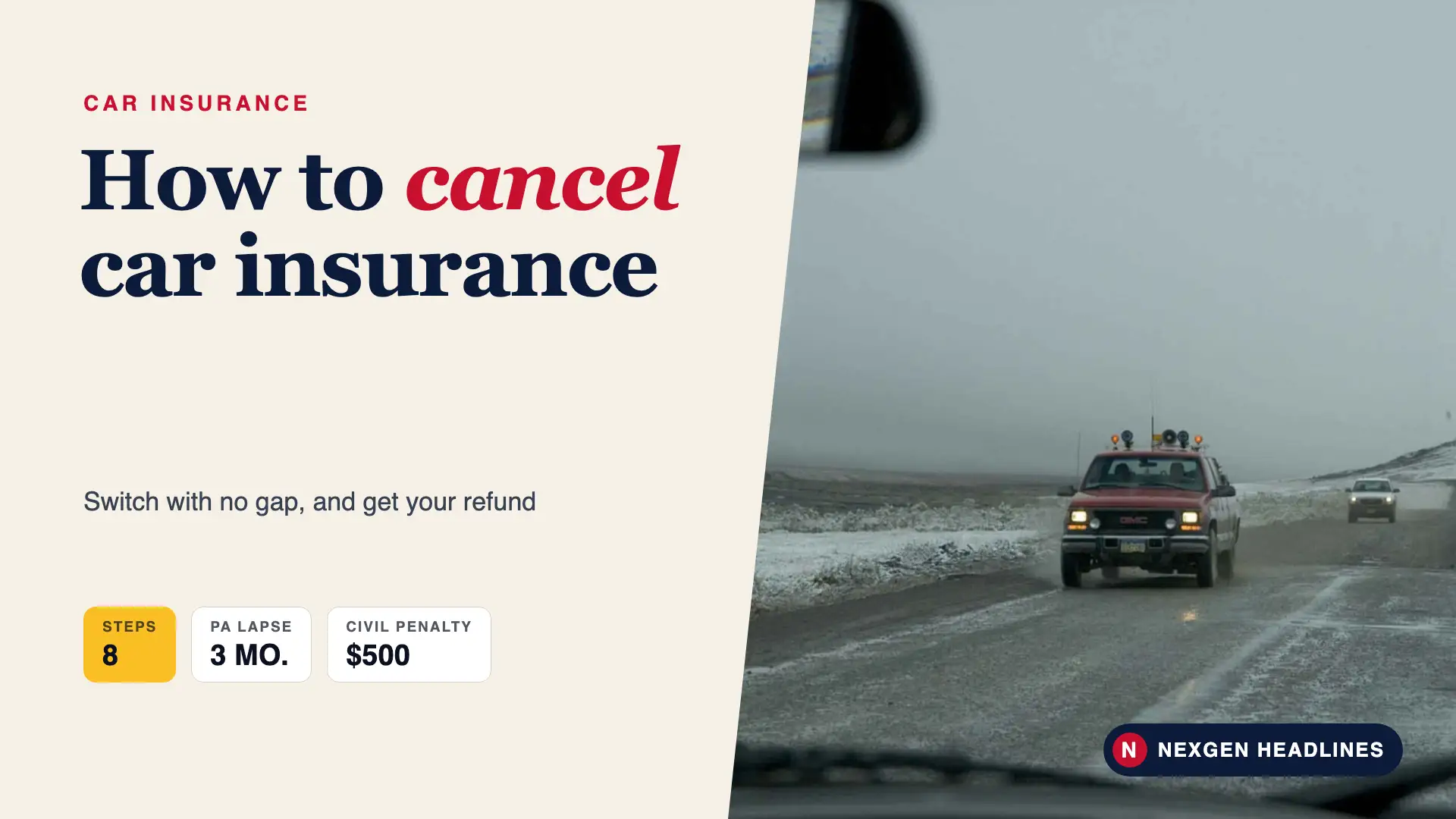
Featured image: Highway traffic. Photo: Steve Hillebrand, U.S. Fish and Wildlife Service / Wikimedia Commons, public domain; edited by Nexgen Headlines.