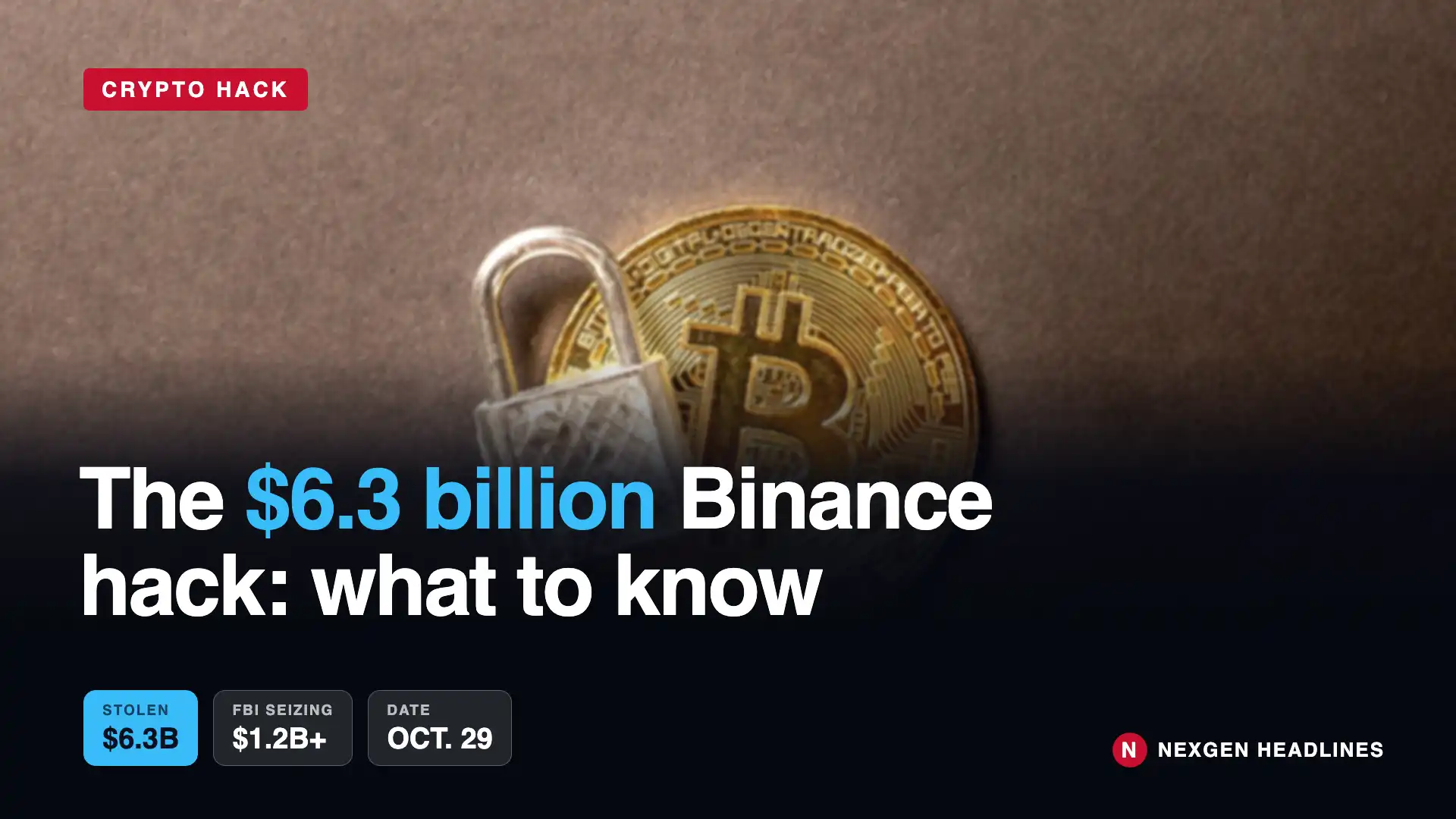

Quick answer: As of Nov. 15, 2026, hackers stole about $6.3 billion in crypto from Binance on Oct. 29, the largest crypto theft on record. The FBI blames North Korean hackers it calls “TraderTraitor.” Binance says it has covered customers’ losses from its own funds, and on Nov. 13 the FBI said it had court approval to seize or restrain more than $1.2 billion of the stolen crypto. If you use any crypto exchange, now is the time to lock down your account and watch for fake “recovery” scams.
The hack shook crypto prices and crypto stocks for days. Most Americans don’t use Binance.com directly, but the attack is a warning for anyone who keeps crypto on any exchange. Here’s what happened, who is involved, what comes next and what to do right now.
Timeline: how the Binance hack unfolded
| Date (2026) | What happened |
|---|---|
| Oct. 29, about 4 p.m. ET | Attackers began draining Binance “hot wallets” (wallets connected to the internet) across several blockchains, according to news timelines |
| Oct. 29, evening | Binance confirmed a security incident, put the loss at about $6.3 billion and paused withdrawals (CNBC) |
| Oct. 29–30 | Stablecoin issuers Circle and Tether froze some affected funds (CNBC). Crypto prices and crypto stocks fell |
| Oct. 30–31 | Binance said the breach started with a compromised engineer’s laptop, then reported additional points of breach |
| Nov. 1 | Withdrawals resumed (CNN) |
| Nov. 2 | Binance said it had covered about 95% of the stolen assets (The Washington Post) |
| Nov. 3 | North Korea denied involvement |
| Early November | FBI attributed the attack to North Korea’s “TraderTraitor” hackers |
| Nov. 13 | FBI said it got court authorization to seize or restrain more than $1.2 billion of the stolen crypto (CNBC, CBS News) |
Times and some details come from live coverage and may be revised. Binance’s own full incident report had not been published in the sources we reviewed.
How big is this hack?
Binance’s own estimate is about $6.3 billion. Blockchain analysis firm Elliptic puts the total slightly higher, at about $6.4 billion, spread across more than 20,000 wallets and 16 blockchains.
Either way, it’s the biggest crypto theft ever recorded. The previous record was the roughly $1.5 billion Bybit hack in February 2025, which the FBI also blamed on North Korea.
Who is involved and who decides what happens next
| Who | Role |
|---|---|
| Binance | The world’s largest crypto exchange by trading volume; the victim of the hack and the company covering customer losses |
| FBI | Leads the U.S. investigation; attributed the hack to North Korea and is seizing stolen funds |
| TraderTraitor (North Korea) | The hacking group the FBI blames. North Korea denies involvement |
| Elliptic, Chainalysis, TRM Labs | Private firms tracing the stolen crypto on public blockchains |
| Circle and Tether | Stablecoin issuers that can freeze their tokens; they froze some stolen funds |
| U.S. courts | Approve seizures and decide what happens to recovered funds |
Were Americans affected?
Binance.com says it doesn’t serve U.S. residents. Americans who trade on “Binance” usually use Binance.US, a separately run U.S. company. The Oct. 29 attack hit Binance’s global platform.
But Americans still felt it. Crypto prices dropped after the news, and crypto-related stocks slumped (Yahoo Finance). If you hold Bitcoin, Ethereum or crypto ETFs in a retirement or brokerage account, your balance may have dipped even if you never used Binance.
Some Americans also hold Binance’s own token, BNB, through other exchanges. Its price swung sharply after the hack.
Made-up example (for illustration):
Marcus keeps $3,000 of Bitcoin on a U.S. exchange and has never used Binance. Two days after the hack, he gets an email that looks like it’s from “Binance Support” saying he’s owed compensation. It asks him to connect his wallet on a website to “verify ownership.”
Marcus remembers he never had a Binance account. He deletes the email and turns on app-based two-factor login at his own exchange. The “compensation” site was a fake built to drain wallets, a common trick after big hacks.
Also read: What to do if your identity is stolen
What to do right now if you own crypto
- Check your accounts on every exchange you use. Look for logins, withdrawals or new devices you don’t recognize.
- Turn on app-based two-factor login (an authenticator app or security key), not text-message codes, which can be stolen through SIM swaps.
- Turn on withdrawal allowlists if your exchange offers them, so crypto can only go to addresses you approved.
- Use a unique, strong password for each crypto account, saved in a password manager.
- Consider self-custody for long-term holdings. A hardware wallet keeps keys offline. Write your recovery phrase on paper and never type it into a website.
- Ignore “compensation” emails and DMs. Go to the exchange’s site or app yourself, never through a link.
- Report fraud to the FBI at IC3.gov and the FTC at ReportFraud.ftc.gov.
Watch out for “crypto recovery” scams
After every big hack, scammers target victims and worried investors. The FBI has warned about fake recovery services for years. Common signs:
- Someone contacts you first and says they can get your stolen crypto back.
- They ask for an upfront fee, “taxes” or a “release fee.”
- They claim to work with the FBI, a court or a “blockchain recovery agency.”
- They ask you to install remote-access apps or connect your wallet to a website.
The FBI does not charge fees to return stolen money. Real exchanges don’t ask for your recovery phrase. If anyone does, it’s a scam.
What happens next: key things to watch
| What to watch | Why it matters |
|---|---|
| Binance’s full incident report | Will explain exactly how attackers got in and what changed |
| More FBI seizures | Billions are still being traced; more court orders may follow |
| Frozen funds | Reports put frozen crypto at roughly $2.7 billion to $3 billion so far; figures vary by source and date |
| Regulator response | Lawmakers and regulators may push new security rules for exchanges |
| Crypto prices | Markets may stay jumpy until more funds are recovered |
We’ll add dated updates at the top of this page when there’s major news.
Why exchange hacks keep happening
Exchanges keep some crypto in hot wallets so customers can withdraw quickly. That convenience makes them targets. Many recent attacks, including Bybit and now Binance, started with one compromised employee device or account, not a flaw in the blockchain itself.
Groups the FBI links to North Korea have stolen billions in crypto over the past several years, according to blockchain analysts. Stolen funds are often split across thousands of wallets and swapped between coins to hide their trail, which is why tracing can take months.
Is it safe to keep money on a crypto exchange?
Exchanges are convenient, but crypto held there is not FDIC-insured the way bank deposits are. Some exchanges keep emergency funds to cover hack losses, as Binance did, but that’s a company choice, not a government guarantee.
- Keep only what you trade on an exchange.
- Move long-term holdings to a wallet you control, if you’re comfortable managing it safely.
- Spread holdings across more than one platform if you hold a lot.
- Never invest more in crypto than you can afford to lose.
Common mistakes after a big crypto hack
- Panic-selling at the bottom because of headlines.
- Clicking “claim your refund” links in emails, texts or social media.
- Sharing your recovery phrase with “support” agents. Real support never asks.
- Reusing passwords between your email and exchange accounts.
- Skipping records. Save screenshots and transaction IDs if you lose money; you’ll need them for reports and taxes.
Recommended products
Tools that help protect your crypto and accounts.
Disclosure: As an Amazon Associate, Nexgen Headlines earns from qualifying purchases.
FAQ
How much was stolen in the Binance hack?
About $6.3 billion, according to Binance. Elliptic estimates about $6.4 billion. It’s the largest crypto theft on record.
Who hacked Binance?
The FBI blames North Korean hackers it calls TraderTraitor. North Korea denies it.
Did Binance customers lose money?
Binance says it has covered customers’ losses from its reserves and treasury. The Washington Post reported 95% covered as of Nov. 2.
Is Binance.US affected?
The attack hit Binance’s global platform. Binance.US is a separately run company for U.S. customers; check its official site for any notices.
Can the stolen crypto be recovered?
Some can. The FBI moved to seize or restrain more than $1.2 billion on Nov. 13, and billions more have been frozen.
Bottom line
The $6.3 billion Binance hack is the biggest crypto theft ever, and the FBI says North Korea is behind it. Binance says customers were made whole, and the FBI is clawing back over $1.2 billion. For everyone else, the lesson is simple: lock down your accounts, keep long-term crypto off exchanges if you can, and never pay a “recovery” service.
Last reviewed: Nov. 15, 2026. This is a developing story; figures come from named outlets and may change.
Sources: CNBC (Oct. 29), CNN, The Washington Post, CNBC (Nov. 13), CBS News, Elliptic, FBI IC3, FTC ReportFraud.
Featured image: Bitcoin and cryptocurrency security. Photo: Edwin.images / Wikimedia Commons, CC BY-SA 4.0; edited by Nexgen Headlines.