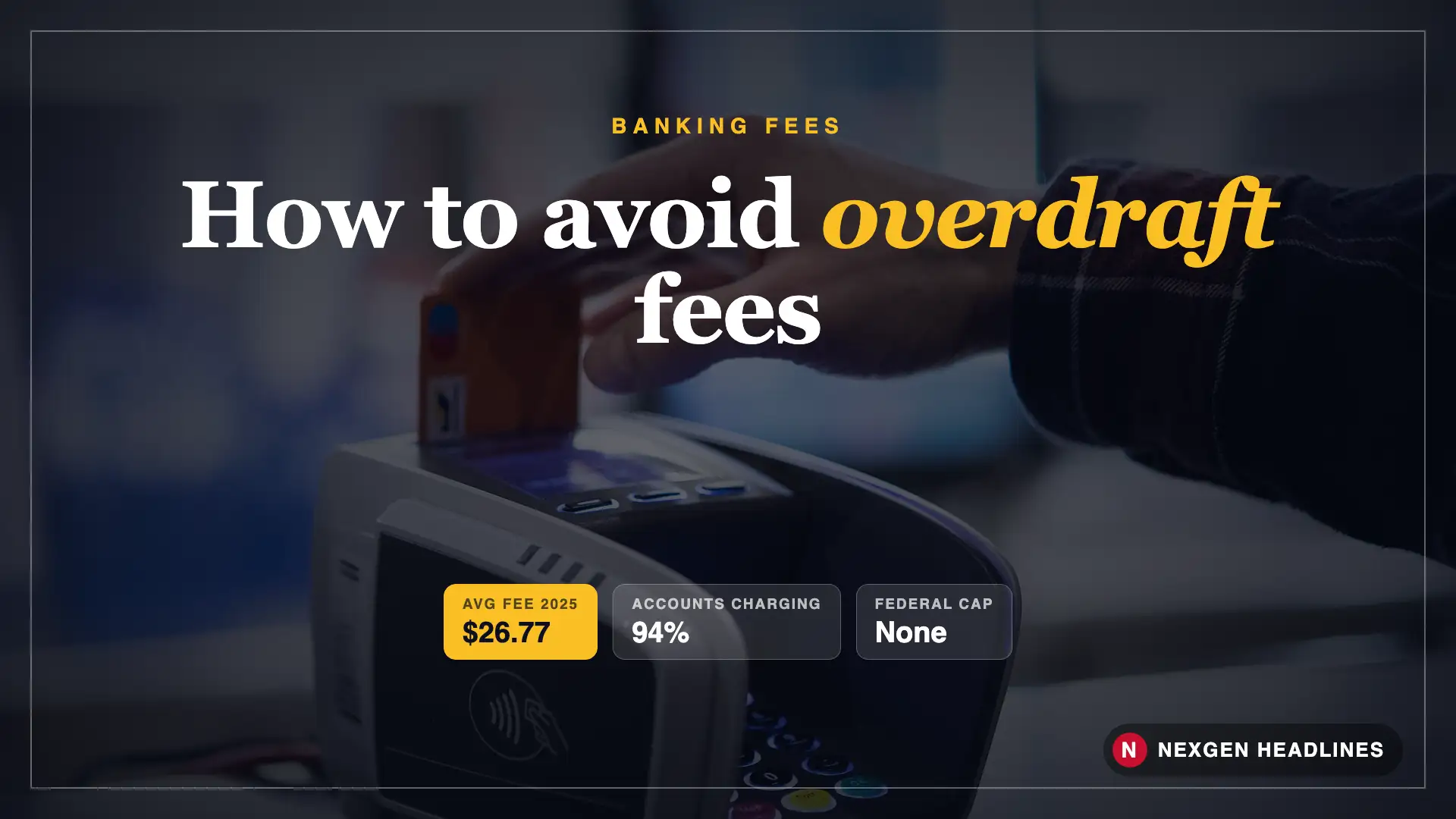

Quick answer: The easiest ways to avoid overdraft fees are to opt out of overdraft coverage for debit card and ATM transactions, link a savings account as backup, turn on low-balance alerts, or move to a bank that charges no overdraft fees. The average overdraft fee was $26.77 in Bankrate’s 2025 study, and a federal $5 cap was repealed by Congress in May 2025, so protecting yourself is up to you.
One coffee that pushes your balance below zero can cost almost $27. Three in a day can cost more than $80. Here’s how to stop that for good, plus what to do if you’ve already been charged.
7 ways to avoid overdraft fees
| # | What to do | Time it takes | How well it works |
|---|---|---|---|
| 1 | Opt out of overdraft for debit and ATM | 5 minutes | Stops most fees; purchases get declined instead |
| 2 | Link savings for overdraft transfers | 10 minutes | Covers shortfalls; transfer fee may apply |
| 3 | Turn on low-balance alerts | 5 minutes | Warns you before you go negative |
| 4 | Keep a small cash buffer | Ongoing | Very effective |
| 5 | Use your bank’s grace or cushion feature | Check once | Many banks skip fees under a set amount |
| 6 | Time bills to payday | 15 minutes | Avoids timing gaps |
| 7 | Switch to a no-overdraft-fee bank | An afternoon | Ends the problem |
What is an overdraft fee?
An overdraft happens when you spend more than your balance and the bank pays it anyway. The bank then charges a fee for “covering” you. A non-sufficient funds (NSF) fee is different: that’s when the bank declines a check or payment and still charges you. Bankrate’s 2025 study found the average NSF fee fell to $16.82, and many big banks have dropped NSF fees entirely.
Overdraft fees are still common. Bankrate found 94% of the checking accounts it studied still charged one in 2025.
1. Opt out of overdraft coverage for debit and ATM
Under federal Regulation E, banks can’t charge overdraft fees on ATM withdrawals and one-time debit card purchases unless you opted in. Many people opted in at account opening without noticing.
To opt out, open your banking app, look for “overdraft settings” or “overdraft services,” and choose to decline transactions that would overdraw your account. Or call or visit the bank. After that, a debit card swipe that would overdraw your account is simply declined, and there’s no fee.
Note: checks, recurring debit payments and ACH bills are handled under your bank’s own policy. Ask how the bank treats those after you opt out.
2. Link a savings account (overdraft protection transfer)
Most banks let you link a savings account, a second checking account, or a credit line. If checking runs short, money moves over automatically. Some banks charge a transfer fee, often far less than an overdraft fee, and many charge nothing. Ask your bank for its exact fee.
3. Turn on low-balance alerts
Set a text or app alert for when your balance drops below an amount, such as $100. Add alerts for large purchases and deposits. Alerts are free at nearly every bank and give you time to move money before a payment hits.
4. Keep a small buffer
Pretend your balance is zero when it’s actually $100 or $200. Some people do this by keeping a hidden “floor” in a separate savings bucket. A small buffer covers timing gaps when a deposit is slow.
Made-up example (for illustration):
Tasha has $40 in checking on Thursday. Her paycheck lands Friday. She buys groceries for $55 and gas for $35. Her bank charges $27 per overdraft, so those two swipes cost her $54 in fees, more than the gas itself.
After that, she opts out of debit overdraft coverage, links her savings, and sets a $100 alert. A month later, her balance dips again. The app pings her at $100, she moves $50 from savings, and she pays $0 in fees.
Fee amounts are made up for this example. Check your own bank’s fee schedule.
5. Use your bank’s grace period or cushion
Many large banks now offer features like these:
- No fee under a small amount, such as when you’re overdrawn by $50 or less.
- A grace period, often one business day, to bring the account back to positive before a fee is charged.
- A daily cap on the number of overdraft fees.
- Early direct deposit, which gets your paycheck in up to two days sooner.
Features change, so look up your bank’s current fee schedule on its website.
Also read: How to avoid holiday debt with a simple budget
6. Line up bills with payday
Most billers let you change your due date. Move rent, car, phone and credit card due dates to a few days after payday. Then set autopays for those dates. Fewer timing gaps mean fewer surprises.
Also check recurring charges. Free trials that turn into paid subscriptions are a common cause of surprise overdrafts.
7. Switch to a bank with no overdraft fees
Several major banks and many online banks have dropped overdraft fees entirely. Capital One and Citi, for example, ended overdraft fees on consumer checking accounts in 2022. Many credit unions and online banks also offer fee-free accounts.
When you compare, look for:
- No overdraft fees and no NSF fees
- No monthly maintenance fee, or one that’s easy to waive
- A large free ATM network
- FDIC insurance (or NCUA for credit unions)
What happened to the $5 overdraft fee cap?
In December 2024, the Consumer Financial Protection Bureau finalized a rule that would have let very large banks charge as little as $5 for overdrafts. It never took effect. Congress repealed it in May 2025 using the Congressional Review Act. So there’s no federal cap on overdraft fees. Each bank sets its own.
How to get an overdraft fee refunded
- Call or chat with your bank soon after the fee posts.
- Be polite and brief. Explain what happened and that it’s unusual for you.
- Ask directly: “Can you waive this overdraft fee as a courtesy?”
- Mention your history, such as years as a customer or direct deposit.
- Ask to opt out or add protection on the same call, so it doesn’t happen again.
Banks often refund a first fee for customers in good standing. It isn’t guaranteed, but it costs nothing to ask. If you believe a fee broke the bank’s own rules, you can file a complaint with the CFPB.
Common mistakes that cause overdrafts
- Trusting the “available balance” while checks or pending charges haven’t cleared yet.
- Hotel, gas station and rental car holds that freeze more money than you spent.
- Forgetting autopays for subscriptions, gym memberships and insurance.
- Using a debit card for big purchases right before payday.
- Ignoring the order of transactions. Banks post them in different orders, which can affect how many fees you get.
Are overdraft apps and cash advances a good fix?
Cash advance apps can cover a small gap, but read the costs. “Tips,” express fees and monthly memberships can add up to a high cost for a short loan. They can also make the next paycheck short, starting a cycle. A linked savings buffer is cheaper and safer.
Recommended products
Simple tools to track spending and build a buffer.
Disclosure: As an Amazon Associate, Nexgen Headlines earns from qualifying purchases.
FAQ
How much is the average overdraft fee?
$26.77 in Bankrate’s 2025 study of 245 banks and credit unions, down slightly from $27.08 in 2024.
Can I be charged an overdraft fee on a debit card?
Only if you opted in to overdraft coverage for ATM and one-time debit card transactions. If you opt out, those transactions are declined instead.
Do overdrafts hurt my credit score?
Not directly. Banks don’t report overdrafts to the credit bureaus. But an unpaid negative balance sent to collections can show up and hurt your score.
How long does the bank give me to fix an overdraft?
It depends. Some banks give a one-day grace period. If the account stays negative for weeks, the bank may close it and report you to ChexSystems, making it hard to open a new account.
Is there a limit on overdraft fees per day?
There’s no federal limit. Many banks cap fees at three or four per day. Check your fee schedule.
Bottom line
Overdraft fees average about $27, and there’s no federal cap. Spend five minutes today to opt out of debit overdraft coverage, link savings, and set a low-balance alert. If your bank still charges fees, ask for a refund, then think about switching to one that charges no overdraft fees at all.
Last reviewed: Nov. 13, 2026. Bank features and fees change; check your bank’s current fee schedule.
Sources: Bankrate 2025 Checking Account and ATM Fee Study, CFPB: Overdraft coverage, CFPB: Regulation E, 12 CFR 1005.17, Bankrate: Banks that eliminated overdraft fees.
Featured image: Card payment at a terminal. Photo: European Commission / Wikimedia Commons, CC BY 4.0; edited by Nexgen Headlines.